Turn on suggestions
Auto-suggest helps you quickly narrow down your search results by suggesting possible matches as you type.
- Discovery Summit 2026: Early User Edition - September 23-24.Register. It's free.
- Graph Builder Toolbar streamlines interactive graphing. Creates shortcuts on Report and GraphBuilder Helpers toolbars. Download and install the extension.
JMP Wish List
We want to hear your ideas for improving JMP. Share them here.- User Community
- :
- JMP Wish List : Hot Ideas
We want to hear your ideas for improving JMP software
We know that you have many valuable ideas on potential new features, or enhancements to existing features. You can use this Wish List to share your ideas, and discuss how to improve JMP, with other users across the globe.
Here's how to participate:
- Search: Please search for an existing idea first before submitting a new idea.
- Kudo & Comment Kudo ideas you like, and comment to add to an idea.
- Subscribe: Follow the status of ideas you like. Refer to status definitions to understand where an idea is in its lifecycle. (You are automatically subscribed to ideas you've submitted or commented on.)
- Submit: Post your new idea using the Suggest an Idea button. Please submit one actionable idea per post rather than a single post with multiple ideas.
We can’t implement everything, so please include the following to help JMP Product Management evaluate your ideas for consideration:
- What inspired this wish list request? Please describe the current issue that needs improvement or the problem to be solved that is not easy or possible right now, with an example use case.
- What is the improvement you would like to see? Please describe the idea for improving JMP. Please include mock-ups, wireframes, screenshots, scripts, other documents or examples from other software that help describe the change you would like to see.
- Why is this idea important? Please describe the value to you and/or other users if the idea is implemented (for example, ease of use, must have,…).
Hi JMP users, I would like to know if it is possible to develop an add-in to calculate the effect-size for repeated-measures design with random effect. I used to run the LSMeans Tukey HSD algorithm in Fit Model report. Thank you.
... View more
See more ideas labeled with:
- Find more ideas tagged with:
- Content Organization
- Data access
- Mass Customization
Hi JMP users, I used to run some non-parametric comparisons for each pair using the Wilcoxon method in a repeated-measures designs through Analysis -> Fit Y by X report. I would like to know if it is possible to develop an effect-size calculator (add-in) for that purpose, please. Thank you.
... View more
See more ideas labeled with:
- Find more ideas tagged with:
- Content Organization
- Data access
- Mass Customization
- Predictive Modeling and Machine Learning
Hi,
I'm looking at the Profiler red triangle, under Optimization and Desirability -> Set Desirabilities.
Several of our newer users get confused when they have multiple y variables because JMP pops up a separate modal box to set desirability for each response one at a time. The astute ones notice that each box is for a different response, but others don't notice the subtle change.
Any way we could replace this interface with a single window? Use a List Box or a Combo Box or a Tab Box to arrange the different responses. Then the user can go to "Set Desirabilities", see all the responses in one window, and potentially set all of them from the same window. Or, with flexibility to choose which responses need to be set, having a "select the response to change" property allows the user to skip over two or three responses that don't need to be changed in the first place.
Icing on the cake: allow some sort of "Standardize Desirabilities" option from the Profiler as well. Sure, you can standardize attributes from the data table and set the Response Limits property, but when you're in the middle of a Profiler that isn't intuitive.
... View more
See more ideas labeled with:
- Find more ideas tagged with:
- Data Blending and Cleanup
With the "New Formula Column", a Log can be easy made. it would be a nice feature to transform spec and control limits, axis settings ect.too.
... View more
See more ideas labeled with:
- Find more ideas tagged with:
- Data Blending and Cleanup
- Mass Customization
Most of the tables that JMP uses have the magic JMP Home Button icon bottom right of the table which takes you back to the Home Window . I use the Query builder a lot and if I have a number of JMP applications open it can be quite tricky to find which one contains the query as well as any other tables I'm using. Can the JMP Home window button be added to the Query Builder ( as well as any others not currently having it)? David
... View more
See more ideas labeled with:
- Find more ideas tagged with:
- Data access
Ability to use table or local variables from formula editor to control some values in axis, platforms, … 2018-03-22 13_22_18-Y Axis Settings.bmp
... View more
See more ideas labeled with:
- Find more ideas tagged with:
- Data Exploration and Visualization
When updating a target table that includes columns with a List Check property, the update on that column fails silently if the update source table contains items that are not in the target table's List Check.
I agree that the update should fail, but it should fail with a warning and an option to (a) remove the List Check before proceeding or (b) abort the update.
... View more
See more ideas labeled with:
- Find more ideas tagged with:
- Data Blending and Cleanup
In case there are named ranges in Excel sheets it would be good if those could be accessed when importing data into JMP. I have workbooks containing data in named ranges and want to automate data import. The only way i have so far is to script some "search algorithm" to find the boundaries of the named range or using additional software tools like R or Excel-VBA.
... View more
See more ideas labeled with:
- Find more ideas tagged with:
- Data access
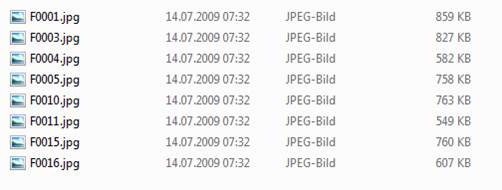
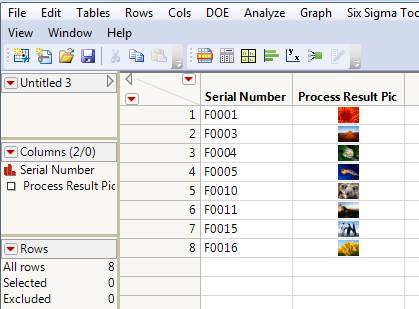
I would like to be able to import selected images from a folder into a new or existing Data Table with the option to either match names of images with names in an existing column or to have the names of the images written in a separate column (see attached illustration). It should be possible to specify a name for the Expression column ("Process Result Pic" in the illustration) and a name for the ID column (if used, "Serial Number" in the illustration), or if names of images should be matched with entries in an existing column, then the name of the existing column must be specified. It would be very handy if file sizes could be reduced (on import) down to a max of x Mbyte, and to a maximum width or height (as in the Column Property "Expression Role"). I'm aware that there is a community entry by M_Anderson with supplied jsl code that goes in a very similar direction, but with the expectation that a column with pic names already exists. I couldn't get this to work (probably I misinterpreted sth there). It would be nice to have an official tool for this with more options. https://community.jmp.com/t5/JMP-Scripts/Adding-Images-to-A-Data-Table-From-a-Directory/ta-p/40341
... View more
See more ideas labeled with:
Autosaving data tables should have an option to rename and retain the existing file as "table.jmp.bak" before saving the new version as "table.jmp". The reason is to prevent autosave unintentionally overwriting a "good" copy of a table with a (mis-)edited version.
An even better option is be able to designate a backup folder where N previous versions of the file can be optionally retained.
... View more
See more ideas labeled with:
- Find more ideas tagged with:
- Mass Customization
Status:
Archived
Submitted on
01-04-2018
01:47 PM
Submitted by
walter_isaac
on
01-04-2018
01:47 PM
See the attached journal.
This is a simple example of a variability/gauge plot. from one of the sample datasets.
I do a lot of beginning JMP user training, and I always show them the variability chart because it is so useful for visulaizing the effects of different X factors on a Y response all on one plot.
I would like to be able to do more statistical analysis off this platform. I am looking for the same analysis that is on the fit Y by X platform. For instance in this case an Anova/Tukey means comparison by Gender. And/or a T test comparing gender by each drug.
JMPScreenSnapz172.png
... View more
See more ideas labeled with:
- Find more ideas tagged with:
- Basic Data Analysis and Modeling
Status:
Not Planned For Now
Submitted on
12-19-2017
04:06 PM
Submitted by
ewittry
on
12-19-2017
04:06 PM
Expose as many as possible GUI features through JSL. Specifically, in this case, 'new formula column'.
... View more
See more ideas labeled with:
- Find more ideas tagged with:
- Automation and Scripting
For factorial combinations (in Fit Model), LSMeans tables (also "Connecting Letter Report" tables) should present level names as separate strings in separate columns. That will allow to alternate group order by sorting these tables by level of one factor ("Level i") or by the second factor ("Level j"), regardless the factors' order in the data table.
... View more
Since version 12, "Preferences" allows to set the default Summary Statistics in the output of "Distribution". This option should be effective to all platforms.
... View more
See more ideas labeled with:
- Find more ideas tagged with:
- Data Exploration and Visualization
- Mass Customization
Status:
Archived
Submitted on
12-08-2017
08:48 AM
Submitted by
uday_guntupalli
on
12-08-2017
08:48 AM
In the current version of "Create Excel Workbook", JMP requires the data to be exported to only be a data table . It would be nice and useful to expand this to Matrices and Lists as well
... View more
See more ideas labeled with:
- Find more ideas tagged with:
- Automation and Scripting
Other places where you are picking a column have a little red triangle (lrt) that allows me to select things that "contains" or such.
When I put ~100 (ish) columns in, and want to reduce them in the effect summary, it would be so much nicer if I could limit the shown columns to those containing or not containing some piece of text in the name.
... View more
See more ideas labeled with:
- Find more ideas tagged with:
- Basic Data Analysis and Modeling

What inspired this wish list request?
I was working on data collection scripts which utilize few extra rows to indicate that the collection has been run EVEN if no data was returned. These few rows use row states. When the table is saved, this will more or less break the JMP table compression, and I did end up with 100MB file instead of 10MB file.
What is the improvement you would like to see?
I would like for JMP's table compression to be able to compress other data than just column data, in this case row states (table scripts are another one) as just single selected row can increase your table size massively when you save it.
Below is an example scripts which you can test out, just by adding one selected row to your table, you can increase the table size almost tenfold if you use compression (and in my opinion you should with JMP tables).
Names Default To Here(1);
path1 = "$TEMP/file1.jmp";
path2 = "$TEMP/file2.jmp";
dt = New Table("test",
Add Rows(10000000),
New Column("A", Numeric, Continuous, Set Each Value(Row())),
New Column("B", Character, Nominal, Set Each Value(Hex(Mod(Row(), 10))))
);
dt << Compress File When Saved(1);
Column(dt, "B") << Compact();
Wait(0);
dt << Save(path1);
Wait(0);
dt << Select Rows(1);
dt << Save(path2);
Show(File Size(path1), File Size(path2), File Size(path1) / File Size(path2));
//File Size(path1) = 11981335;
//File Size(path2) = 91981345;
//File Size(path1) / File Size(path2) = 0.130258314878957;
Close(dt, no save);
/*
Delete File(path1);
Delete File(path2);
*/
Write();
Why is this idea important?
Makes JMPs table compression much more useful as you can still utilize other powerful tools JMP offers you with.
... View more
What inspired this wish list request?
JMP currently provides Value Colors, which assign colors to specific values within a column. However, there is no comparable Column Color property for assigning one default color to the column itself.
This is particularly relevant when multiple columns are displayed simultaneously, for example in a Parallel Y plot. Each column represents a different parameter, but there is currently no simple way to ensure that each parameter is always displayed with one specific and consistent color.
More generally, some columns have a clear semantic meaning and should consistently use the same color across analyses. For example, a column representing errors could always be shown in red, while a column representing positive events could always be shown in green
What is the improvement you would like to see?
Add a Column Color property "Column Color" that assigns a default color to an entire column, independently of its individual cell values.
Whenever the column is used in a visualization, JMP should use this color as the default color for the corresponding parameter. This would be especially useful in Parallel Y plots and other graphs that display several columns at the same time.
As an additional improvement, specification limits associated with the column should be displayed in the same color. In Parallel Y plots and comparable visualizations, this would make it much easier to identify which specification limits belong to which parameter.
The column color should serve as the default, while still allowing users to override it locally in an individual graph.
Why is this idea important?
Will make Parallel Y plots MUCH more useful! especially in combination with grouping!
... View more
What inspired this wish list request?
The user interface in JMP has trained me to select columns and drag those to boxes, including the formula editor. In the background those Col List Boxes generate strings that correspond to column names, but that is not how the dialogs present things., i'm dragging columns around.
The same behavior does not work in scripting:
dt = Open( "$SAMPLE_DATA/Cars.jmp" );
ColList = {};
For(i=1, i<=NCols(), i++,
If(Column(i)<<GetDataType=="Numeric", InsertInto(ColList, Column(i)))
);
MeanExpr = NameExpr(Mean());
For(i=1, i<=NItems(ColList), i++,
InsertInto(MeanExpr, ColList[i])
);
Eval(
EvalExpr(
dt << NewColumn("Average of numerics",
Formula(
Expr(NameExpr(MeanExpr))
)
)
)
);
This example generates an invalid list of Column("Name") objects which the Mean() function cannot handle. This makes working with column formula's much more difficult from a new scripter perspective than it needs to be.
See this disucssion: https://community.jmp.com/t5/Discussions/How-to-create-an-average-column-with-JSL-based-on-random-columns/m-p/968140#M110445
See support case: 00345202
What is the improvement you would like to see?
Extend all column formula functions to accept objects of type Column("Name") and internally convert them to indexable column type of style :"Name"n. That way even though technically it is a different object, it does match the UI style of dropping column's in.
All functions listed here should be augmented to accept column() type.
Why is this idea important?
It makes JSL and UI logically working the same, providing a lower barrier to entry for new scripters.
... View more
☐ cool new feature ☑ could help many users! ☑removes a „bug“ ☐ nice to have ☐ nobody needs it
What inspired this wish list request? Caption in Graph builder is an extremely useful feature. Unfortunately, it has a severe bug! In many (!!) cases, the labels overlap with the values, an the graph looks very unprofessional.
What is the improvement you would like to see? add an option to place the labels outside of the graph!
Why is this idea important? will fix the bug ! More professional graphs! other wishes submitted by hogi
... View more
Idea Statuses
- New 627
- Needs Info 58
- Acknowledged 775
- Under Consideration 19
- Yes, Stay Tuned! 36
- Delivered 261
- © 2026 JMP Statistical Discovery LLC. All Rights Reserved.
- Terms of Use
- Privacy Statement
- Contact Us