cancel
Showing results for 
Show  only  | Search instead for 
Did you mean: 

Discussions

Solve problems, and share tips and tricks with other JMP users.
%3CLINGO-SUB%20id%3D%22lingo-sub-222728%22%20slang%3D%22en-US%22%20mode%3D%22NONE%22%3EStatistique%20du%20test%20de%20Dunnett%3C%2FLINGO-SUB%3E%3CLINGO-BODY%20id%3D%22lingo-body-222728%22%20slang%3D%22en-US%22%20mode%3D%22NONE%22%3E%3CP%3EJ'ai%20ex%C3%A9cut%C3%A9%20une%20ANOVA%20dans%20JMP%20avec%20un%20test%20post%20hoc%20de%20Dunnett%20pour%20comparer%208%20traitements%20%C3%A0%20mon%20contr%C3%B4le.%20Dans%20une%20publication%20sur%20laquelle%20je%20travaille%2C%20j'ai%20rapport%C3%A9%20les%20valeurs%20p%20pour%20chaque%20comparaison%20au%20contr%C3%B4le.%20Un%20critique%20m'a%20demand%C3%A9%20d'inclure%20la%20statistique%20du%20test%20ainsi%20que%20les%20valeurs%20p.%20Pour%20une%20raison%20quelconque%2C%20une%20statistique%20de%20test%20ne%20s'affiche%20pas%20avec%20les%20valeurs%20p%20dans%20les%20param%C3%A8tres%20par%20d%C3%A9faut%20sur%20la%20sortie%20de%20Dunnett%20dans%20la%20personnalit%C3%A9%20du%20mod%C3%A8le%20d'ajustement.%20Je%20suis%20nouveau%20dans%20les%20statistiques%2C%20donc%20je%20ne%20suis%20m%C3%AAme%20pas%20certain%20de%20la%20statistique%20du%20test%20pour%20une%20proc%C3%A9dure%20de%20Dunnett.Quelqu'un%20sait-il%20quelle%20serait%20cette%20statistique%20de%20test%20et%20comment%20puis-je%20demander%20%C3%A0%20JMP%20de%20l'afficher%26nbsp%3B%3F%3C%2FP%3E%3C%2FLINGO-BODY%3E%3CLINGO-SUB%20id%3D%22lingo-sub-223789%22%20slang%3D%22en-US%22%20mode%3D%22NONE%22%3ERe%3A%20Statistique%20du%20test%20de%20Dunnett%3C%2FLINGO-SUB%3E%3CLINGO-BODY%20id%3D%22lingo-body-223789%22%20slang%3D%22en-US%22%20mode%3D%22NONE%22%3E%3CP%3EJ'aurais%20%C3%A9galement%20d%C3%BB%20mentionner%20l'aide%20en%20ligne%20de%20JMP%26nbsp%3B%3A%3C%2FP%3E%0A%3CP%3E%3CSPAN%20class%3D%22lia-inline-image-display-wrapper%20lia-image-align-inline%22%20image-alt%3D%22dunnetts2.PNG%22%20style%3D%22width%3A%20999px%3B%22%3E%3CSPAN%20class%3D%22lia-inline-image-display-wrapper%22%20image-alt%3D%22dunnetts2.PNG%22%20style%3D%22width%3A%20999px%3B%22%3E%3Cspan%20class%3D%22lia-inline-image-display-wrapper%22%20image-alt%3D%22dunnetts2.PNG%22%20style%3D%22width%3A%20999px%3B%22%3E%3Cimg%20src%3D%22https%3A%2F%2Fcommunity.jmp.com%2Ft5%2Fimage%2Fserverpage%2Fimage-id%2F19048iA202520768F1520A%2Fimage-size%2Flarge%3Fv%3Dv2%26amp%3Bpx%3D999%22%20role%3D%22button%22%20title%3D%22dunnetts2.PNG%22%20alt%3D%22dunnetts2.PNG%22%20%2F%3E%3C%2Fspan%3E%3C%2FSPAN%3E%3C%2FSPAN%3E%3C%2FP%3E%0A%3CP%3E%3CA%20href%3D%22https%3A%2F%2Fwww.jmp.com%2Fsupport%2Fhelp%2F14-2%2Feffect-details.shtml%23625536%22%20target%3D%22_blank%22%20rel%3D%22noopener%20noreferrer%22%3Ehttps%3A%2F%2Fwww.jmp.com%2Fsupport%2Fhelp%2F14-2%2Feffect-details.shtml%23625536%3C%2FA%3E%3C%2FP%3E%0A%3CP%3E%26nbsp%3B%3C%2FP%3E%3C%2FLINGO-BODY%3E%3CLINGO-SUB%20id%3D%22lingo-sub-223787%22%20slang%3D%22en-US%22%20mode%3D%22NONE%22%3ERe%3A%20Statistique%20du%20test%20de%20Dunnett%3C%2FLINGO-SUB%3E%3CLINGO-BODY%20id%3D%22lingo-body-223787%22%20slang%3D%22en-US%22%20mode%3D%22NONE%22%3E%3CP%3EJ'ai%20rassembl%C3%A9%20quelques%20fausses%20donn%C3%A9es%20pour%20illustrer%20ce%20qui%20se%20passe%26nbsp%3B%3A%3C%2FP%3E%0A%3CP%3E%26nbsp%3B%3C%2FP%3E%0A%3CP%3E%3CSPAN%20class%3D%22lia-inline-image-display-wrapper%20lia-image-align-inline%22%20image-alt%3D%22dunnetts.PNG%22%20style%3D%22width%3A%20917px%3B%22%3E%3CSPAN%20class%3D%22lia-inline-image-display-wrapper%22%20image-alt%3D%22dunnetts.PNG%22%20style%3D%22width%3A%20917px%3B%22%3E%3Cspan%20class%3D%22lia-inline-image-display-wrapper%22%20image-alt%3D%22dunnetts.PNG%22%20style%3D%22width%3A%20917px%3B%22%3E%3Cimg%20src%3D%22https%3A%2F%2Fcommunity.jmp.com%2Ft5%2Fimage%2Fserverpage%2Fimage-id%2F19047i85C6BAD174D7D451%2Fimage-size%2Flarge%3Fv%3Dv2%26amp%3Bpx%3D999%22%20role%3D%22button%22%20title%3D%22dunnetts.PNG%22%20alt%3D%22dunnetts.PNG%22%20%2F%3E%3C%2Fspan%3E%3C%2FSPAN%3E%3C%2FSPAN%3E%3C%2FP%3E%0A%3CP%3E%26nbsp%3B%3C%2FP%3E%0A%3CP%3EJ'ai%20choisi%20les%20donn%C3%A9es%20de%20telle%20sorte%20que%20le%20contraste%20entre%20c%20et%20le%20contr%C3%B4le%20(a)%20ait%20une%20valeur%20p%20de%200%2C05%2C%20c'est-%C3%A0-dire%20le%20seuil%20auquel%20nous%20%C3%A9valuons%20la%20signification%20statistique.%26nbsp%3B%26nbsp%3B%3C%2FP%3E%0A%3CP%3E%26nbsp%3B%3C%2FP%3E%0A%3CP%3EUne%20statistique%20t%20peut%20%C3%AAtre%20calcul%C3%A9e%20comme%20le%20rapport%20de%20la%20diff%C3%A9rence%20%C3%A0%20l%E2%80%99erreur%20type%20de%20la%20diff%C3%A9rence.Pour%20le%20deuxi%C3%A8me%20contraste%2C%20la%20statistique%20est%20de%202%2C5%2C%20c'est-%C3%A0-dire%20la%20statistique%20Q.Ainsi%2C%20m%C3%AAme%20s'il%20existe%20une%20statistique%20pour%20chaque%20comparaison%2C%20nous%20pouvons%20d%C3%A9finir%20une%20seule%20statistique%20qui%20constitue%20le%20seuil%20de%20signification%20statistique.%3C%2FP%3E%0A%3CP%3E%26nbsp%3B%3C%2FP%3E%0A%3CP%3EVous%20pouvez%20consulter%20Wiki%20pour%20les%20r%C3%A9f%C3%A9rences%20sur%20la%20m%C3%A9thode%20bien%20qu'il%20y%20ait%20une%20tendance%20%C3%A0%20%C3%AAtre%20trop%20abstrait%20pour%20les%20m%C3%A9thodes%20statistiques%2C%20mais%20vous%20devriez%20facilement%20pouvoir%20rechercher%20d'autres%20explications%2C%20par%20exemple%3C%2FP%3E%0A%3CP%3E%3CA%20href%3D%22http%3A%2F%2Fdavidmlane.com%2Fhyperstat%2FB112114.html%22%20target%3D%22_blank%22%20rel%3D%22nofollow%20noopener%20noreferrer%22%3Ehttp%3A%2F%2Fdavidmlane.com%2Fhyperstat%2FB112114.html%3C%2FA%3E%3C%2FP%3E%3C%2FLINGO-BODY%3E%3CLINGO-SUB%20id%3D%22lingo-sub-222974%22%20slang%3D%22en-US%22%20mode%3D%22NONE%22%3ERe%3A%20Statistique%20du%20test%20de%20Dunnett%3C%2FLINGO-SUB%3E%3CLINGO-BODY%20id%3D%22lingo-body-222974%22%20slang%3D%22en-US%22%20mode%3D%22NONE%22%3EJe%20pense%20que%20c'est%20ce%20que%20je%20recherche.%20merci.%20Je%20suis%20quand%20m%C3%AAme%20un%20peu%20confus.%20Pourquoi%20n'y%20a-t-il%20qu'une%20seule%20statistique%20pour%20l'ensemble%20du%20tableau.%20La%20plupart%20des%20tableaux%20comportent%20une%20statistique%20de%20test%20individuelle%20pour%20chaque%20valeur%20p.%20Pouvez-vous%2C%20ou%20quelqu'un%20d'autre%2C%20m'expliquer%20pourquoi%20celui%20de%20Dunnett%20serait%20diff%C3%A9rent%26nbsp%3B%3F%3CBR%20%2F%3E%3C%2FLINGO-BODY%3E%3CLINGO-SUB%20id%3D%22lingo-sub-222973%22%20slang%3D%22en-US%22%20mode%3D%22NONE%22%3ERe%3A%20Statistique%20du%20test%20de%20Dunnett%3C%2FLINGO-SUB%3E%3CLINGO-BODY%20id%3D%22lingo-body-222973%22%20slang%3D%22en-US%22%20mode%3D%22NONE%22%3EJe%20pense%20que%20ce%20que%20vous%20recherchez%20est%20la%20valeur%20Q%20affich%C3%A9e%20dans%20le%20tableau%20LSMeans%20Difference%20Dunnett%20(%C3%A9quivalent%20aux%20statistiques%20t%20mais%20pour%20une%20comparaison%20multiple%20avec%20une%20valeur%20de%20contr%C3%B4le).%3CBR%20%2F%3E%20Si%20ce%20n'est%20pas%20ce%20que%20vous%20recherchez%2C%20j'ai%20bien%20peur%20de%20ne%20pas%20pouvoir%20vous%20aider%20davantage.%3CBR%20%2F%3E%20TS%3C%2FLINGO-BODY%3E%3CLINGO-SUB%20id%3D%22lingo-sub-222880%22%20slang%3D%22en-US%22%20mode%3D%22NONE%22%3ERe%3A%20Statistique%20du%20test%20de%20Dunnett%3C%2FLINGO-SUB%3E%3CLINGO-BODY%20id%3D%22lingo-body-222880%22%20slang%3D%22en-US%22%20mode%3D%22NONE%22%3EJe%20regarde%20donc%20le%20tableau%20LS%20Means%20Differences%20Dunnett%20sur%20votre%20capture%20d'%C3%A9cran%20et%20il%20comporte%20des%20colonnes%20pour%20Level%2C%20-Level%2C%20Difference%2C%20Std%20Err%20Dif%2C%20Lower%20CL%2C%20Upper%20CL%20et%20p-Value.%20Ne%20devrait-il%20pas%20y%20avoir%20une%20colonne%20suppl%C3%A9mentaire%20indiquant%20la%20statistique%20t%20(ou%20une%20autre%20statistique%20de%20test)%20%C3%A0%20c%C3%B4t%C3%A9%20de%20la%20valeur%20p%20afin%20que%20nous%20sachions%20ce%20qui%20a%20%C3%A9t%C3%A9%20utilis%C3%A9%20pour%20calculer%20cette%20valeur%20p.%20Quelque%20chose%20comme%20%C3%A7a%20semble%20se%20trouver%20sur%20la%20plupart%20des%20sorties%20JMP.%20C'est%20ce%20que%20je%20pense%20rechercher%2C%20mais%20peut-%C3%AAtre%20que%20je%20ne%20comprends%20tout%20simplement%20pas%20les%20statistiques%20et%20que%20je%20suppose%20que%20quelque%20chose%20existe.%20Les%20proc%C3%A9dures%20de%20Dunnett%20n'ont-elles%20pas%20de%20statistiques%20de%20test%26nbsp%3B%3F%3C%2FLINGO-BODY%3E%3CLINGO-SUB%20id%3D%22lingo-sub-222795%22%20slang%3D%22en-US%22%20mode%3D%22NONE%22%3ERe%3A%20Statistique%20du%20test%20de%20Dunnett%3C%2FLINGO-SUB%3E%3CLINGO-BODY%20id%3D%22lingo-body-222795%22%20slang%3D%22en-US%22%20mode%3D%22NONE%22%3E%3CP%3ESalut%2C%3C%2FP%3E%3CP%3E%26nbsp%3B%3C%2FP%3E%3CP%3EJe%20pense%20que%20vous%20pourrez%20peut-%C3%AAtre%20obtenir%20ce%20que%20le%20critique%20demande%20en%20effectuant%20votre%20test%20dans%20l'analyse%20%C2%AB%26nbsp%3BAjuster%20le%20mod%C3%A8le%26nbsp%3B%C2%BB%20au%20lieu%20de%20%C2%AB%26nbsp%3BY%20par%20X%26nbsp%3B%C2%BB.%3C%2FP%3E%3CP%3E%26nbsp%3B%3C%2FP%3E%3CP%3EVoici%20un%20exemple%20simple%20avec%20des%20donn%C3%A9es%20factices%20(Y)%20pour%203%20niveaux%20cat%C3%A9goriels%20(X)%3C%2FP%3E%3CP%3E%26nbsp%3B%3C%2FP%3E%3CP%3EAcc%C3%A9dez%20%C3%A0%20Analyse%20%26gt%3B%20Ajuster%20le%20mod%C3%A8le%20et%20attribuez%20vos%20Y%20et%20X%20comme%20indiqu%C3%A9%26nbsp%3B%3A%3C%2FP%3E%3CP%3E%26nbsp%3B%3CSPAN%20class%3D%22lia-inline-image-display-wrapper%20lia-image-align-inline%22%20image-alt%3D%22Fit%20Model%20Simple%20ONEWAY.PNG%22%20style%3D%22width%3A%20400px%3B%22%3E%3CSPAN%20class%3D%22lia-inline-image-display-wrapper%22%20image-alt%3D%22Fit%20Model%20Simple%20ONEWAY.PNG%22%20style%3D%22width%3A%20400px%3B%22%3E%3Cspan%20class%3D%22lia-inline-image-display-wrapper%22%20image-alt%3D%22Fit%20Model%20Simple%20ONEWAY.PNG%22%20style%3D%22width%3A%20400px%3B%22%3E%3Cimg%20src%3D%22https%3A%2F%2Fcommunity.jmp.com%2Ft5%2Fimage%2Fserverpage%2Fimage-id%2F18955i76533B6F6B8A31AD%2Fimage-size%2Fmedium%3Fv%3Dv2%26amp%3Bpx%3D400%22%20role%3D%22button%22%20title%3D%22Fit%20Model%20Simple%20ONEWAY.PNG%22%20alt%3D%22Fit%20Model%20Simple%20ONEWAY.PNG%22%20%2F%3E%3C%2Fspan%3E%3C%2FSPAN%3E%3C%2FSPAN%3E%3C%2FP%3E%3CP%3ECliquez%20sur%20Ex%C3%A9cuter%20et%20dans%20le%20r%C3%A9sultat%20du%20mod%C3%A8le%2C%20acc%C3%A9dez%20%C3%A0%20Effet%20GROUP%20%26gt%3B%20Dunnett's%3C%2FP%3E%3CP%3E%3CSPAN%20class%3D%22lia-inline-image-display-wrapper%20lia-image-align-inline%22%20image-alt%3D%22Sub%20Menu%20Dunnet's%20in%20Fit%20Model%20Result.PNG%22%20style%3D%22width%3A%20400px%3B%22%3E%3CSPAN%20class%3D%22lia-inline-image-display-wrapper%22%20image-alt%3D%22Sub%20Menu%20Dunnet's%20in%20Fit%20Model%20Result.PNG%22%20style%3D%22width%3A%20400px%3B%22%3E%3Cspan%20class%3D%22lia-inline-image-display-wrapper%22%20image-alt%3D%22Sub%20Menu%20Dunnet's%20in%20Fit%20Model%20Result.PNG%22%20style%3D%22width%3A%20400px%3B%22%3E%3Cimg%20src%3D%22https%3A%2F%2Fcommunity.jmp.com%2Ft5%2Fimage%2Fserverpage%2Fimage-id%2F18956i14A471F7FD2F4173%2Fimage-size%2Fmedium%3Fv%3Dv2%26amp%3Bpx%3D400%22%20role%3D%22button%22%20title%3D%22Sub%20Menu%20Dunnet's%20in%20Fit%20Model%20Result.PNG%22%20alt%3D%22Sub%20Menu%20Dunnet's%20in%20Fit%20Model%20Result.PNG%22%20%2F%3E%3C%2Fspan%3E%3C%2FSPAN%3E%3C%2FSPAN%3E%3C%2FP%3E%3CP%3EL'%C3%A9cran%20r%C3%A9sultant%20vous%20donne%20les%20statistiques%20compl%C3%A8tes%20du%20test%20(LS%20Means%20Differences%20Dunnett's)%2C%20comme%20indiqu%C3%A9%20dans%20cette%20capture%20d'%C3%A9cran%20finale%26nbsp%3B%3A%3C%2FP%3E%3CP%3E%3CSPAN%20class%3D%22lia-inline-image-display-wrapper%20lia-image-align-inline%22%20image-alt%3D%22Dunnet%20Test%20Statitics%20in%20Fit%20Model.jpg%22%20style%3D%22width%3A%20999px%3B%22%3E%3CSPAN%20class%3D%22lia-inline-image-display-wrapper%22%20image-alt%3D%22Dunnet%20Test%20Statitics%20in%20Fit%20Model.jpg%22%20style%3D%22width%3A%20999px%3B%22%3E%3Cspan%20class%3D%22lia-inline-image-display-wrapper%22%20image-alt%3D%22Dunnet%20Test%20Statitics%20in%20Fit%20Model.jpg%22%20style%3D%22width%3A%20999px%3B%22%3E%3Cimg%20src%3D%22https%3A%2F%2Fcommunity.jmp.com%2Ft5%2Fimage%2Fserverpage%2Fimage-id%2F18957i1B9DB568E97DD420%2Fimage-size%2Flarge%3Fv%3Dv2%26amp%3Bpx%3D999%22%20role%3D%22button%22%20title%3D%22Dunnet%20Test%20Statitics%20in%20Fit%20Model.jpg%22%20alt%3D%22Dunnet%20Test%20Statitics%20in%20Fit%20Model.jpg%22%20%2F%3E%3C%2Fspan%3E%3C%2FSPAN%3E%3C%2FSPAN%3E%3C%2FP%3E%3CP%3ECela%20devrait%20satisfaire%20le%20critique.%20Si%20ce%20n'est%20pas%20le%20cas%2C%20vous%20devriez%20essayer%20de%20clarifier%20ce%20qu'il%20entend%20par%20statistiques%20de%20test.%3C%2FP%3E%3CP%3E%26nbsp%3B%3C%2FP%3E%3CP%3ETS%3C%2FP%3E%3C%2FLINGO-BODY%3E
Choose Language Hide Translation Bar
Mananahi
Level I

Dunnett's Test Statistic

I have run an ANOVA in JMP with a Dunnett's post hoc test to compare 8 treatments to my control. In a publication I am working on I reported the p-values for each comparison to the control. A reviewer has asked me to include the test statistic along with the p-values. For some reason, a test statistic is not displayed along with the p-values in the default settings on the Dunnett's output within the fit model personality. I'm new to statistics so I'm not even certain what the test statistic is for a Dunnett's procedure.  Does anyone know what that test statistic would be and how I can get JMP to display it?

2 ACCEPTED SOLUTIONS

Accepted Solutions
Thierry_S
Super User

Re: Dunnett's Test Statistic

I believe what you are looking for is the Q value shown in the LSMeans Difference Dunnett table (equivalent to t statistics but for multiple comparison to a control value).
If this not what you are looking for, then I'm afraid that I will not be able to help you any further.
TS

Thierry R. Sornasse

View solution in original post

David_Burnham
Super User (Alumni)

Re: Dunnett's Test Statistic

I've put together some fake data to illustrate what is going on:


dunnetts.PNG


I've chosen the data such thast the contrast between c and the control (a) has a p-value of 0.05 i.e. the threshold at which we are assessing statistical significance.  


A t-statistic can be calculated as a the ratio of the difference to the standard error of the difference.  For the second contrast the statistic is 2.5 i.e. the Q statistic.  So whilst there is a statistic for each comparison, we can define a single statistic to that is the threshold for statistical significance.


You can check Wiki for references on the method although there is a tendency for Wiki to be overly abstract for statistical methods but you should easily be able to search for other explanations, e.g.

http://davidmlane.com/hyperstat/B112114.html

-Dave

View solution in original post

6 REPLIES 6
Thierry_S
Super User

Re: Dunnett's Test Statistic

Hi, 


I think you may be able to get what the reviewer is asking by performing your test in the "Fit Model" analysis instead of the "Y by X".


Here is a simple example with dummy data (Y) for 3 categorical levels (X)


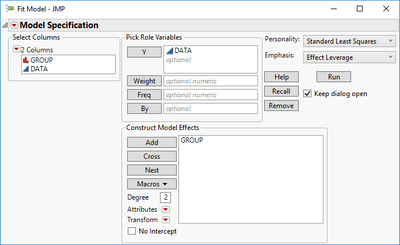
Go to Analysis > Fit Model and assign your Y and X as shown:

 Fit Model Simple ONEWAY.PNG

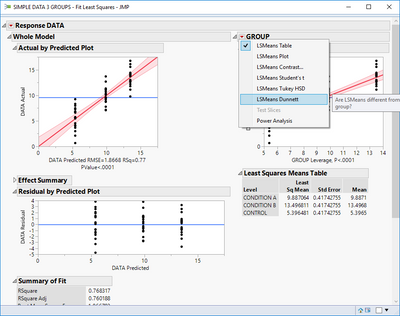
Click Run, and in the model result, go to GROUP effect > Dunnett's

Sub Menu Dunnet's in Fit Model Result.PNG

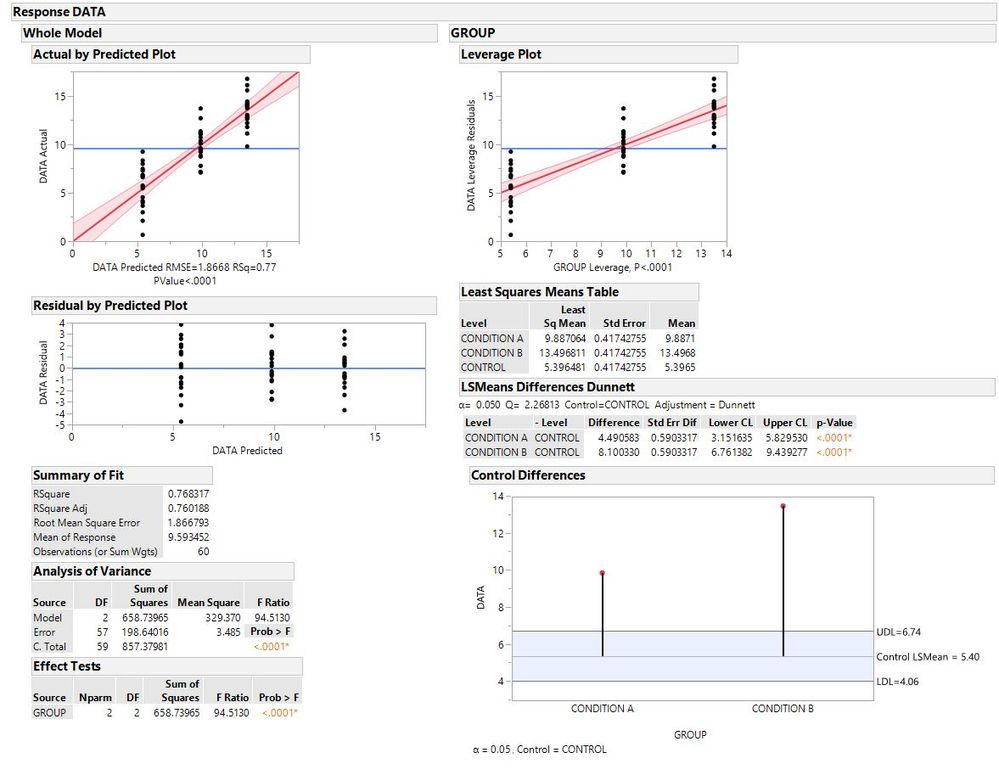
The resulting screen in giving you the full test statistics (LS Means Differences Dunnett's) as shown in this final screenshot:

Dunnet Test Statitics in Fit Model.jpg

That should satisfy the reviewer. If it does not, you should try to clarify what he/she means by Test Statistics.


TS

Thierry R. Sornasse
Mananahi
Level I

Re: Dunnett's Test Statistic

So I'm looking at the LS Means Differences Dunnett's table on your screenshot and it has columns for Level, -Level, Difference, Std Err Dif, Lower CL, Upper CL, and p-Value. Shouldn't there be one more column in there that says t-Statistic (or some other test statisctic) next to the p-value so that we know what was used to calculate that p-value. Something like that seems to be on most JMP outputs. That's what I think I am looking for, but maybe I just don't understand stats and am assuming that something exists. Do Dunnett's procedures not have test statistics?
Thierry_S
Super User

Re: Dunnett's Test Statistic

I believe what you are looking for is the Q value shown in the LSMeans Difference Dunnett table (equivalent to t statistics but for multiple comparison to a control value).
If this not what you are looking for, then I'm afraid that I will not be able to help you any further.
TS
Thierry R. Sornasse
Mananahi
Level I

Re: Dunnett's Test Statistic

I think that is what I'm looking for. thanks. I'm still a little confused though. Why is there only one statistic for the whole table. Most tables have an individual test statistic for each p-value. Can you or anyone enlighten me to why Dunnett's would be different?
David_Burnham
Super User (Alumni)

Re: Dunnett's Test Statistic

I've put together some fake data to illustrate what is going on:
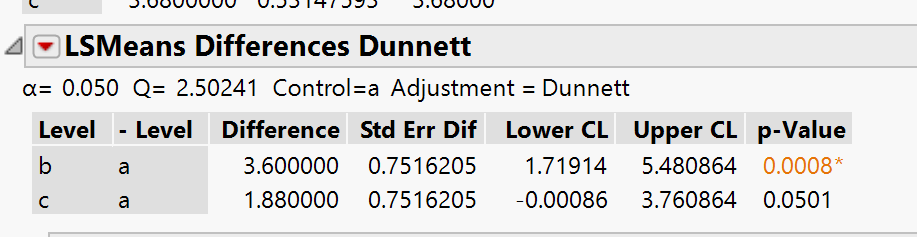
 

dunnetts.PNG


I've chosen the data such thast the contrast between c and the control (a) has a p-value of 0.05 i.e. the threshold at which we are assessing statistical significance.  


A t-statistic can be calculated as a the ratio of the difference to the standard error of the difference.  For the second contrast the statistic is 2.5 i.e. the Q statistic.  So whilst there is a statistic for each comparison, we can define a single statistic to that is the threshold for statistical significance.


You can check Wiki for references on the method although there is a tendency for Wiki to be overly abstract for statistical methods but you should easily be able to search for other explanations, e.g.

http://davidmlane.com/hyperstat/B112114.html

-Dave
David_Burnham
Super User (Alumni)

Re: Dunnett's Test Statistic

Also I should have mentioned JMP's online help:

dunnetts2.PNG

https://www.jmp.com/support/help/14-2/effect-details.shtml#625536


-Dave

Recommended Articles