- JMP will suspend normal business operations for our Winter Holiday beginning on Wednesday, Dec. 24, 2025, at 5:00 p.m. ET (2:00 p.m. ET for JMP Accounts Receivable).
Regular business hours will resume at 9:00 a.m. EST on Friday, Jan. 2, 2026. - We’re retiring the File Exchange at the end of this year. The JMP Marketplace is now your destination for add-ins and extensions.
- Subscribe to RSS Feed
- Mark Topic as New
- Mark Topic as Read
- Float this Topic for Current User
- Bookmark
- Subscribe
- Mute
- Printer Friendly Page
Discussions
Solve problems, and share tips and tricks with other JMP users.- JMP User Community
- :
- Discussions
- :
- Deming analysis

- Mark as New
- Bookmark
- Subscribe
- Mute
- Subscribe to RSS Feed
- Get Direct Link
- Report Inappropriate Content
Deming analysis
Hello,
I would like to compare two measurement methods using a deming regression.
This is a follow-up study, and in the first study my colleagues have used a deming regression in the "Analyze it" platform in Excel. But we don't have access to the software anymore, so instead I would like to conduct the analysis using JMP v. 16.
As far as I understand, deming regression is not found in JMP?
I have seen previous posts about using orthogonal fit if the variance ratio is 1. And I've also found an add-in from russ.wolfinger@sas.com.
The Deming analysis output in "Analyze it" contains the slope, intercept, and CI and p-value for the slope and intercept. Moreover the CI values are Jackknife 95%.
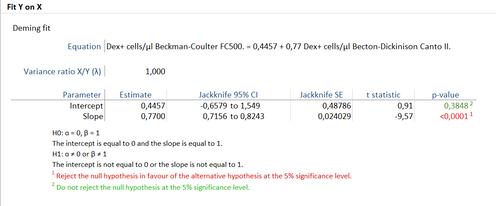
The output from Orthogonal fit in JMP only contains slope, intercept and confidence interval for the slope.
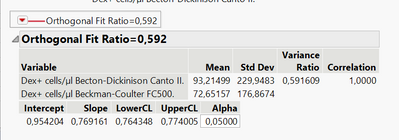
So, my question is how can I interpret the JMP output and determine if the two measurement methods are different without having the CI for the intercept and p-values for the slope and intercept. Do I need additional analyses, like Bland Altman in addition to the Orthogonal fit?
And are there better options in JMP for deming regression?
Thanks.
Br.
Dilek
Accepted Solutions


- Mark as New
- Bookmark
- Subscribe
- Mute
- Subscribe to RSS Feed
- Get Direct Link
- Report Inappropriate Content
Re: Deming analysis
Yes, the orthogonal regression in the Bivariate platform is Deming regression. Alpha is set to 0.05 so the lower and upper limits are 95% confidence. The slope interval does not contain 1, so you decide that the two measurements are not equal.
Select Analyze > Specialized Modeling > Matched Pairs to see a Bland Altman analysis. That could answer the questions about the intercept not equal to zero, but you will find based on the result for the slope that it is not a constant bias, but a proportional bias.
You might also be interested in the MSA platform.
- Mark as New
- Bookmark
- Subscribe
- Mute
- Subscribe to RSS Feed
- Get Direct Link
- Report Inappropriate Content
Re: Deming analysis
Yes, the orthogonal regression in the Bivariate platform is Deming regression. Alpha is set to 0.05 so the lower and upper limits are 95% confidence. The slope interval does not contain 1, so you decide that the two measurements are not equal.
Select Analyze > Specialized Modeling > Matched Pairs to see a Bland Altman analysis. That could answer the questions about the intercept not equal to zero, but you will find based on the result for the slope that it is not a constant bias, but a proportional bias.
You might also be interested in the MSA platform.
- Mark as New
- Bookmark
- Subscribe
- Mute
- Subscribe to RSS Feed
- Get Direct Link
- Report Inappropriate Content
Re: Deming analysis
Thank you - this is very helpful and answers my questions.
Recommended Articles
- © 2025 JMP Statistical Discovery LLC. All Rights Reserved.
- Terms of Use
- Privacy Statement
- Contact Us