Turn on suggestions
Auto-suggest helps you quickly narrow down your search results by suggesting possible matches as you type.
- Don’t miss your chance to experience Discovery Summit Europe at our best available rate! Early bird registration through 31 Oct.
- Graph Builder Toolbar streamlines interactive graphing. Creates shortcuts on Report and GraphBuilder Helpers toolbars. Download and install the extension.
Options
- Subscribe to RSS Feed
- Mark Topic as New
- Mark Topic as Read
- Float this Topic for Current User
- Bookmark
- Subscribe
- Mute
- Printer Friendly Page
Discussions
Solve problems, and share tips and tricks with other JMP users.- User Community
- :
- Discussions
- :
- Re: How to understand Lambda1 and Lambda2 for Box Cox transformation ?

Level III
- Mark as New
- Bookmark
- Subscribe
- Mute
- Subscribe to RSS Feed
- Get Direct Link
- Report Inappropriate Content
How to understand Lambda1 and Lambda2 for Box Cox transformation ?
Created:
Mar 21, 2023 04:25 AM
| Last Modified: Jun 8, 2023 5:59 PM
(3545 views)
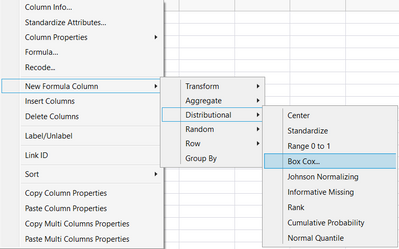
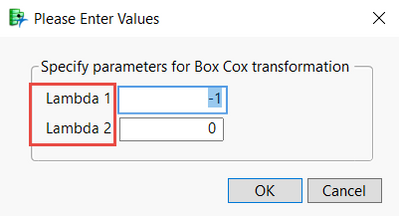
What do Lambda1 and Lambda2 mean when specify parameters for Box Cox transformation? How to specify them?
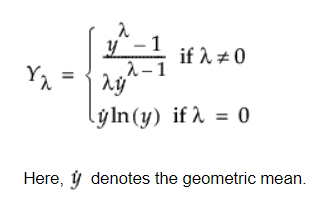
I have searched Box Cox formula in Help. It has only one Lambda parameter in formula. So I'm confusing.
Thank you!
1 ACCEPTED SOLUTION
Accepted Solutions


Super User
Solution
- Mark as New
- Bookmark
- Subscribe
- Mute
- Subscribe to RSS Feed
- Get Direct Link
- Report Inappropriate Content
Re: How to understand Lambda1 and Lambda2 for Box Cox transformation ?
JMP's Box-Cox function (as opposed to the B-C transformation in linear models, as you show above) is based on the following.
https://en.wikipedia.org/wiki/Power_transform.
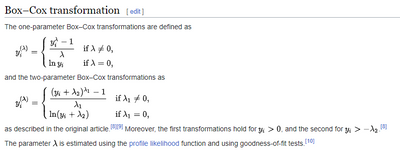
From Wikipedia, the free encyclopedia In statistics, a power transform is a family of functions applied to create a monotonic transformation of data using power functions. It is a data transformation technique used to stabilize variance, make the data more normal distribution-like, improve the ...
2 REPLIES 2
Super User
Solution
- Mark as New
- Bookmark
- Subscribe
- Mute
- Subscribe to RSS Feed
- Get Direct Link
- Report Inappropriate Content
Re: How to understand Lambda1 and Lambda2 for Box Cox transformation ?
JMP's Box-Cox function (as opposed to the B-C transformation in linear models, as you show above) is based on the following.
https://en.wikipedia.org/wiki/Power_transform.
From Wikipedia, the free encyclopedia In statistics, a power transform is a family of functions applied to create a monotonic transformation of data using power functions. It is a data transformation technique used to stabilize variance, make the data more normal distribution-like, improve the ...
Level III
- Mark as New
- Bookmark
- Subscribe
- Mute
- Subscribe to RSS Feed
- Get Direct Link
- Report Inappropriate Content
Re: How to understand Lambda1 and Lambda2 for Box Cox transformation ?
Thank you!
Recommended Articles
- © 2026 JMP Statistical Discovery LLC. All Rights Reserved.
- Terms of Use
- Privacy Statement
- Contact Us