cancel
Showing results for 
Show  only  | Search instead for 
Did you mean: 
  • New to JMP? Join us Sept. 23-24 for the Early User Edition of Discovery Summit, tailor-made for new users. Register now for free!
  • Use World Cup data to build models, explore spatial relationships, and create informative visualizations in JMP. Register. July 17, 2 pm US Eastern Time.
  • Your voice matters! Tell us how you prefer to receive JMP updates, so we can tailor our communication to your needs. Take short survey.

Discussions

Solve problems, and share tips and tricks with other JMP users.
Choose Language Hide Translation Bar
John3
Level I

Discrepancy measure for space filling design

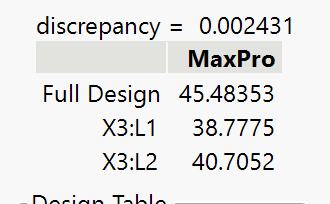
John3_0-1663165294700.png

Hello, how is the "discrepancy" measure calculated? I read in the docs that "The discrepancy value shown below the table is the integrated difference between the design points based and a uniform distribution." Is this the L1 distance? or something else? The DiceDesign R package has a boatload of different (L2) discrepancy measures. Any help appreciated.


1 REPLY 1
Phil_Kay
Staff

Re: Discrepancy measure for space filling design

@Mark_Bailey explains discrepancy in this previous thread.


"The discrepancy measure is a relative measure of the quality of a space filling design solution. It is useful when comparing two or more space filling designs. A smaller discrepancy indicates a better design.


Discrepancy is the difference between the design points (which have an empirical uniform distribution) and a theoretical uniform distribution."


I am not sure which discrepancy measure this corresponds to in the R package. The documentation for the R package does not have a lot of detail.


Perhaps you might want to generate a space-filling design in JMP and then run it through diagnostics in the R package to see which measure is the same. Alternatively you might want to contact technical support to see if they can get more statistical details ([email protected]).


I hope that helps,

Phil

Recommended Articles