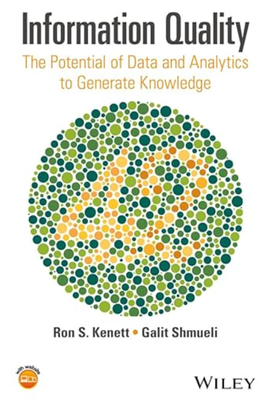
In 2018, JMP had the pleasure of interviewing Dr. Ron Kenett as part of the Analytically Speaking webinar series. We are reposting an excerpt from this interview for two reasons. First, to honor him as the recipient of the 2026 Deming Medal award, which is being bestowed at this month’s American Society for Quality’s World Conference on Quality and Improvement. Second, to underscore the relevance of information quality in this era of artificial intelligence (AI), machine learning, and massive amounts of data (including fake data/misinformation), which Kenett examined in the book he co-authored with Galit Shmueli.
In addition to being a Deming Medal recipient, Kenett is an applied statistician and Chairman of the KPA Group, an analytics consultancy. Kenett is also Research Professor at the University of Turin, Italy; Senior Research Fellow at the Samuel Neaman Institute, Technion, Haifa; and Chairman of the Data Science Society of the Israel Association of Engineers. He is the recipient of the UK Royal Statistical Society’s 2013 Greenfield Medal, the 2018 George Box Medal from the European Network for Business and Industrial Statistics, and Editor-in-Chief of the Wiley Encyclopedia of Statistics (StatsRef). Kenett’s expertise spans multiple fields, including design of experiments, statistical process control, industrial statistics, biostatistics, consumer research, data science, and risk management. He has authored and co-authored 18 books and more than 300 peer-reviewed papers.
We make a distinction between data and information, because data [combined] with analytics becomes information when the data help achieve a study goal. Information quality is determined by how the data were collected and analyzed to result in the presented findings.
Information quality is a framework that integrates classical statistics with modern artificial intelligence and machine learning. We label this integration ‘analytics.’ The point is that the goal of analytics should be generating quality information, not just an aggregation of data. This is also in part why we need expertise in overseeing what data are collected (strategic design of experiments, sampling methods, survey question design, etc.), how the data are collected, and the potential of the data to inform decisions of interest – indeed to answer the most important questions that we need to ensure are being asked. In this era of AI, the importance of statistical thinking is often undervalued, but it is more important than ever.
With so much data being generated and collected – via sensors and other means – we sometimes forget that the reasons for collecting this data were often quite narrow in scope: to see if a system will soon need maintenance, if humidity levels are affecting outcomes, etc. That is not to say there is no residual value in looking at these data for other insights, but the data simply may not be adequate to answer new and more important questions that we may think to ask, and, ultimately, which data will be most valuable in informing important future decisions.
Hear Dr. Kenett discuss information quality in the Analytically Speaking interview:
Kenett’s Discovery Summit Europe 2017 plenary talk, Quality by Design to Information Quality: A Journey Through Science and Business Analytics, may also be of interest. Watch the recording here.
For Kenett’s many contributions to statistics, data science, and better decisions spanning many fields, we thank him and congratulate him on this latest honor of receiving the Deming Medal.
In a recent conversation I had with Dr. Kenett about the relevance of information quality in this era, he said, "The big picture of analytics is being formed right in front of our eyes. It combines perspectives from various disciplines and, in this landscape, statistics is at a crossroads. The interview, which is linked above, lists many opportunity areas. An important element in this evolutionary path is to ensure that methodological advancements are in place to address real and generalizable problems. Analytics will affect (and will be influenced by) academia, practitioners, educators, and tool developers. Lots of work ahead!"


You must be a registered user to add a comment. If you've already registered, sign in. Otherwise, register and sign in.