- JMP will suspend normal business operations for our Winter Holiday beginning on Wednesday, Dec. 24, 2025, at 5:00 p.m. ET (2:00 p.m. ET for JMP Accounts Receivable).
Regular business hours will resume at 9:00 a.m. EST on Friday, Jan. 2, 2026. - We’re retiring the File Exchange at the end of this year. The JMP Marketplace is now your destination for add-ins and extensions.
- Subscribe to RSS Feed
- Mark Topic as New
- Mark Topic as Read
- Float this Topic for Current User
- Bookmark
- Subscribe
- Mute
- Printer Friendly Page
Discussions
Solve problems, and share tips and tricks with other JMP users.- JMP User Community
- :
- Discussions
- :
- Weibull model for bacterial decay

- Mark as New
- Bookmark
- Subscribe
- Mute
- Subscribe to RSS Feed
- Get Direct Link
- Report Inappropriate Content
Weibull model for bacterial decay
I have been asked to do a linear regression using Weibull on jmp. It only seems to work for data with a positive curve (growth), however, when trying to select the Weibull for the decay data it cannot be selected. Is there a parameter I am missing or an assumption that doesn't allow me to use this model?
- Tags:
- windows
Accepted Solutions

- Mark as New
- Bookmark
- Subscribe
- Mute
- Subscribe to RSS Feed
- Get Direct Link
- Report Inappropriate Content
Re: Weibull model for bacterial decay
Thanks for elaborating! And my guess might be correct.
According to your description, I think I found one article closely related to this context: Modeling the pressure inactivation dynamics of Escherichia coli
In the paper Weibull function (or model) is highlighted in the following:

But in Fit Curve platform, Weibull Growth model looks like the following:
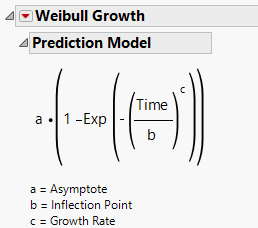
Meanwhile, the Power model looks like the following:

So, the Weibull function in the paper matches the Power Model in Fit Curve platform, and your Y is logCFU.
It would be helpful for you to ask the one who gave you the task to provide the exact formula of the equation, so you will be able to back out the values of estimates of your alpha and beta. In the above paper, the coefficient 2.303 may not exist in your model. And I suspect your alpha parameter is the "b" in that paper, and your beta is "n" in that paper. If all my assumptions hold, here are the alpha and beta estimates from the Power Model outputs:
beta = Power
alpha = (1/abs(Slope))^(1/Power)


- Mark as New
- Bookmark
- Subscribe
- Mute
- Subscribe to RSS Feed
- Get Direct Link
- Report Inappropriate Content
Re: Weibull model for bacterial decay
Which platform are you using? Which model are you posing?
- Mark as New
- Bookmark
- Subscribe
- Mute
- Subscribe to RSS Feed
- Get Direct Link
- Report Inappropriate Content
Re: Weibull model for bacterial decay
JMP pro 16.0
I am able to execute Gompertz in the Fit Curve menu. The reason I want to use Weibull model is so I can see the inflection point where decay of the bacteria occurs.


- Mark as New
- Bookmark
- Subscribe
- Mute
- Subscribe to RSS Feed
- Get Direct Link
- Report Inappropriate Content
Re: Weibull model for bacterial decay
Welcome to the community. Have you looked here:
- Mark as New
- Bookmark
- Subscribe
- Mute
- Subscribe to RSS Feed
- Get Direct Link
- Report Inappropriate Content
Re: Weibull model for bacterial decay
I have, I do not really understand how to use these formulas. They also seem to rely on a censor and are geared towards equipment failures. Below I have attached what my graphs look like. They are simply Time on the X and a bacterial count on the Y. A JMP support f[page for the Fit Curve Options stipulates a Weibell Growth model is only available when bothe response values and regressor values are nonnegative. So I am confused as to why previous researchers have been able to use this model for similar graphs.


- Mark as New
- Bookmark
- Subscribe
- Mute
- Subscribe to RSS Feed
- Get Direct Link
- Report Inappropriate Content
Re: Weibull model for bacterial decay
Seems you have negative Y values. But your Y is logarithm of another variable based on name. What does the data look like before transformation? CFU vs Time.
- Mark as New
- Bookmark
- Subscribe
- Mute
- Subscribe to RSS Feed
- Get Direct Link
- Report Inappropriate Content
Re: Weibull model for bacterial decay
By convention when counting a bacterial sample without any colony forming units you use 0.5. Taking the log of that gives you the negative values once transformed into log.
- Mark as New
- Bookmark
- Subscribe
- Mute
- Subscribe to RSS Feed
- Get Direct Link
- Report Inappropriate Content
Re: Weibull model for bacterial decay
I might be wrong, but based on my reading, you might be interested in one of the following:
- A Weibull model without logarithm.
- A Power model with logarithm.

If you can provide more context, that would help. E.g. a little background on the data and the desired model, such that they can help a non-biologist to understand. A reference to the desired model or the subject might help too.
- Mark as New
- Bookmark
- Subscribe
- Mute
- Subscribe to RSS Feed
- Get Direct Link
- Report Inappropriate Content
Re: Weibull model for bacterial decay
The y values are the Log of the number of bacteria estimated to be in a sample of bacteria taken from a solution. The number of bacteria is referred to as “colony forming unit” as it is correlated to a singular bacteria starting a distinct colony on a Petri dish. We take the log of that value as it’s a more digestible value. So the log of 9000000 would be 6.9.
I have four graphs. One control, three experimental treatments. For 7 time points I have three sets of log values as the samples were taken in triplicate. I’m interested in doing a linear regression model that allows me to see at which treatment starts to decrease the amount of bacteria sooner. Basically, the maximum and minimum and inflection point. I was told the Weibull beta value would be equivalent to the inflection point and the alpha would be the max and min.
I appreciate the help! I really wasn’t expecting the number of people to reach out.
- Mark as New
- Bookmark
- Subscribe
- Mute
- Subscribe to RSS Feed
- Get Direct Link
- Report Inappropriate Content
Re: Weibull model for bacterial decay
Thanks for elaborating! And my guess might be correct.
According to your description, I think I found one article closely related to this context: Modeling the pressure inactivation dynamics of Escherichia coli
In the paper Weibull function (or model) is highlighted in the following:
But in Fit Curve platform, Weibull Growth model looks like the following:
Meanwhile, the Power model looks like the following:
So, the Weibull function in the paper matches the Power Model in Fit Curve platform, and your Y is logCFU.
It would be helpful for you to ask the one who gave you the task to provide the exact formula of the equation, so you will be able to back out the values of estimates of your alpha and beta. In the above paper, the coefficient 2.303 may not exist in your model. And I suspect your alpha parameter is the "b" in that paper, and your beta is "n" in that paper. If all my assumptions hold, here are the alpha and beta estimates from the Power Model outputs:
beta = Power
alpha = (1/abs(Slope))^(1/Power)
Recommended Articles
- © 2025 JMP Statistical Discovery LLC. All Rights Reserved.
- Terms of Use
- Privacy Statement
- Contact Us