- JMP will suspend normal business operations for our Winter Holiday beginning on Wednesday, Dec. 24, 2025, at 5:00 p.m. ET (2:00 p.m. ET for JMP Accounts Receivable).
Regular business hours will resume at 9:00 a.m. EST on Friday, Jan. 2, 2026. - We’re retiring the File Exchange at the end of this year. The JMP Marketplace is now your destination for add-ins and extensions.
- Subscribe to RSS Feed
- Mark Topic as New
- Mark Topic as Read
- Float this Topic for Current User
- Bookmark
- Subscribe
- Mute
- Printer Friendly Page
Discussions
Solve problems, and share tips and tricks with other JMP users.- JMP User Community
- :
- Discussions
- :
- Two-way repeated measures ANOVA

- Mark as New
- Bookmark
- Subscribe
- Mute
- Subscribe to RSS Feed
- Get Direct Link
- Report Inappropriate Content
Two-way repeated measures ANOVA
Hi,
I did an experiment with 10 rice varieties and 4 water treatments. All the combinations of variety x water treatment were were tested and each combination had 4 replica's. I now want to test the signifcance of water treatment variety and their interaction.
I think I have to do a two-way repeated measures ANOVA (because both variety and water treatment are within-subject factors) but I don't really know how to do this in JMP (version 14). I am also a puzzled what to do with the fact that i have 4 replica's.
Thanks,
Rebecca
Accepted Solutions


- Mark as New
- Bookmark
- Subscribe
- Mute
- Subscribe to RSS Feed
- Get Direct Link
- Report Inappropriate Content
Re: Two-way repeated measures ANOVA
I don't think that the treatments are nested within subject. You said that you conducted a full factorial for each replica. That means that you have 10 x 4 x 4 = 160 observations.
I think that replica represents a block. It should be added to the model as a random effect. Follow the previous instructions but also add Replica to the Effects and then select this effect, click the red triangle next to Attributes, and select Random Effect.
If this suggestion still does not make sense, would you be able to post the data?
- Mark as New
- Bookmark
- Subscribe
- Mute
- Subscribe to RSS Feed
- Get Direct Link
- Report Inappropriate Content
Re: Two-way repeated measures ANOVA
Repeated measures means that you have observations over time that are correlated. You mention replication but that is not repetition.
- Select Analyze > Fit Model.
- Select the data column with the response and click Y.
- Select the data columns for Rice Variety and for Water Treatment.
- Click Macros and select Full Factorial.
- Click Run.
The replicates are used to estimate the response error (natural random variation). This measure is used to make the denominator of the statistics to assess the strength of the evidence against the null hypothesis (there is no effect of rice variety or water treatment).
- Mark as New
- Bookmark
- Subscribe
- Mute
- Subscribe to RSS Feed
- Get Direct Link
- Report Inappropriate Content
Re: Two-way repeated measures ANOVA
So should I analyze the data as a normal two-way factorial ANOVA?
I thought I had to do the repeated measures because both factors are within-subject factors?
Also if i do a normal two-way ANOVA I don't take the replica's into account? Every replica was placed on one table so they are correlated in that a way?
Thanks in advance!
- Mark as New
- Bookmark
- Subscribe
- Mute
- Subscribe to RSS Feed
- Get Direct Link
- Report Inappropriate Content
Re: Two-way repeated measures ANOVA
I don't think that the treatments are nested within subject. You said that you conducted a full factorial for each replica. That means that you have 10 x 4 x 4 = 160 observations.
I think that replica represents a block. It should be added to the model as a random effect. Follow the previous instructions but also add Replica to the Effects and then select this effect, click the red triangle next to Attributes, and select Random Effect.
If this suggestion still does not make sense, would you be able to post the data?
- Mark as New
- Bookmark
- Subscribe
- Mute
- Subscribe to RSS Feed
- Get Direct Link
- Report Inappropriate Content
Re: Two-way repeated measures ANOVA
Yes I had 160 plants and I get what you mean and how the analysis should be done. I do have 2 more things who are not clear yet.
Why couldn't I use repeated measures? Can you only use repeated measures if you have subjects which you measure mutliple times in time?
Is replica a random effect or do we assume this for the model?
I attached the data!
- Mark as New
- Bookmark
- Subscribe
- Mute
- Subscribe to RSS Feed
- Get Direct Link
- Report Inappropriate Content
Re: Two-way repeated measures ANOVA
You replicated the design. That is, you applied the same treatment to four new subjects. Replication is not the same as repeated measures. If you measured the plant height every week for four weeks and included every weekly measurement in the analysis, that would be repeated measures. Instead, you measured the end point four times.
Replica is the replication. Each replica is a block of runs. Yes, results are correlated. That is, the block effect. The blocks produce random effects, if at all. You could estimate a fixed effect for block but I think that interpretation would not be meaningful.
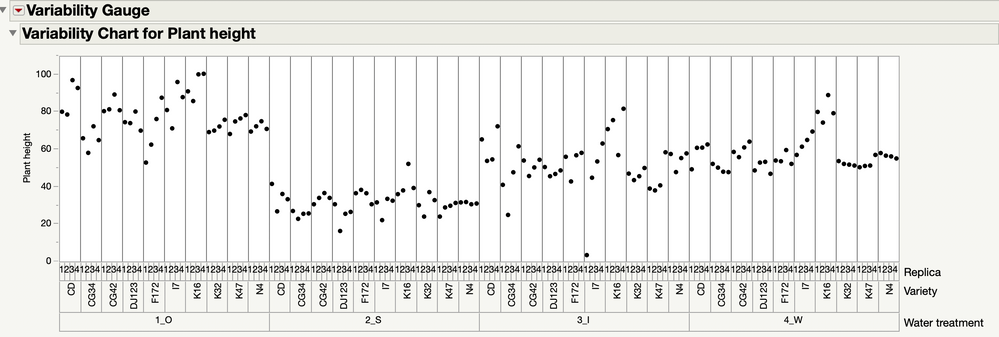
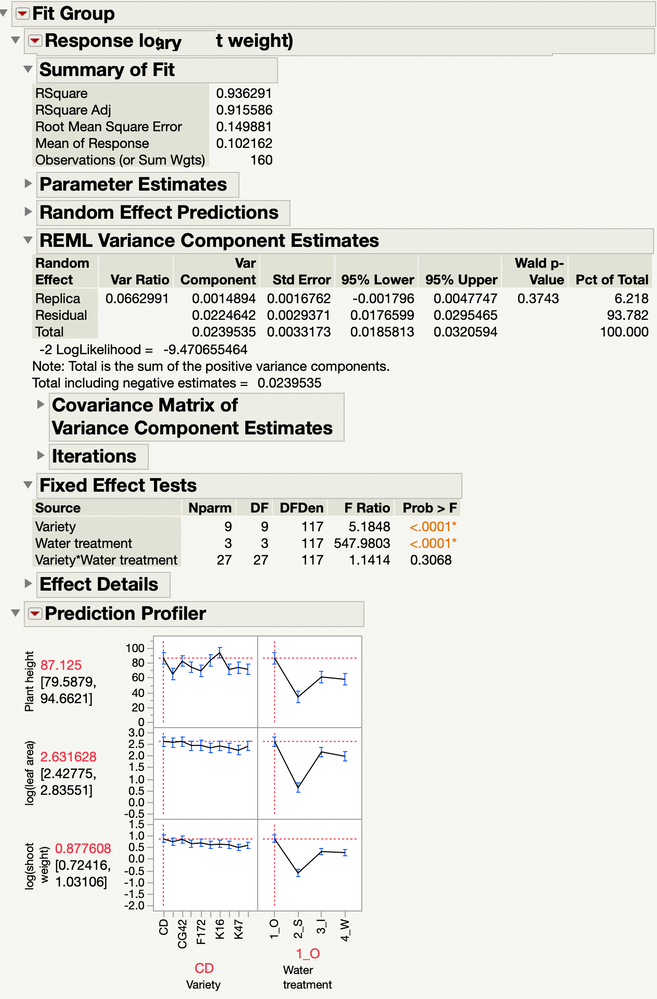
I added a script for both of these platforms to your data table and attached it here.
- Mark as New
- Bookmark
- Subscribe
- Mute
- Subscribe to RSS Feed
- Get Direct Link
- Report Inappropriate Content
Re: Two-way repeated measures ANOVA
I think I get it know, thank you very much!!!
Recommended Articles
- © 2025 JMP Statistical Discovery LLC. All Rights Reserved.
- Terms of Use
- Privacy Statement
- Contact Us