- Don’t miss your chance to experience Discovery Summit Europe at our best available rate! Early bird registration through 31 Oct.
- Graph Builder Toolbar streamlines interactive graphing. Creates shortcuts on Report and GraphBuilder Helpers toolbars. Download and install the extension.
- Subscribe to RSS Feed
- Mark Topic as New
- Mark Topic as Read
- Float this Topic for Current User
- Bookmark
- Subscribe
- Mute
- Printer Friendly Page
Discussions
Solve problems, and share tips and tricks with other JMP users.- User Community
- :
- Discussions
- :
- Re: Mixture DOE - Rubber Formulation Problem

- Mark as New
- Bookmark
- Subscribe
- Mute
- Subscribe to RSS Feed
- Get Direct Link
- Report Inappropriate Content
Mixture DOE - Rubber Formulation Problem
Hello JMP community,
My team plans to use JMP to design a mixture DOE to study and optimize the flame-retardant properties of a rubber compound in early development.
Typically, we express ingredient concentrations relative to the rubber polymer, in parts per hundred rubber (phr). For instance, a formulation of 110 phr contains 100 phr rubber polymer and 10 phr additives. This convention becomes problematic in a mixture DOE, where factors must sum to 1 (100%), because the total phr exceeds 100.
To address this, I have reformulated the ingredients on a % w/w basis. In this experiment, we are evaluating different flame retardants at 1–5 phr. Under normal conditions, all other ingredients would remain at fixed concentrations. When expressed as % w/w, however, the ingredient concentrations become interdependent, as shown by the factor settings in the attached image.
For example:
- 1 phr flame retardant corresponds to 0.88% w/w (0.0088) in the formulation.
- 5 phr flame retardant corresponds to 4.25% w/w (0.0425) in the formulation.
We are comfortable working within this range. I have also imposed a linear constraint: 0.8492 ≤ Polymers A + B + C ≤ 0.8791, meaning the rubber formulation should contain between 84.92% and 87.91% w/w of polymers A–C.
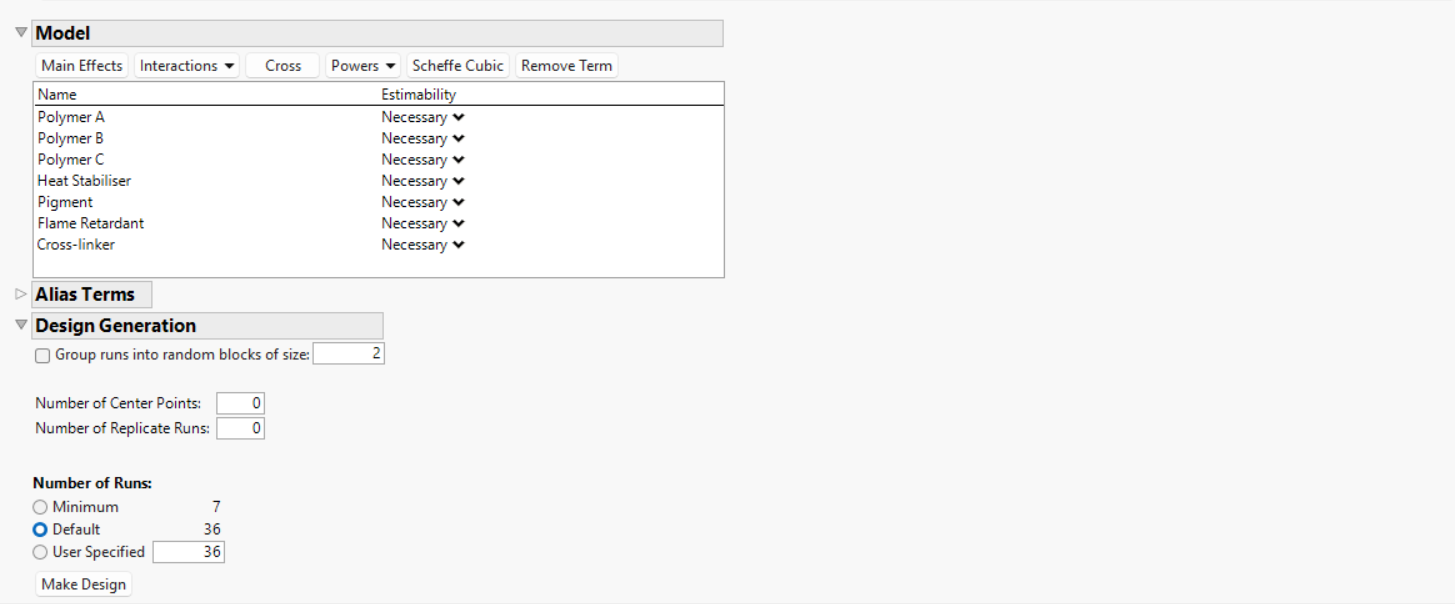
Limiting the design to main effects only, this mixture DOE produces 36 experimental runs for a single flame retardant. We plan to investigate at least five different flame retardants in this project. Due to time, cost and material constraints, it is not practical for us to conduct 180 experimental trials using this approach.
So, is there a more strategic approach to this design problem where the factors are treated as “mixtures” or should we simplify the design by treating the flame-retardant as a “continuous factor” at predetermined treatment levels instead?
I’m curious to know how fellow rubber formulators are using DOE in material development, too.
Thank you, JMP community !
Sammi


- Mark as New
- Bookmark
- Subscribe
- Mute
- Subscribe to RSS Feed
- Get Direct Link
- Report Inappropriate Content
Re: Mixture DOE - Rubber Formulation Problem
Have you considered trying out Bayesian Optimisation as an approach? Its more capable of handling complex formulations and is a good use case for trying to minimise experiments and emphasise the focus on reaching the optimum.
If you're interested, here's some resources:
A talk on using Bayes opt for complex formulations
An overview of Bayes opt applications in industry


- Mark as New
- Bookmark
- Subscribe
- Mute
- Subscribe to RSS Feed
- Get Direct Link
- Report Inappropriate Content
Re: Mixture DOE - Rubber Formulation Problem
Using Bayesian Optimization might be a good choice for you, but if you want to gain more knowledge, I think a designed experiment is the way to go. Which is more important: the knowledge gained or the optimum formulation? And, are you willing to possibly do more trials through Bayesian optimization than a designed experiment can give you? You don't know the full optimization path a priori when you use Bayesian optimization.
If you decide on the designed experiment route, here are a few thoughts. Is the rubber polymer always at 100 phr? You state that it is, but then it looks like you vary the total a bit in the design. I do not know if you WANTED to do that or if you felt that you HAD to do that. If you would prefer to keep the rubber polymer at 100 phr, then you could simplify your design tremendously by holding those three polymers constant and build the design around just the additives. That should allow you to reduce the number of runs.
If you really want to adjust the three rubber polymers, then you will have to make some choices. You cannot get something for nothing. With this many components, more runs will be required. JMP is suggesting 36 runs because you have many components, each at narrow ranges. The resulting design space will have many vertices and edges which can lead to that inflated number. The default number is a good starting point, but does not guarantee the best design for your needs.
What I would recommend is to start looking at different designs with different numbers of runs. I would also consider using an I-optimal design since you stated that you were interested in optimization. Since you plan on using different flame retardants, why not put that into the design as well? Getting the mixture design and saying to do that for each flame retardant may not be necessary. Optimization typically means modeling curvature, so I would consider a model with the 2-way cross products.
There are lots of things that you can do to make sure you get a model that meets your needs at a run number that is more feasible. Of course for a problem this large you will need to perform some trials. You cannot get something for nothing. Use the Design Explorer that JMP provides to try various combinations and see what leads to an acceptable trade-off between number of runs and the prediction properties that you need/want. I hope this helps a little bit.


- Mark as New
- Bookmark
- Subscribe
- Mute
- Subscribe to RSS Feed
- Get Direct Link
- Report Inappropriate Content
Re: Mixture DOE - Rubber Formulation Problem
Hi @Sammi_Chemist,
Completely agree with the comments, propositions and recommendations from @Dan_Obermiller. Choosing between Bayesian Optimization and DoE is more a question of objective. BO is very helpful for optimization, but will give you an incomplete view of the experimental space, and is effective for low sample size iterations. In some chemical/physical contexts with high preparation and experimentation time, it's often easier to run a DoE, in order to prepare all your samples in advance and run the experiments at the same time, instead of waiting (and wasting) long time for each run without any visibility on the next required run and the total number of runs.
I would also recommend to enter all your factors in your design, and not "replicate" the design for each flame retardant. Even if conceptually simple and looking logical, the design propositions you could get from having all your factors defined can save you some redundant runs that are not useful to determine the coefficients of the model. So you can easily end up with less than 180 runs for your 5 flame retardants. Like Dan mentioned, a Mixture design with main effects and interaction effects would be a good start.
I would also recommend to take a look at space filling designs if you're interested about optimization and prediction. These model-agnostic DoE have the great advantage to allow a good coverage of the design space, without any prior model definition, and through the use of flexible Machine Learning models (like SVM, Gaussian Process, etc...) enable to reach good predictive performances. Since no model is assumed, the number of points is freely adjustable, so it may allow to proceed through several iterations: a first "raw" mapping, before augmenting and doing a second set of runs in a narrower area for example.
One warning however, space filling mixture designs are concerned by the "Curse of dimensionality": the more factors you have with a constraint/dependance (Like for Mixture designs), the less points in the extreme parts of the experimental space you'll have. The points are more and more located in the centre of the experimental space with higher dimensions. To avoid and reduce this problem, it may be interesting to combine approaches, for example combine a main effect model-based Mixture design (to have points located at the edges of the experimental space) with a space filling approach (to have points located near the centre of the experimental space). See this post for more info: https://www.linkedin.com/posts/victorguiller_doe-doe-datascience-activity-7350781215546699777-Ofo9
Finally, I would encourage you to think sequentially about your formulation problem. Don't expect to have all the results in one design, but try to think about each step and it's related objectives. Maybe mixing different methods could be the most efficient strategy for your situation, for example starting with a simple model-based Mixture design, then augmenting through a space filling approach, and finally optimizing with a Bayesian Optimization approach ?
For more info, I have helped a PhD student on the use of space filling design and Machine Learning for flame retardant formulations. It also involves Bayesian Optimization, and you can find the thesis here: https://theses.hal.science/tel-04976497
Hope this complementary answer may help you,
"It is not unusual for a well-designed experiment to analyze itself" (Box, Hunter and Hunter)
Recommended Articles
- © 2026 JMP Statistical Discovery LLC. All Rights Reserved.
- Terms of Use
- Privacy Statement
- Contact Us