JMP Security Notice: CVE-2026-109618 and CVE-2026-109619
JMP promptly initiated a review of its products, services, and relevant infrastructure for exposure to CVE-2026-109618 and CVE-2026-109619.
Our assessment of JMP products has not identified exposure to these vulnerabilities. Where remediation was required within supporting environments, appropriate security updates and controls have been applied and validated.
We have identified no evidence of successful exploitation or unauthorized access to JMP systems or customer information associated with these vulnerabilities.
JMP continues to monitor the issue and relevant vendor guidance. No action is required by JMP customers at this time.
- Don’t miss your chance to experience Discovery Summit Europe at our best available rate! Early bird registration through 31 Oct.
- Graph Builder Toolbar streamlines interactive graphing. Creates shortcuts on Report and GraphBuilder Helpers toolbars. Download and install the extension.
- Subscribe to RSS Feed
- Mark Topic as New
- Mark Topic as Read
- Float this Topic for Current User
- Bookmark
- Subscribe
- Mute
- Printer Friendly Page
Discussions
Solve problems, and share tips and tricks with other JMP users.- User Community
- :
- Discussions
- :
- Re: How do you interpret Welch's Test results?

- Mark as New
- Bookmark
- Subscribe
- Mute
- Subscribe to RSS Feed
- Get Direct Link
- Report Inappropriate Content
How do you interpret Welch's Test results?
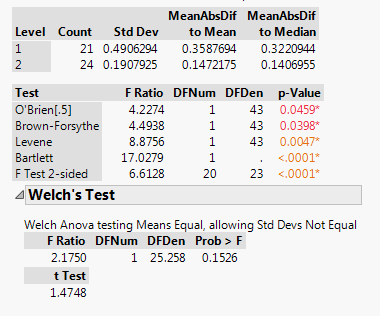
Since the tests for Unequal Variances indicates that the variances ARE unequal, how do I interpret the Welch's Test results? My take, based on the JMP Help is that since the Prob > F is greater than 0.05, the means of my two sample groups are NOT significantly different.
Accepted Solutions

- Mark as New
- Bookmark
- Subscribe
- Mute
- Subscribe to RSS Feed
- Get Direct Link
- Report Inappropriate Content
Re: How do you interpret Welch's Test results?
jeff.kolton1 wrote:
My take, based on the JMP Help is that since the Prob > F is greater than 0.05, the means of my two sample groups are NOT significantly different.
That is true given that you are testing at the 5% significance level. When using p-values to determine the results of a test the general rule is no significant differences were detected if p > α; in JMP α = 0.05 by default. JMP also shows you significance by color-coding the p-values. If you look at the results of your tests for equal variances, you can see that all of the tests are significant at the 5% level. Note that the Levene, Bartlett, and 2-sided F Test are also significant at the 1% level. My guess, is that the color coding, which I think started with JMP 12, distinguishes between the 5% level (red) and 1% level (orange).
I am not aware of any global way to change the default significance level, but I know I have seen and option to select the significance level for tests in specific platforms.


- Mark as New
- Bookmark
- Subscribe
- Mute
- Subscribe to RSS Feed
- Get Direct Link
- Report Inappropriate Content
Re: How do you interpret Welch's Test results?
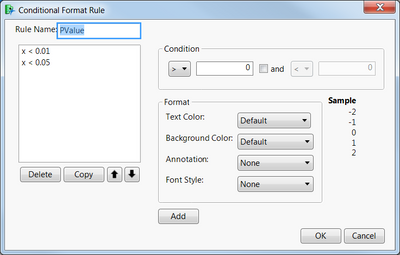
You can control the formatting that JMP uses for the p-values. Go to File > Preferences. Click the Reports category. Click the "Manage Rules" button next to Show Conditional Formatting.

From there choose PValue and edit. You then get a dialog box that allows you to change when JMP flags a low p-value.
Note that by using p-values, you never really have to specify your confidence level. You just always use the generic rule: if p-value is less than alpha, reject the null hypothesis. It is the formatting in JMP that may cause issues.
- Mark as New
- Bookmark
- Subscribe
- Mute
- Subscribe to RSS Feed
- Get Direct Link
- Report Inappropriate Content
Re: How do you interpret Welch's Test results?
Good to know. I generally follow the generic rule, but I also have yet to work on anything that required better than the 5% significance level.
Recommended Articles
- © 2026 JMP Statistical Discovery LLC. All Rights Reserved.
- Terms of Use
- Privacy Statement
- Contact Us