cancel
Showing results for 
Show  only  | Search instead for 
Did you mean: 
  • JMP will suspend normal business operations for our Winter Holiday beginning on Wednesday, Dec. 24, 2025, at 5:00 p.m. ET (2:00 p.m. ET for JMP Accounts Receivable).
    Regular business hours will resume at 9:00 a.m. EST on Friday, Jan. 2, 2026.
  • We’re retiring the File Exchange at the end of this year. The JMP Marketplace is now your destination for add-ins and extensions.

Discussions

Solve problems, and share tips and tricks with other JMP users.
Choose Language Hide Translation Bar

How do I make my Mixed model work with AR(1) covariance structure?

I have a large(2010X 4) data set and I need to calculate the effects of cycles and stresses on my wave speeds along with the interaction between them. My wavespeeds are collected for 4 stress levels so stresses here are repeated measurements. Here is a glimpse of what my stacked table looks like : N=subject on first row, CYC=cycle number on second row, STR: stress levels on third row and wave speeds collected in fourth row 

AvgMethodMoose7_0-1722478733404.png

I used the Mixed model on JMP pro where I have my cycle and stresses full factorial on fixed effects, N(subject number) on random effects, and wave speeds in Y. 

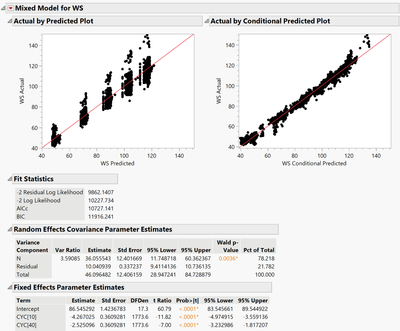
My question here is in repeated structure, I am unsure whether I should use a residual structure or AR(1) for repeated covariance structure. when I use residual structure for my co variance these are my results : 
AvgMethodMoose7_1-1722481031159.png

AvgMethodMoose7_2-1722481060372.png


In  the fixed effects, the cycles, and stresses individually shows significance however cyc*stress interaction does not show significance which is not what is interpreted . and the cycles Nparm shows 43 which is taking account of only one fascic How do I approach this problem ? 

1 REPLY 1
MRB3855
Super User

Re: How do I make my Mixed model work with AR(1) covariance structure?

Good question @AvgMethodMoose7 : There are many ways of thinking about this, but here is a good reference (earlier version of JMP, but the same thinking applies).

https://community.jmp.com/t5/Mastering-JMP/Fitting-Repeated-Measures-Data-using-JMP-Pro/ta-p/312501


Pretty good article here as well.

https://support.sas.com/resources/papers/proceedings/proceedings/sugi30/198-30.pdf


Recommended Articles