- Don’t miss your chance to experience Discovery Summit Europe at our best available rate! Early bird registration through 31 Oct.
- Graph Builder Toolbar streamlines interactive graphing. Creates shortcuts on Report and GraphBuilder Helpers toolbars. Download and install the extension.
- JMP will suspend normal business operations for our Rest and Recharge Day on Friday, October 2, 2026.
Regular business hours will resume on Monday, October 5, 2026.
- Subscribe to RSS Feed
- Mark Topic as New
- Mark Topic as Read
- Float this Topic for Current User
- Bookmark
- Subscribe
- Mute
- Printer Friendly Page
Discussions
Solve problems, and share tips and tricks with other JMP users.- User Community
- :
- Discussions
- :
- Help interpreting Freidman Test results (Cochran-Mantel-Haenszel)

- Mark as New
- Bookmark
- Subscribe
- Mute
- Subscribe to RSS Feed
- Get Direct Link
- Report Inappropriate Content
Help interpreting Freidman Test results (Cochran-Mantel-Haenszel)
Hi everyone,
I'm conducting a Freidman test on a dataset. The data tests the effects of a treatment and consists of 10 subjects. Each subject had their heart rate (HR) measured six times over a period of 6 hours. To conduct the test, I saved the HR ranks (ordinal) and set is as the Y in the fit Y by X, the subjects as the 'Block', and the 'Hour' as the X. This is the output of the Cochran-Mantel-Haenszel Tests but I'm having difficulty interpreting them. Is there a significant effect eventhough the Correlation of Scores is much greater than 0.05? Also, if the results do show there are significant changes induced by the treatement, is it appropriate to conduct a Steel-Dwass all pairs test on the nominal data as a post hoc test?
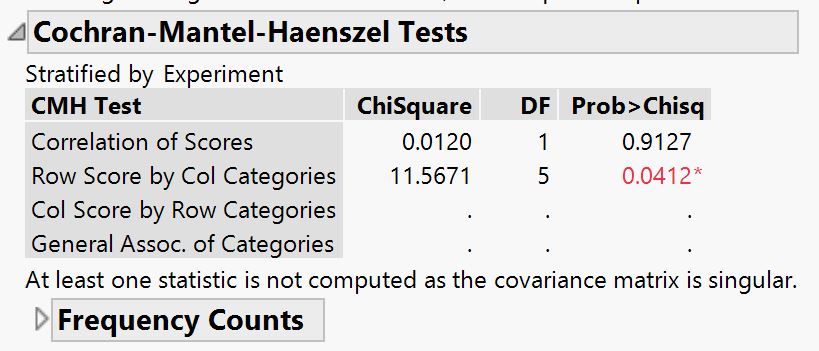
Thank you for your help!
- Mark as New
- Bookmark
- Subscribe
- Mute
- Subscribe to RSS Feed
- Get Direct Link
- Report Inappropriate Content
Re: Help interpreting Freidman Test results (Cochran-Mantel-Haenszel)


- Mark as New
- Bookmark
- Subscribe
- Mute
- Subscribe to RSS Feed
- Get Direct Link
- Report Inappropriate Content
Re: Help interpreting Freidman Test results (Cochran-Mantel-Haenszel)
I see why the ranks work. I have never approached the non-parametric analysis this way.You were following the instructions correctly.
- Mark as New
- Bookmark
- Subscribe
- Mute
- Subscribe to RSS Feed
- Get Direct Link
- Report Inappropriate Content
Re: Help interpreting Freidman Test results (Cochran-Mantel-Haenszel)
I suggest trying the repeated measures analysis. Make sure that your data is organized as Heart Rate, Treatment, Subject, and Hour. See the A Multivariate Approach example in sample I cited.
- « Previous
-
- 1
- 2
- Next »
Recommended Articles
- © 2026 JMP Statistical Discovery LLC. All Rights Reserved.
- Terms of Use
- Privacy Statement
- Contact Us