cancel
Showing results for 
Show  only  | Search instead for 
Did you mean: 
  • New to JMP? Join us Sept. 23-24 for the Early User Edition of Discovery Summit, tailor-made for new users. Register now for free!
  • Your voice matters! Tell us how you prefer to receive JMP updates, so we can tailor our communication to your needs. Take short survey.
  • See how to access JMP Marketplace - and - find, create & share add-ins to extend your JMP. Watch video.

Discussions

Solve problems, and share tips and tricks with other JMP users.
Choose Language Hide Translation Bar

Formula for polynomial function / Finding Area under the Curve

So, I would like to find the Area under some curves. Actually quite many of them, so using the Trapezoid method manually won't work, and can't imagine it would be valid enough. There is some kind of function for this for ROC-curves, but is it usable for finding the AUC in curves, measureing blood substances over time (five times)?

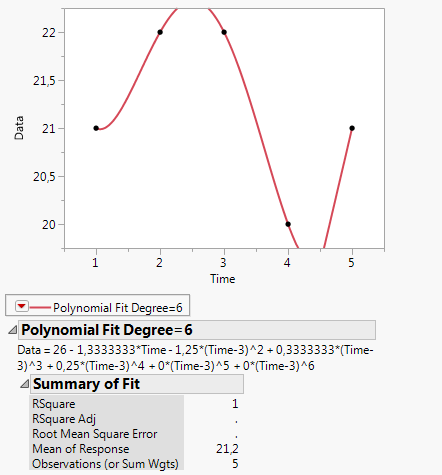
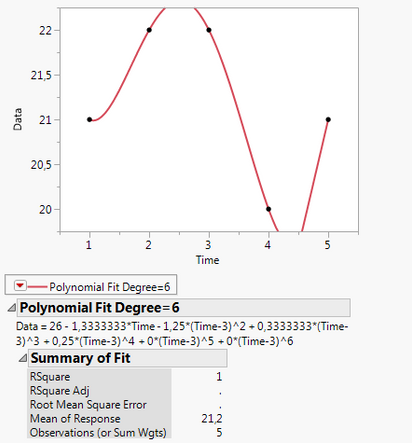
However, if I get a formula for a fitted Curve, I can use it to find AUC (Integral) in other software. For example, a Sixth degree polynomial. Here, I get the the function but I can't make sense of it (pic 1). 
 

AUCJMP.PNG
Polynomial functions are:a_{n}x^{n}+a_{n-1}x^{n-1}+\dotsb +a_{2}x^{2}+a_{1}x+a_{0},
But I can't make sense of the Formula JMP provides me. Using only Time=3? 

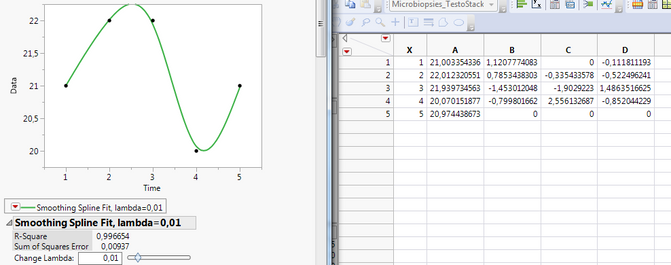
By using a flexible smoothing spline fit, I can get some coeffecients, but those won't help me (pic 2)? 
AUCJMP2.PNG


Would be grateful for tips getting the equation integral-ready and/or finding the AUC easily, for many subjects/curves.


10 REPLIES 10

Re: Formula for polynomial function / Finding Area under the Curve

Good point, Craige.


The centering also minimizes the correlations between the estimates. Otherwise, the correlations increase the standard errors of the estimates. The larger standard errors produce wider confidence interval estimates and smaller t-ratios for the same estimate. The smaller t-ratio will have a higher p-value. So correlations compromise the power of the decision about the estimate being significantly different from zero.

Recommended Articles