- JMP will suspend normal business operations for our Winter Holiday beginning on Wednesday, Dec. 24, 2025, at 5:00 p.m. ET (2:00 p.m. ET for JMP Accounts Receivable).
Regular business hours will resume at 9:00 a.m. EST on Friday, Jan. 2, 2026. - We’re retiring the File Exchange at the end of this year. The JMP Marketplace is now your destination for add-ins and extensions.
- Subscribe to RSS Feed
- Mark Topic as New
- Mark Topic as Read
- Float this Topic for Current User
- Bookmark
- Subscribe
- Mute
- Printer Friendly Page
Discussions
Solve problems, and share tips and tricks with other JMP users.- JMP User Community
- :
- Discussions
- :
- Designing discrete choice survey

- Mark as New
- Bookmark
- Subscribe
- Mute
- Subscribe to RSS Feed
- Get Direct Link
- Report Inappropriate Content
Designing discrete choice survey
I have my responses data in one table, and my Choice Profiles data in the second table. I am struggling to find functionality that would be able to specify which columns from my responses (I have 9 different questions) are responsible for each row from my Choice Profiles. What is the best way to link these two?
Accepted Solutions


- Mark as New
- Bookmark
- Subscribe
- Mute
- Subscribe to RSS Feed
- Get Direct Link
- Report Inappropriate Content
Re: Designing discrete choice survey
Hi, Pawel,
Usually, when you do Willingness to Pay (WTP), you use the most basic product (the one with the fewest features) as your baseline with a low price. Each line, then, is the Willingness to Pay for an "upgrade" for that feature.
The "Price Change" is what the customer is willing to pay for an upgrade, so in the attached example, you could charge $959.67 more for a larger hard drive. "New Price" is what you could charge for the whole product with the baseline settings plus that one upgrade (so, New Price - Price Change = baseline price).
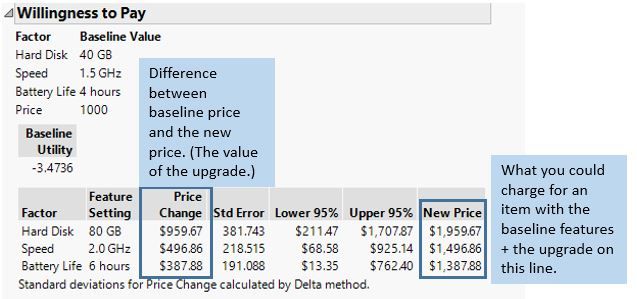
The laptop example is pretty old. I'm not sure anyone would pay $950+ for a 40GB of storage these days!


- Mark as New
- Bookmark
- Subscribe
- Mute
- Subscribe to RSS Feed
- Get Direct Link
- Report Inappropriate Content
Re: Designing discrete choice survey
It would be very helpful if you could attach a sample of the data from each of your tables.
- Mark as New
- Bookmark
- Subscribe
- Mute
- Subscribe to RSS Feed
- Get Direct Link
- Report Inappropriate Content
Re: Designing discrete choice survey
Please see attached. I appreciate it is probably fairly basic, but I cannot find my way around it.

- Mark as New
- Bookmark
- Subscribe
- Mute
- Subscribe to RSS Feed
- Get Direct Link
- Report Inappropriate Content
Re: Designing discrete choice survey
It's probable JMP will take care of it for you. If the two tables you show were generated by 'DOE > Consumer Studies > Choice Design':
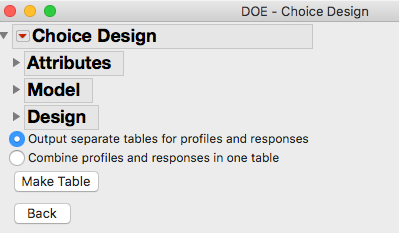
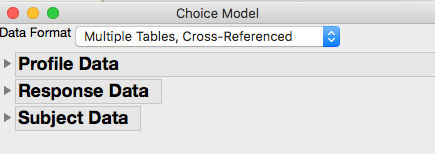
then, when you do 'Analyze > Consumer Research > Choice' you just have to select the right 'Data Format' option:

- Mark as New
- Bookmark
- Subscribe
- Mute
- Subscribe to RSS Feed
- Get Direct Link
- Report Inappropriate Content
Re: Designing discrete choice survey
Done as requested and it helped me a lot.
I recently got to the Willingness to Pay calculation, and have problems with interpreting the data. First of all, does the JMP SAS methodology to calculate WTP from discrete choice follow the logistics function? Secondly, I am not sure what the New Price I got to actually represents? I started from the price of 20 as baseline and it gives me £7.58? How can i understand it? Do you have any defintion of it?
Thank you for your prompt replies, I found them very useful.

- Mark as New
- Bookmark
- Subscribe
- Mute
- Subscribe to RSS Feed
- Get Direct Link
- Report Inappropriate Content
Re: Designing discrete choice survey
http://www.jmp.com/support/help/13-2/Willingness_to_Pay.shtml#453057
http://www.jmp.com/support/help/Valuing_Trade-offs.shtml
Hi Pawel,
These links should be useful. In addtion, try searching "willingness to pay" in the community.
I hope this helps.
Phil
- Mark as New
- Bookmark
- Subscribe
- Mute
- Subscribe to RSS Feed
- Get Direct Link
- Report Inappropriate Content
Re: Designing discrete choice survey
Hi, Pawel,
Usually, when you do Willingness to Pay (WTP), you use the most basic product (the one with the fewest features) as your baseline with a low price. Each line, then, is the Willingness to Pay for an "upgrade" for that feature.
The "Price Change" is what the customer is willing to pay for an upgrade, so in the attached example, you could charge $959.67 more for a larger hard drive. "New Price" is what you could charge for the whole product with the baseline settings plus that one upgrade (so, New Price - Price Change = baseline price).
The laptop example is pretty old. I'm not sure anyone would pay $950+ for a 40GB of storage these days!
Recommended Articles
- © 2025 JMP Statistical Discovery LLC. All Rights Reserved.
- Terms of Use
- Privacy Statement
- Contact Us