- JMP will suspend normal business operations for our Winter Holiday beginning on Wednesday, Dec. 24, 2025, at 5:00 p.m. ET (2:00 p.m. ET for JMP Accounts Receivable).
Regular business hours will resume at 9:00 a.m. EST on Friday, Jan. 2, 2026. - We’re retiring the File Exchange at the end of this year. The JMP Marketplace is now your destination for add-ins and extensions.
- Subscribe to RSS Feed
- Mark Topic as New
- Mark Topic as Read
- Float this Topic for Current User
- Bookmark
- Subscribe
- Mute
- Printer Friendly Page
Discussions
Solve problems, and share tips and tricks with other JMP users.- JMP User Community
- :
- Discussions
- :
- Definitive Screening Design Questions

- Mark as New
- Bookmark
- Subscribe
- Mute
- Subscribe to RSS Feed
- Get Direct Link
- Report Inappropriate Content
Definitive Screening Design Questions
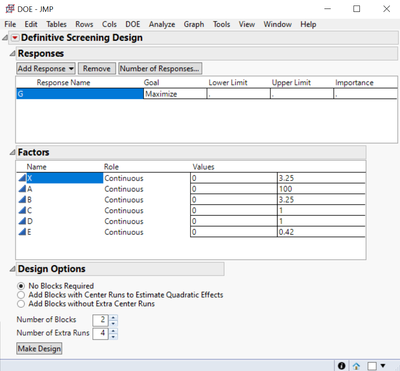
I'm looking to construct a definitive screening design and I'm new to this method. I have JMP 16. This study has 6 factors. A few questions to better understand DSD:
1. Is there any way in the DSD platform to tell it I want replicates? The option doesn't show up anywhere.
2. If I just ran each condition in duplicate and pasted in the duplicate runs, would affect the model ?
3. What is the need of the extra runs? Is there an optimal number of extra runs needed? It seems my choices are 0, 4, and 8. How does one go about figuring a good number of extra runs?
4. If I want to runs center points, what is the necessity of adding blocks? I plan to run these in one experiment.
Accepted Solutions


- Mark as New
- Bookmark
- Subscribe
- Mute
- Subscribe to RSS Feed
- Get Direct Link
- Report Inappropriate Content
Re: Definitive Screening Design Questions
Hi @sanch1,
If you're new to Definitive Screening Design, I would recommend you have a look at these two ressources :
Concerning your questions :
- There are no way to add replicates directly from the DSD platform. If you need replicates, you can add them through the Augment Design platform : Replicate a Design
- No, replicates don't add any degree of freedom in the model, since they only reproduce original treatments used to assume a specific model. Replicates are used to get more precise estimates for the model's coefficients and have a better evaluation of model error.
- Extra runs are helpful in order to have more flexibility in the choice of an appropriate model, and can help in increasing estimates precision. If you step back, DSD are designed to be able to determine main effects in priority, then 2-factors interactions and quadratic effects if these effects are important and the number of degree of freedom is sufficient. For 6 factors, that means you have 1 intercept, 6 main effects, 15 interactions with 2 factors, and 6 quadratic effects that could be estimated : 27 possible effects terms. Since DSD for 6 factors is done by default with 4 extra runs in the platform for a total of 17 runs, that means you would be able to estimate 16 terms between 6 possible main effects, 15 possible interactions and 6 possible quadratic effects. Extra runs are useful to increase the number of treatments in your design, so increase the degree of freedom, to help estimate more terms coefficients. 4 extra runs is the default recommended option, but if you suspect that you may have a complex model and a need to estimate more terms, you can increase it to 8. JMP Help documentation on this topic : Structure of Definitive Screening Designs / Effective Model Selection for DSDs
- By default, DSD always create one centre point. So you can click on "No Blocks required" if you don't need a block. Blocks are helpful if you run the experiments by groups of runs (not possible to run them simultaneously) for example. When creating blocks in DSD, the platform will create a centre point for each block (option "Add blocks with Center Runs..."), but you also can choose to not add centre point for each block (option "Add blocks without Extra Center Runs").
I hope these answers will help you,
"It is not unusual for a well-designed experiment to analyze itself" (Box, Hunter and Hunter)

- Mark as New
- Bookmark
- Subscribe
- Mute
- Subscribe to RSS Feed
- Get Direct Link
- Report Inappropriate Content
Re: Definitive Screening Design Questions
Just a clarification, replication does indeed add degrees of freedom to the model. They are assigned to the error term, which is why they may improve the inference space of the design. They don't add additional terms to the model is, I believe, Victor's point.
Blocking is a strategy for noise. Center points on block effects are non-sensical. Essentially a block is a categorical factor, a set of noise variables. The noise is constant within the block increasing the precision of the design. That same noise that was constant within the block, changes between the blocks. Therefore it can be assigned as term in the model (e.g., won't be confounded with the MSE). This will reduce the MSE increasing the precision of the design.
Center points are not really needed in DSD's as the factors are tested at 3 levels and quadratic effects can be estimated. Center points are an efficient test for non-linear effects in 2-level designs, but the quadratic effect estimated is not specific.
- Mark as New
- Bookmark
- Subscribe
- Mute
- Subscribe to RSS Feed
- Get Direct Link
- Report Inappropriate Content
Re: Definitive Screening Design Questions
Hi @sanch1,
If you're new to Definitive Screening Design, I would recommend you have a look at these two ressources :
Concerning your questions :
- There are no way to add replicates directly from the DSD platform. If you need replicates, you can add them through the Augment Design platform : Replicate a Design
- No, replicates don't add any degree of freedom in the model, since they only reproduce original treatments used to assume a specific model. Replicates are used to get more precise estimates for the model's coefficients and have a better evaluation of model error.
- Extra runs are helpful in order to have more flexibility in the choice of an appropriate model, and can help in increasing estimates precision. If you step back, DSD are designed to be able to determine main effects in priority, then 2-factors interactions and quadratic effects if these effects are important and the number of degree of freedom is sufficient. For 6 factors, that means you have 1 intercept, 6 main effects, 15 interactions with 2 factors, and 6 quadratic effects that could be estimated : 27 possible effects terms. Since DSD for 6 factors is done by default with 4 extra runs in the platform for a total of 17 runs, that means you would be able to estimate 16 terms between 6 possible main effects, 15 possible interactions and 6 possible quadratic effects. Extra runs are useful to increase the number of treatments in your design, so increase the degree of freedom, to help estimate more terms coefficients. 4 extra runs is the default recommended option, but if you suspect that you may have a complex model and a need to estimate more terms, you can increase it to 8. JMP Help documentation on this topic : Structure of Definitive Screening Designs / Effective Model Selection for DSDs
- By default, DSD always create one centre point. So you can click on "No Blocks required" if you don't need a block. Blocks are helpful if you run the experiments by groups of runs (not possible to run them simultaneously) for example. When creating blocks in DSD, the platform will create a centre point for each block (option "Add blocks with Center Runs..."), but you also can choose to not add centre point for each block (option "Add blocks without Extra Center Runs").
I hope these answers will help you,
"It is not unusual for a well-designed experiment to analyze itself" (Box, Hunter and Hunter)
- Mark as New
- Bookmark
- Subscribe
- Mute
- Subscribe to RSS Feed
- Get Direct Link
- Report Inappropriate Content
Re: Definitive Screening Design Questions
Just a clarification, replication does indeed add degrees of freedom to the model. They are assigned to the error term, which is why they may improve the inference space of the design. They don't add additional terms to the model is, I believe, Victor's point.
Blocking is a strategy for noise. Center points on block effects are non-sensical. Essentially a block is a categorical factor, a set of noise variables. The noise is constant within the block increasing the precision of the design. That same noise that was constant within the block, changes between the blocks. Therefore it can be assigned as term in the model (e.g., won't be confounded with the MSE). This will reduce the MSE increasing the precision of the design.
Center points are not really needed in DSD's as the factors are tested at 3 levels and quadratic effects can be estimated. Center points are an efficient test for non-linear effects in 2-level designs, but the quadratic effect estimated is not specific.
Recommended Articles
- © 2025 JMP Statistical Discovery LLC. All Rights Reserved.
- Terms of Use
- Privacy Statement
- Contact Us