cancel
Showing results for 
Show  only  | Search instead for 
Did you mean: 
  • New to JMP? Join us Sept. 23-24 for the Early User Edition of Discovery Summit, tailor-made for new users. Register now for free!
  • Use World Cup data to build models, explore spatial relationships, and create informative visualizations in JMP. Register. July 17, 2 pm US Eastern Time.
  • Your voice matters! Tell us how you prefer to receive JMP updates, so we can tailor our communication to your needs. Take short survey.

Discussions

Solve problems, and share tips and tricks with other JMP users.
Choose Language Hide Translation Bar
AvaSchwartz7
Level I

Cohen's d Effect Size from Mixed Model Output

Hello,

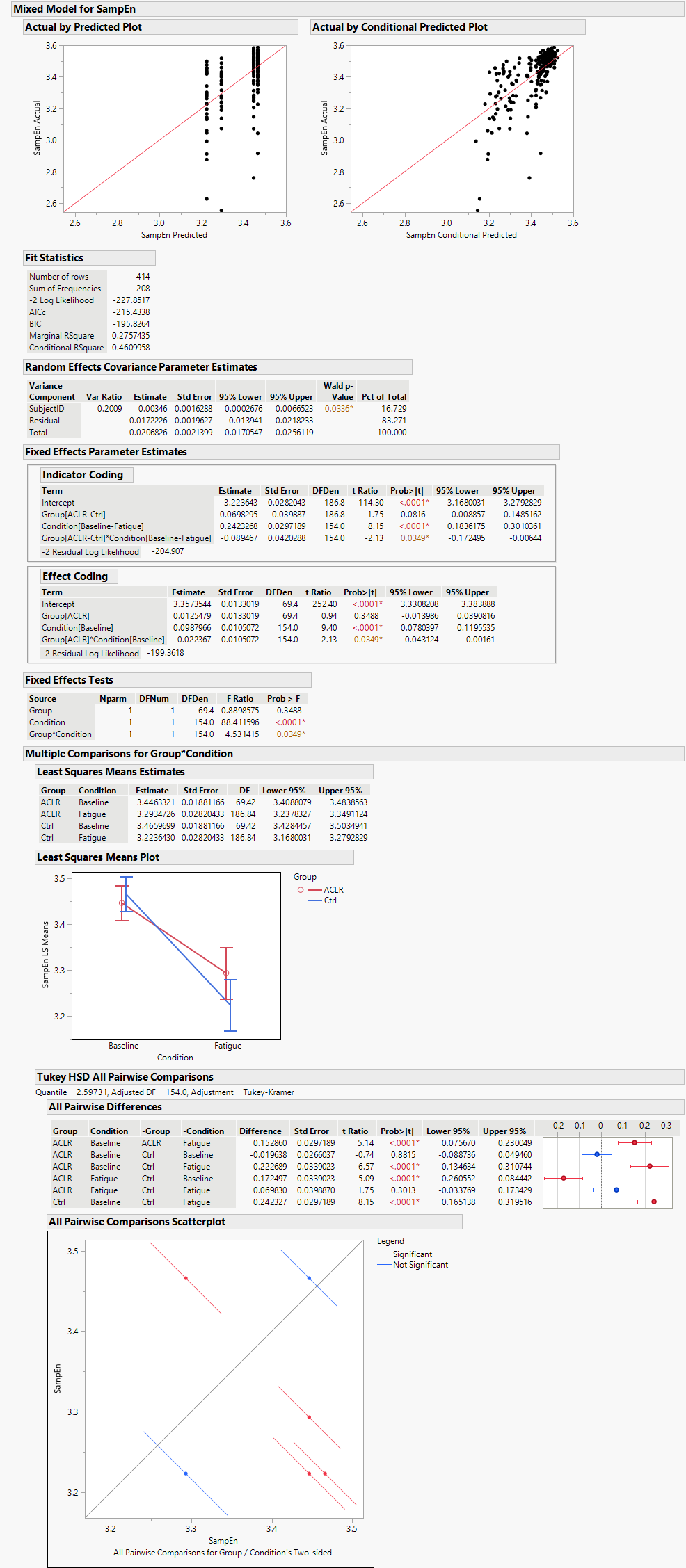
I am wondering how I can calculate a Cohen's d effect size from my mixed model output (attached), especially in the case of an interaction effect? I have seen some online resources saying to use the least squares mean difference divided by the model root mean square error in order to do so for main effects. However, when doing this, I sometimes get an effect size that appears inflated based on the data. I am using JMP Student Edition 19.0.3.

Any advice would be greatly appreciated, thank you!

- Ava

1 REPLY 1
MRB3855
Super User

Re: Cohen's d Effect Size from Mixed Model Output

Hi @AvaSchwartz7 : I'm no expert in Cohen's d, but there is a thoughtful discussion here.

https://stats.stackexchange.com/questions/179098/cohens-d-for-2x2-anova-interaction/179102#179102

And, for a Mixed Model, another issue is what to use as your estimate of sigma.  Rather than RMSE (as with a fixed effects model), I'd think, in general, you'd want to use the Total SD (square root of the total variance). 

And, FWIW, why not use confidence intervals instead?  Cohen's d, in my view, is too simplistic. Others may disagree...


Edit: And, generally speaking, Cohen's d (and confidence intervals) for main effects would not be appropriate when interactions are present (yes, it can be calulated but it could be very misleading).


Recommended Articles