JMP Security Notice: CVE-2026-109618 and CVE-2026-109619
JMP promptly initiated a review of its products, services, and relevant infrastructure for exposure to CVE-2026-109618 and CVE-2026-109619.
Our assessment of JMP products has not identified exposure to these vulnerabilities. Where remediation was required within supporting environments, appropriate security updates and controls have been applied and validated.
We have identified no evidence of successful exploitation or unauthorized access to JMP systems or customer information associated with these vulnerabilities.
JMP continues to monitor the issue and relevant vendor guidance. No action is required by JMP customers at this time.
- Don’t miss your chance to experience Discovery Summit Europe at our best available rate! Early bird registration through 31 Oct.
- Graph Builder Toolbar streamlines interactive graphing. Creates shortcuts on Report and GraphBuilder Helpers toolbars. Download and install the extension.
- Subscribe to RSS Feed
- Mark Topic as New
- Mark Topic as Read
- Float this Topic for Current User
- Bookmark
- Subscribe
- Mute
- Printer Friendly Page
Discussions
Solve problems, and share tips and tricks with other JMP users.- User Community
- :
- Discussions
- :
- Anderson-Darling - Shapiro Wilk

- Mark as New
- Bookmark
- Subscribe
- Mute
- Subscribe to RSS Feed
- Get Direct Link
- Report Inappropriate Content
Anderson-Darling - Shapiro Wilk
I have to test the data for normality.
First used 9 version now 15.0
As I understand from the forum the Shapiro Wilk test is outdated and the Anderson-Darling test (AD) is currently being used. AD is used to define kind of Distribution
Normal Distribution;
Cauchy;
Lognormal;
Exponential;
Gamma;
SHASH;
Weibull.
But what about a criterion. Does it look like Shapiro-Wilk's?
Please help me to interpret three situations below
1.
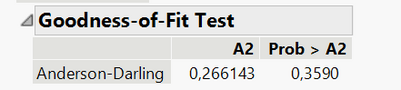
2.
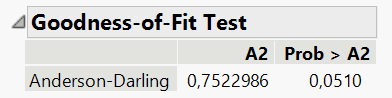
3.
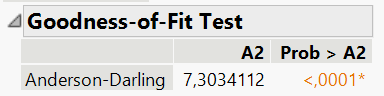
And why does Prob everytime is > then A2 ?
Accepted Solutions


- Mark as New
- Bookmark
- Subscribe
- Mute
- Subscribe to RSS Feed
- Get Direct Link
- Report Inappropriate Content
Re: Anderson-Darling - Shapiro Wilk
It is a hypothesis test, so it works like the Shapiro-Wilks test. The null hypothesis is the fitted distribution. The sample test statistic is A2. It is an upper-tailed test like the chi square and F tests. A large statistics is evidence against the null. The stated probability is for A2 at least as large as the one estimated from your sample when the null hypothesis is true.
It is meant to be used to decide if you should reject the fitted model. It is not intended to be used for model selection. A criterion such as AICc would be better for that purpose.
The three examples that you provided each present a p-value for your decision. First you decide the type I error risk you are willing to take (i.e., alpha level) and then compare the p-value to alpha. If the p-value is less than alpha, you reject the null hypothesis. Otherwise, you continue to assume the null is true. For example, if I use alpha = 0.1, then I do not reject the null for the first case but I do reject the null for the other two tests.
Note that using the same hypothesis test with the same sample of the population for many different models increases the chances of type I errors. Such a practice is an example of multiple comparisons.


- Mark as New
- Bookmark
- Subscribe
- Mute
- Subscribe to RSS Feed
- Get Direct Link
- Report Inappropriate Content
Re: Anderson-Darling - Shapiro Wilk
Just one additional comment to your question. Shapiro-Wilk is not an outdated test. That test is still appropriate, but is only used for testing normality. Since JMP can fit many different distributions, the switch was made to Anderson-Darling for consistency. That test can be used for testing any distribution.
Recommended Articles
- © 2026 JMP Statistical Discovery LLC. All Rights Reserved.
- Terms of Use
- Privacy Statement
- Contact Us