- DownloadSemiconductor Toolkit: Tools to create wafer maps, add wafer geometry to graphics, explore die defects & compare wafers.
- Discovery Summit 2026: Early User Edition - September 23-24.Register. It's free.
- Use JMP Clinical with CDISC-compliant data. Review studies, ID safety and efficacy signals & communicate findings with interactive graphics. Register to see how. Aug. 27, 2 pm US ET.
JMPer Cable
A technical blog for JMP users of all levels, full of how-to's, tips and tricks, and detailed information on JMP features- JMP User Community
- :
- Blogs
- :
- JMPer Cable
- :
- Assessing treatment adherence in clinical trials using the Exposure Summary repo...
- Subscribe to RSS Feed
- Mark as New
- Mark as Read
- Bookmark
- Subscribe
- Printer Friendly Page
- Report Inappropriate Content


Data on treatment exposure represent some of the most important information collected in clinical trials, though it may not be apparent to most of us. Efficacy endpoints are, not surprisingly, of principal focus since they determine whether a new medical product will one day reach the market to address unmet medical need. However, efficacious drugs also need to be safe and tolerable, and there are numerous past examples of treatments that were removed from the marketplace due to mounting evidence of elevated safety risk. Once upon a time, the analysis of safety endpoints did not receive much attention. In the last 25 years, however, there has been considerable progress toward improving the analysis and reporting of safety and tolerability endpoints throughout the development and marketing life cycle.
This brings us to the analysis of treatment exposure and the concept of treatment adherence. Treatment adherence answers the question: “Do patients enrolled in clinical trials take their treatments as required by the protocol?” It is a straightforward question with important implications:
- Assuming that the treatment is efficacious, failure to take it as prescribed means that patients will not experience the maximum benefit possible. For the endpoints used to design the study, this can be particularly problematic in two ways. First, the treatment effect will be smaller than it otherwise could have been, resulting in a loss of power for the primary endpoint. Second, the inadequate control of disease can lead to more variable responses, which results in further power loss. The potential outcome of this power loss is that an effective treatment may fail to reach patients in the marketplace.
- Assuming that the treatment is “safe” (as no treatment is truly risk-free), failure to take it as prescribed means that patients may experience elevated safety risk through uncontrolled disease. However, if a treatment does have some accompanying safety and tolerability issues, poor adherence has the potential to mask this risk, potentially leading to an unsafe treatment, or unsafe doses of an otherwise safe treatment, in the marketplace.
Given that the responses for safety and efficacy are directly tied to whether or not patients actually take their drug, why are analyses of exposure often so limited in scope? Often times, a single table is all that is produced for a clinical study report.
There are a number of considerations:
- Volume. Daily treatments create a data point for each and every day the patient is under investigation, which, for chronic diseases, can create hundreds of records. It is further exacerbated for treatments requiring multiple doses per day, which creates even more data to manage. Coupled with the data entry lag of traditional methods of treatment accountability, poor adherence can go unchecked for a considerable period of time.
- Tools. Systems used to house and clean these data are often incapable of providing useful analysis and reporting.
- Measurements. Many traditional methods for drug accountability are reliant on the patient, either through written diaries or by bringing unused medication back to the clinic during study visits. These methods are often inaccurate. Newer electronic methods can be used to better understand treatment accountability with real-time data, though they still are not in widespread use. However, many of these methods offer no guarantee that the patient actually took their treatment! The only way to be sure patients are taking treatment are through:
- Pharmacokinetics to measure drug concentrations in blood or other tissue. This approach is burdensome for the patient, expensive, and can lead to adverse events.
- Apps that visually record the patient taking their treatment. These apps are useful but can be burdensome for frequent dosing or certain patient populations.
- In-clinic treatments, which is often common practice for intravenous treatments with infrequent dosing.
- Implants that slowly release drug over time.
However, newer technologies are allowing for confirmation of patient adherence to treatment that minimize patient burden.
Exposure/adherence data are currently imperfect. Despite these imperfections, there are a number of analyses that can be performed to better understand patient exposure to study treatments. Prior to the completion of the study, understanding patient exposure gives sponsors the opportunity to:
- Intervene with individual patients to improve adherence.
- Intervene with problematic clinical sites to improve adherence.
- Assess the implications of poor adherence and its relationship or timing relative to:
- Adverse events.
- Hospitalizations.
- Protocol deviations.
- Key study endpoints.
- Develop analyses that consider patient adherence.
- Assess the implications of poor adherence to refine monitoring practices or future clinical trials designs.
JMP Clinical 19.1 can assist sponsors with its newly revamped Exposure Summary report. Key improvements include the ability to handle multiple treatments per patient and multiple treatment periods, and computing numerous metrics including:
- Duration of exposure (includes treatment gaps between first and last dose).
- Total dose of treatment.
- Average daily dose over the duration of exposure.
- Frequency of days receiving treatment (removes treatment gaps between first and last dose).
- Percent of duration of days receiving treatment.
- Average daily dose over the days receiving treatment.
- Frequency of treatment gaps.
- Duration of treatment gaps.
A further improvement summarizes treatment exposure using a swimmer plot to explore notable trends by treatment arm with the ability to gain more detailed insight into individual patients.
Throughout this blog post, we illustrate methodologies using data from patients with probable mild-to-moderate Alzheimer’s disease. The CDISC Pilot study includes data from 254 patients randomized to one of three treatments (Xanomeline high dose, Xanomeline low dose, or Placebo) for a 26-week treatment period. To really drive home the point of treatment gaps, however, data from the Nicardipine study will be used.
Figure 1 summarizes the duration of exposure using a Kaplan-Meier plot. The Time at Risk table at the bottom of the plot communicates the number of patients who have yet to complete their treatment. This table can be customized according to a user-defined interval, and the table can be modified to present the cumulative number of events, which, in this case, would be the number of individuals who completed their treatment by a given day.
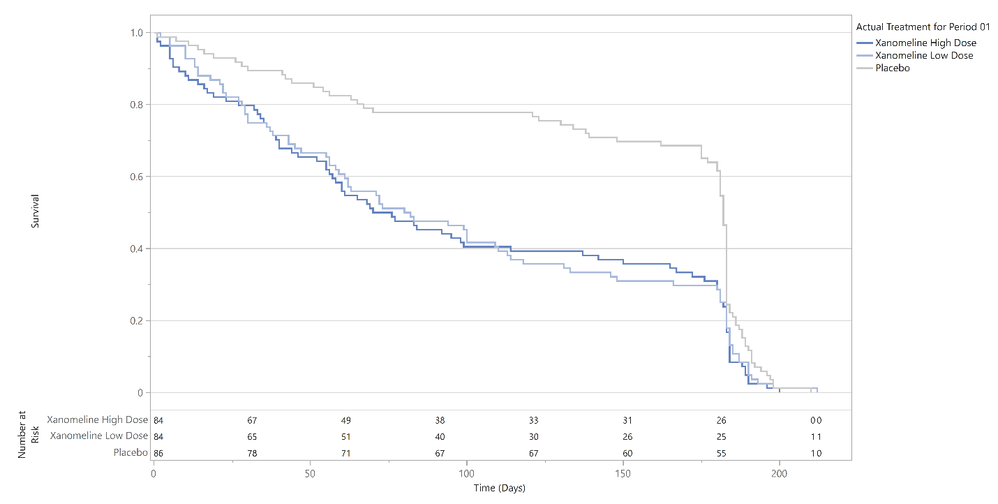
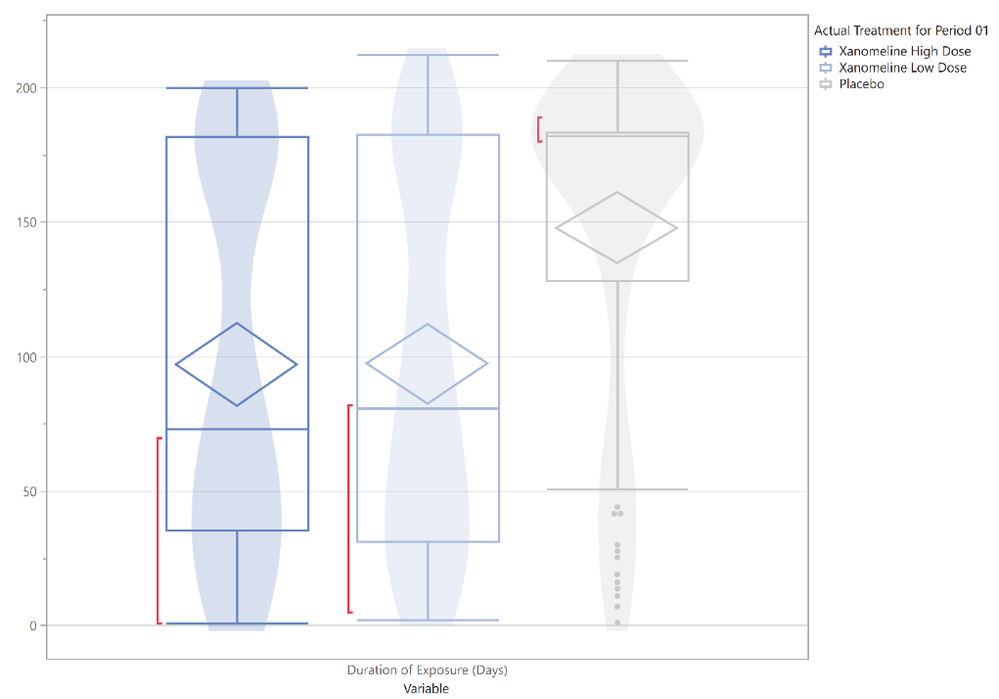
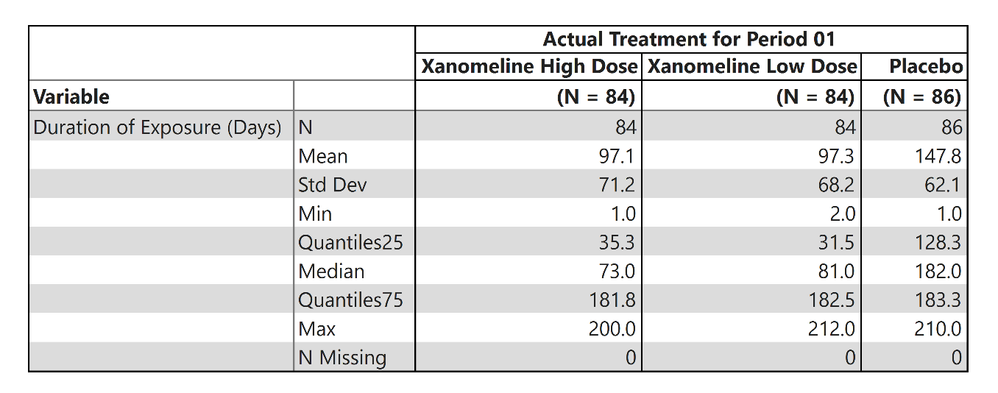
Figure 1 clearly communicates that placebo patients were more likely to complete their treatment compared to the active doses, suggesting a possible tolerability issue with the drug. Duration of exposure, as well as the other metrics listed above, can be further explored using box-violin plots to communicate key summary statistics and highlight potential outliers (Figure 2). The numeric details are summarized in a corresponding table (Figure 3).
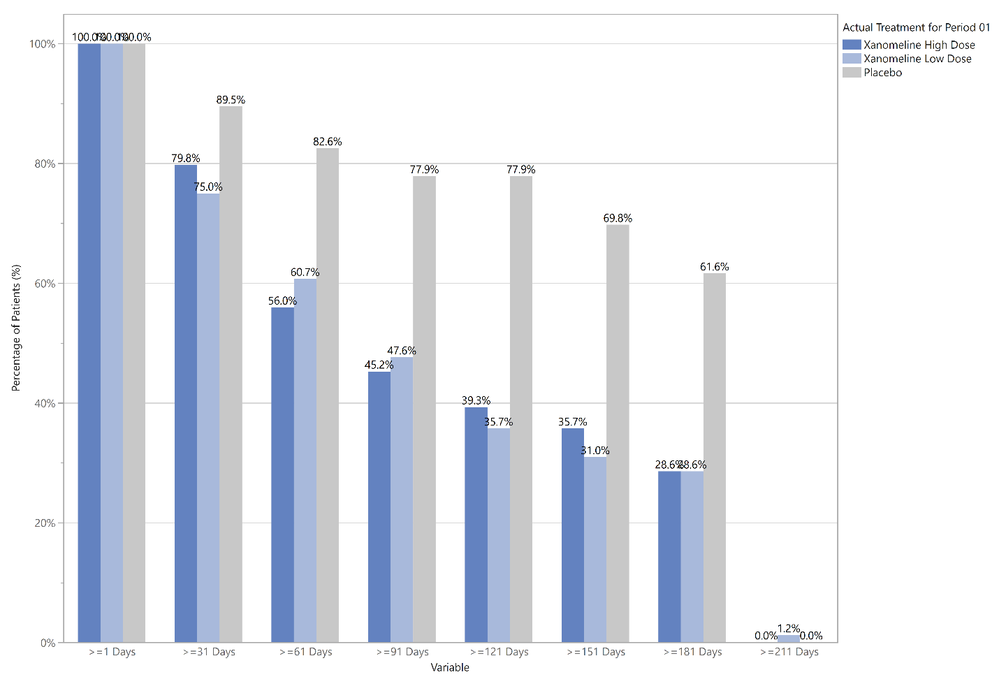
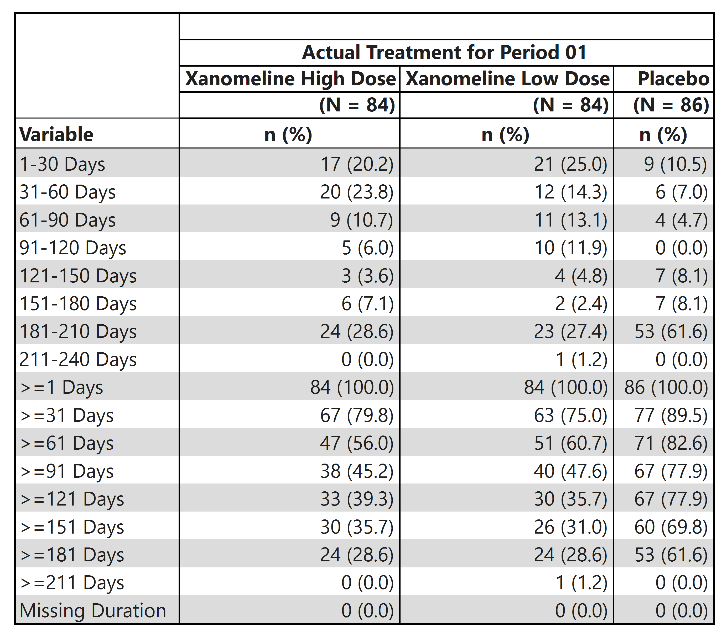
A display of the frequency and percentage of patients achieving exposure milestones according to user-defined individual and cumulative categories are provided in graphical (Figures 4) and tabular (Figure 5) displays.
Perhaps most importantly, a swimmer plot (Figure 6) provides insight into notable trends by treatment arm with the ability to gain more detailed insight into individual patients. Figure 6 communicates the patient treatment journey, sorting individual patients by the duration of their follow up. The plot clearly demonstrates that high dose patients began the study on low dose xanomeline (54 mg), switching to the high dose (81 mg) at approximately two weeks into the trial. For those high dose patients who remained in the study, they returned to the low dose at approximately 24 weeks to complete their final two weeks of treatment. What is notable is the variability present in these treatment changes, especially for the later treatment switch. This information can certainly be used to improve scheduling of these key visits in future trials to ensure that high dose patients achieve the ideal 22 weeks of dosing at 81 mg.
Figure 6. Swimmer plot of treatment exposure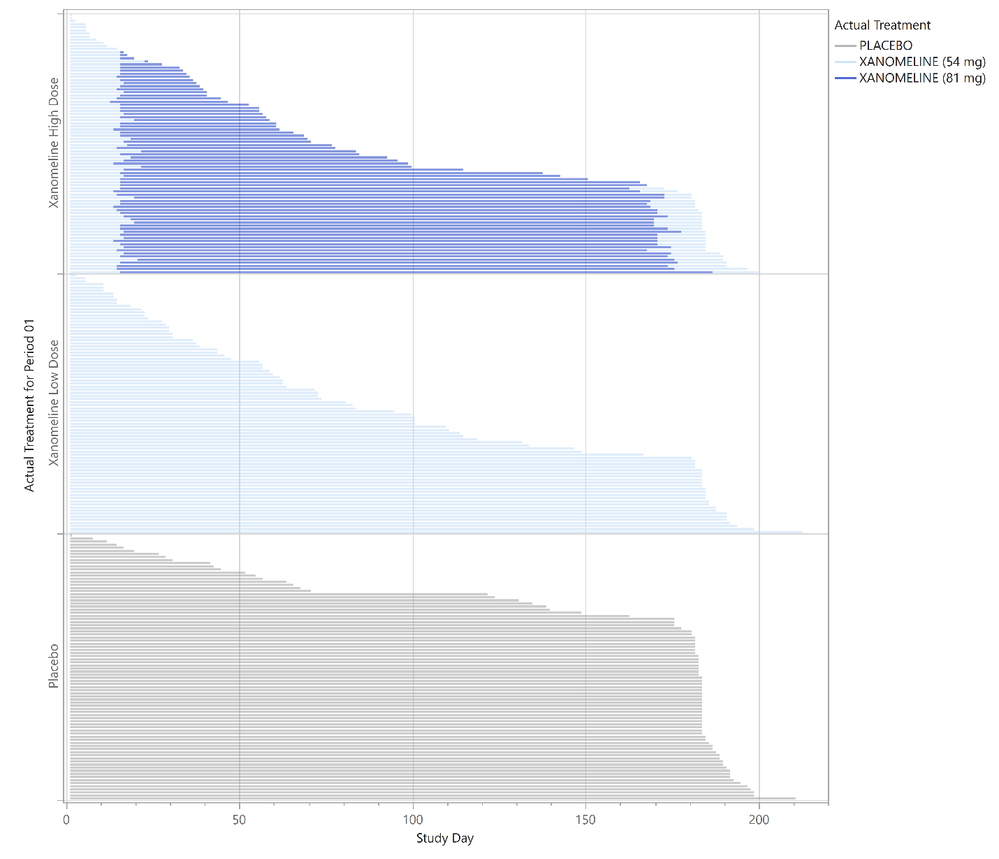
Fortunately for the CDISC Pilot study, though unfortunately for our discussion, there are no treatment gaps present in the data to highlight the annotated swimmer plot feature. For this example, we will have to switch briefly to the Nicardipine data which ships with JMP Clinical.
But let’s spend some time discussing what is meant by the term “treatment gap.” For daily treatments, a more familiar term for periods of time where the treatment is not taken is “treatment interruption.” The expectation is that the patient takes the drug every day, and on a day (or many days) where no drug is taken, this continuous use is “interrupted.” However, for treatments that are taken less frequently, say weekly or monthly, calling the gaps between successive doses “interruptions” is a bit misleading. Therefore, JMP Clinical uses the more general term “treatment gap,” In general,
- JMP Clinical determines the total amount of treatment taken on each and every day between the first and last dose of each treatment.
- Any day between the first and last dose where treatment is not taken is considered a “treatment gap.” The frequency and duration of these gaps are computed for each treatment, and the following summary statistics are computed:
- The frequency of treatment gaps.
- Minimum treatment gap duration, i.e., the shortest gap duration for each patient.
- Median treatment gap duration, i.e., the average gap duration for each patient.
- Maximum treatment gap duration, i.e., the maximum gap duration for each patient.
Plots (like Figure 2) and summary statistics (like Figure 3) are available for these variables.
Though gaps are visible in swimmer plots such as Figure 6, they become much more visible in the annotated swimmer plot view, which activates whenever the swimmer plot is filtered to 50 patients or fewer (Figure 7). Figure 7 summarizes the treatment exposure for the 14 Nicardipine and 4 Placebo patients who have at least one treatment gap (one patient on Placebo has two gaps). The maximum treatment gap for Nicardipine and Placebo, is seven and three days, respectively.
But what are the annotations? Figure 7 has markers that communicate changes in doses, which are useful in scenarios where the number of doses may vary substantially within a given treatment. In practice, the swimmer plot communicates at most three doses for up to three different treatments. If there are too many treatments (four or more) or too many doses, the ability to use color to effectively communicate treatment or dosing changes becomes too complex. In this trial, treatments were supplied intravenously, so delays in changing IV bags can impact the dose patients receive on any given day. Hovering over each symbol communicates this dose. To interpret the plot below more generally, these 18 patients had at least one treatment gap, and the doses changed each and every time a marker is present.

Future versions of JMP Clinical will allow for additional annotations so that users can better understand the implications treatment or dosing changes and their timing relative to:
- Adverse events.
- Hospitalizations.
- Protocol deviations.
- Study visits, to understand dosing issues relative to data for key primary and secondary efficacy endpoints.
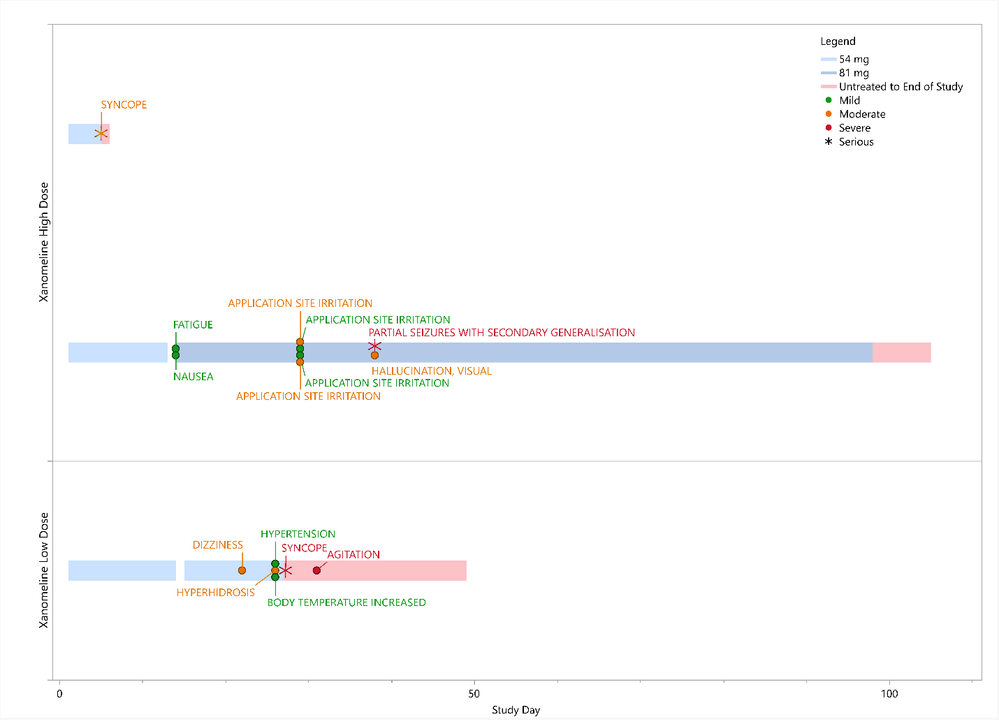
For example, Figure 8 shows a swimmer plot annotated with adverse event (AE) data for the three patients experiencing serious adverse events (SAEs) in the CDISC Pilot Study. For the first and third patient, treatment was ended at the time an SAE occurred, while the second patient experienced fatigue and nausea AEs when the high dose of xanomeline began around day 14.
One final important point. Note that the treatment gap definition does not consider the situation where patients end their treatment early prior to the completion of the treatment phase. This phenomenon is more common now that regulatory agencies want sponsors to keep patients in the study even if they discontinue study medications. Summarizing the time period a treatment is discontinued requires CDISC variables that communicate the start and end of study periods, which are often not provided (the start and end of treatments for each period are always provided). For example, Figure 9 reproduces Figure 6 with the addition of red lines to highlight the period of time patients remained in the clinical trial and did not take drug. This red line is a separate phenomenon than the “treatment gap,” which is defined between the first and last doses. Getting regular access to period start and stop dates (ADSL.APxxSDT/M and ADSL.APxxEDT/M) will make it possible to define this discontinuation period more easily. As Figure 9 shows, many patients may continue to participate in the clinical trial without taking any treatment.
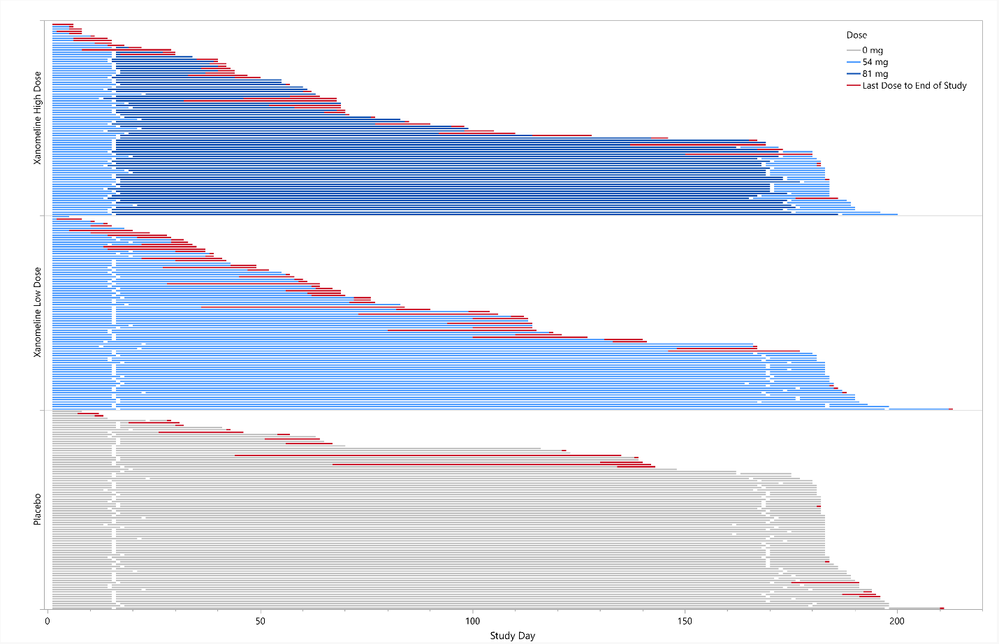
What are the white gaps in Figure 9? This was an early attempt of producing a swimmer plot for JMP Clinical. It illustrates how separate dosing records can create the appearance of treatment gaps, even when treatment is taken every day and the dose does not change. Though these gaps can be informative for showing the variability in kit switches for all treatment arms (where are still discernable in Figure 6 for the high dose arm due to the change in actual dose), JMP Clinical currently removes these artifacts so that they are not confused with true gaps in treatment.
- © 2026 JMP Statistical Discovery LLC. All Rights Reserved.
- Terms of Use
- Privacy Statement
- Contact Us
You must be a registered user to add a comment. If you've already registered, sign in. Otherwise, register and sign in.