- Don’t miss your chance to experience Discovery Summit Europe at our best available rate! Early bird registration through 31 Oct.
- Graph Builder Toolbar streamlines interactive graphing. Creates shortcuts on Report and GraphBuilder Helpers toolbars. Download and install the extension.
JMPer Cable Blog
A technical blog for JMP users of all levels, full of how-to's, tips and tricks, and detailed information on JMP features- User Community
- :
- JMPer Cable Blog
- :
- Teaching responsibly with AI: Risks, guardrails, and what I’ve learned the hard ...
- Subscribe to RSS Feed
- Mark as New
- Mark as Read
- Bookmark
- Subscribe
- Printer Friendly Page
- Report Inappropriate Content


Let me start with a small but telling story.
A student once showed me a beautifully formatted regression analysis – clean output, correct p-values, everything looked perfect. There was just one problem: they had completely misinterpreted the result. When I asked how they reached their conclusion, the answer was simple: “The AI said so.”
That moment stuck with me. Not because the AI was wrong (it wasn’t) but because the thinking had stopped before it even began. The reasoning had been outsourced before the student had formed a single hypothesis.
And that, in a nutshell, is the real risk of AI in data analysis education.
The problem isn’t the tool, it’s the workflow
When we talk about AI risks in education, the conversation often lands on academic integrity, such as plagiarism and automated assignments. Those are real concerns. But for statistics educators, the deeper problem is cognitive: what happens to a student’s reasoning when a tool can generate the analysis, narrate the output, and suggest the conclusion, all before the student has formed a question?
In his 2025 TED Talk on AI and critical thinking, Advait Sarkar [3] calls this becoming “middle managers of our own thoughts,” approving AI outputs rather than generating ideas. That framing resonates every time I see a student submit a report in fluent prose they cannot paraphrase in their own words. The words are there. The understanding is not.
This is what I call the illusion of competence: AI enables students to produce convincing analyses and narratives without the underlying understanding that would allow them to detect errors. The output looks right. The thinking behind it may not exist at all.
Three patterns I keep seeing
- Confidence without verification.
AI tools tend to answer with authority, even when uncertain. A student asks about their ANOVA assumptions and gets a plausible-sounding response. Nobody checks the residual plots. In a traditional lab, an instructor would have said: “Good, but show me the diagnostics.” That friction was pedagogically valuable. We should not engineer it away.
The plot below illustrates exactly this. A simple linear regression on the penguin data set (but ignores the species), might look acceptable at first glance. But the residual plot tells a different story.
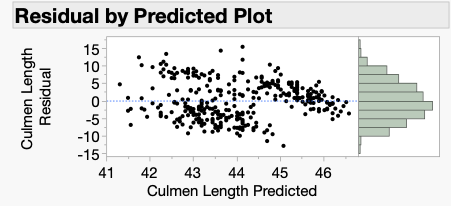
What gets lost without checking: healthy scepticism.
- Fluent reports, fragile understanding.
AI-generated explanations can sound polished and professional. But ask a student to explain their results in their own words, and the gaps appear. I have started asking students to explain their AI-assisted text back to me verbally. The difference between what they submitted and what they can articulate is sometimes striking.
What gets lost: true comprehension.
- Skipping the messy middle.
Why struggle with model setup if AI can jump straight to interpretation? But that struggle is where key insights live: spotting data imbalance, noticing a flawed variable definition, catching an assumption violation before it propagates through the analysis.
What gets lost: learning through doing.
|
“If an assignment can be completed without understanding, it was never really testing understanding.” |
A better approach: design, don’t restrict
Avoiding AI is not the answer. Thoughtful integration is. Here are four strategies that actually work in practice:
- Introduce AI at the right moment.
Let students explore data, build models, and form hypotheses before using AI tools. That way, AI becomes a sparring partner for their thinking, not a replacement for it. The sequence matters: form a view first, then test it against what the tool produces.
- Ask questions AI can’t answer.
Instead of “interpret this model,” ask:
- What surprised you in the data?
- What would you do differently next time?
- Why does this matter for the decision at hand?
These questions require personal reasoning, not generated text.
- Turn AI mistakes into teaching moments.
AI gets things wrong, so use that. Show students a flawed AI suggestion and ask: “Would you trust this? How would you check?” When students learn to spot AI errors, they are developing exactly the critical evaluation skills that transfer to every other analytical context. AI becomes a critical thinking engine, not a shortcut.
- Be transparent about expectations.
Students generally accept clear guidelines. Using AI to learn is fine. Using AI to replace thinking is not. The distinction matters, and it works when stated explicitly, early, and consistently. Neil Selwyn [4] reminds us that AI in education is a choice, not an inevitability. The instructor still designs the learning environment.
What the JMP tools themselves do
The AI tools in JMP Student Edition have guardrails built in. Every LearnBot and Assistant session carries an explicit reminder: “AI-generated content: evaluate accuracy and suitability before use.” Used as a teaching prompt, it models exactly the critical stance we want students to develop.
As JMP’s Russ Wolfinger has put it [6]: AI augments, it does not replace. The tools are designed with that principle in mind. Whether they are used that way in the classroom depends on the instructor.
The bigger picture
Neil Selwyn [4][5], whose work on the structural limits of AI in education deserves more attention than it usually gets, argues that AI in the classroom is a choice, not an inevitability. The question is not whether to use it, but who benefits from each specific use – and whether the core skills of statistical reasoning are being developed or quietly replaced.
Good data analysis is not about getting answers quickly. It is about dealing with uncertainty, questioning results, defending decisions, and sometimes saying: “I don’t fully understand this yet.” Those are exactly the skills most at risk when AI handles everything before the student has had a chance to think.
Episode 5 looks ahead: what does the future of data literacy education look like, and what role do tools like JMP play in it?
Try this
Take an assignment your students currently complete with AI assistance. Add one question that AI cannot answer for them: What assumption in this analysis worries you most, and why? Then bring those answers to class. The concerns that students flag – and the ones they miss – will tell you more about their understanding than the analysis itself.
References
[1] JMP Academic Program, jmp.com/academic
[2] JMP Student Edition, jmp.com/student
[3] Advait Sarkar: “How to stop AI from killing your critical thinking”, TED Talk, 2025
[4] Neil Selwyn: Should Robots Replace Teachers?, Polity Press, 2019
[5] Neil Selwyn: On the limits of artificial intelligence in education, 2024
[6] Russ Wolfinger: The Top Seven Ways Scientists and Engineers Should Prepare for the AI-Driven Era, JMP white paper
[7] GAISE College Report revision (in progress, 2025)
About the Author
Volker Kraft is Principal Academic Ambassador (EMEA) at JMP Statistical Discovery (a SAS company), part of the JMP Global Academic Team. Since 2011, he has supported universities across Europe in integrating JMP into teaching and research. His background is in speech technology research, a field where statistical rigor and engineering pragmatism had to coexist long before AI became a household word. He can be reached via the JMP Community or on LinkedIn.
Episode 4 of 5 • Next: What’s next — the future of data literacy education
- © 2026 JMP Statistical Discovery LLC. All Rights Reserved.
- Terms of Use
- Privacy Statement
- Contact Us
You must be a registered user to add a comment. If you've already registered, sign in. Otherwise, register and sign in.