- Don’t miss your chance to experience Discovery Summit Europe at our best available rate! Early bird registration through 31 Oct.
- Image to Table JMP extension imports single or batch images as data tables. Useful to extract curves from pictures or convert image data to curve data to use in analyses like Functional Data Explorer. Download and install the extension.
- RSS フィードを購読する
- トピックを新着としてマーク
- トピックを既読としてマーク
- このトピックを現在のユーザーにフロートします
- ブックマーク
- 購読
- ミュート
- 印刷用ページ
Discussions
Solve problems, and share tips and tricks with other JMP users.- User Community
- :
- Discussions
- :
- Re: how to convert p value of <.0001 to actual number

- 新着としてマーク
- ブックマーク
- 購読
- ミュート
- RSS フィードを購読する
- ダイレクトリンクを取得
- 印刷
- 不適切なコンテンツを報告
how to convert p value of <.0001 to actual number
Is it possible to get an actual number for pvalues instead of "<.0001"?
受理された解決策


- 新着としてマーク
- ブックマーク
- 購読
- ミュート
- RSS フィードを購読する
- ダイレクトリンクを取得
- 印刷
- 不適切なコンテンツを報告
Re: how to convert p value of <.0001 to actual number
In report table boxes, double-click on a p-value (or any number col box) to bring up the number format window. Change the setting from "PValue" to "Best".


- 新着としてマーク
- ブックマーク
- 購読
- ミュート
- RSS フィードを購読する
- ダイレクトリンクを取得
- 印刷
- 不適切なコンテンツを報告
Re: how to convert p value of <.0001 to actual number
The reason why you see 0e+0 is most likely that the number of leading zeros after the decimal is higher than what you asked to display. Then JMP or any other software can only represent what is given by the calculations which is 0 then.
However, you should be aware of floating point arithmetic and what it is capable of calculating.1e-17 usually is the point where a floating point number cannot differentiate from 0, which means every non-zero value smaller than 1e-17 will be interpreted in calcualtions as zeros. That's (within others) for what symbolic math is good for, because you use symbolic values to deal with that, and the maths behind will calculate further on with mathematical rules rather than actual numeric calculations. Just a side note
- 新着としてマーク
- ブックマーク
- 購読
- ミュート
- RSS フィードを購読する
- ダイレクトリンクを取得
- 印刷
- 不適切なコンテンツを報告
Re: how to convert p value of <.0001 to actual number
In report table boxes, double-click on a p-value (or any number col box) to bring up the number format window. Change the setting from "PValue" to "Best".
- 新着としてマーク
- ブックマーク
- 購読
- ミュート
- RSS フィードを購読する
- ダイレクトリンクを取得
- 印刷
- 不適切なコンテンツを報告
Re: how to convert p value of <.0001 to actual number
Thanks but I have already tried that and the "<.0001" values just get converted to "0".

- 新着としてマーク
- ブックマーク
- 購読
- ミュート
- RSS フィードを購読する
- ダイレクトリンクを取得
- 印刷
- 不適切なコンテンツを報告
Re: how to convert p value of <.0001 to actual number
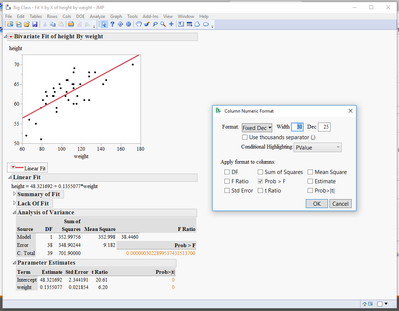
try changing it to fixed Dec as follows:
- 新着としてマーク
- ブックマーク
- 購読
- ミュート
- RSS フィードを購読する
- ダイレクトリンクを取得
- 印刷
- 不適切なコンテンツを報告
Re: how to convert p value of <.0001 to actual number
Thanks but I also tried that, even maxing out the width and decimal places and still converts is to simply "0" or "0.00000..........".
- 新着としてマーク
- ブックマーク
- 購読
- ミュート
- RSS フィードを購読する
- ダイレクトリンクを取得
- 印刷
- 不適切なコンテンツを報告
Re: how to convert p value of <.0001 to actual number
Try to edit the width of the number. But maybe there is a limit for how small numbers JMP will show.
Here's a really small p-value from an ANOVA (I use JMP 12.2).
Prob > F |
4,3e-179 |
- 新着としてマーク
- ブックマーク
- 購読
- ミュート
- RSS フィードを購読する
- ダイレクトリンクを取得
- 印刷
- 不適切なコンテンツを報告
Re: how to convert p value of <.0001 to actual number
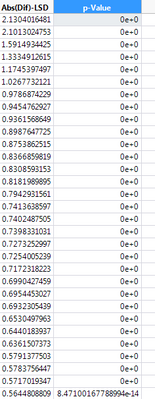
Thanks again, I tried that as well and it still just converts it to "0". Actually the p value you got is exactly what I want as well. Not sure why I cannot convert it like you. I also am using JMP12.2.
Example:
- 新着としてマーク
- ブックマーク
- 購読
- ミュート
- RSS フィードを購読する
- ダイレクトリンクを取得
- 印刷
- 不適切なコンテンツを報告
Re: how to convert p value of <.0001 to actual number
Hi,
Have you tried to use scientific format rather than fixed Dec?
- 新着としてマーク
- ブックマーク
- 購読
- ミュート
- RSS フィードを購読する
- ダイレクトリンクを取得
- 印刷
- 不適切なコンテンツを報告
Re: how to convert p value of <.0001 to actual number
Yes, I have tried all the different formats and different widths and decimal places. It all just converts to "0".
Thanks though.
- 新着としてマーク
- ブックマーク
- 購読
- ミュート
- RSS フィードを購読する
- ダイレクトリンクを取得
- 印刷
- 不適切なコンテンツを報告
Re: how to convert p value of <.0001 to actual number
The reason why you see 0e+0 is most likely that the number of leading zeros after the decimal is higher than what you asked to display. Then JMP or any other software can only represent what is given by the calculations which is 0 then.
However, you should be aware of floating point arithmetic and what it is capable of calculating.1e-17 usually is the point where a floating point number cannot differentiate from 0, which means every non-zero value smaller than 1e-17 will be interpreted in calcualtions as zeros. That's (within others) for what symbolic math is good for, because you use symbolic values to deal with that, and the maths behind will calculate further on with mathematical rules rather than actual numeric calculations. Just a side note
おすすめの記事
- © 2026 JMP Statistical Discovery LLC. All Rights Reserved.
- 利用規約
- 個人情報の取り扱いについて
- お問い合わせ