cancel
Showing results for 
Show  only  | Search instead for 
Did you mean: 

Discussions

Solve problems, and share tips and tricks with other JMP users.
%3CLINGO-SUB%20id%3D%22lingo-sub-312503%22%20slang%3D%22en-US%22%20mode%3D%22NONE%22%3ETest%20class%C3%A9%20Wilcoxon%20Sign%20-%20JMP%20OUT%20PUT%3C%2FLINGO-SUB%3E%3CLINGO-BODY%20id%3D%22lingo-body-312503%22%20slang%3D%22en-US%22%20mode%3D%22NONE%22%3E%3CP%3ESalut%2C%3C%2FP%3E%3CP%3E%26nbsp%3B%3C%2FP%3E%3CP%3EDonc%20je%20fais%20le%20test%20Wilcoxon%20Sign%20Class%C3%A9%20et%20je%20ne%20comprends%20pas%20ce%20que%20fait%20JMP%20l%C3%A0%20o%C3%B9%20il%20est%20dit%20statistique%20de%20test.%20Je%20comprends%20qu'il%20utilise%20la%20%22m%C3%A9thode%20Pratt%22%20et%20c'est%20la%20formule%3C%2FP%3E%3CP%3ES%20%3D%20R%20%2B%20-%201%2F4%20%5B(N%20(N%20%2B%201)%20-do%20(faire%20%2B%201)%5D%3C%2FP%3E%3CP%3Emais%20pourriez-vous%20d%C3%A9velopper%20un%20peu%20plus%20ce%20sujet%20car%20je%20n'obtiens%20pas%20la%20m%C3%AAme%20chose%20que%20ce%20que%20JMP%20obtient.%3C%2FP%3E%3CP%3E%26nbsp%3B%3C%2FP%3E%3CP%3Eo%C3%B9%20mes%20valeurs%20sont%3A%3C%2FP%3E%3CP%3ER%20%2B%20vaut%201527%2C%3C%2FP%3E%3CP%3Emon%20%C3%A9chantillon%20a%2076%20paires%2C%3C%2FP%3E%3CP%3Eet%2011%200.%3C%2FP%3E%3CP%3E%26nbsp%3B%3C%2FP%3E%3CP%3EJ'essaie%20de%20brancher%20mes%20valeurs%20dans%20cette%20formule%20et%20j'obtiens%20mais%20JMP%20renvoie%20581%20pour%20S.%20S'il%20vous%20pla%C3%AEt%2C%20aidez-moi%2C%20je%20deviens%20fou.%3C%2FP%3E%3CP%3E%26nbsp%3B%3C%2FP%3E%3CP%3ES%20%3D%20581%20ne%20correspond%20pas%20%C3%A0%201527-1%20%2F%204%20%5B76%20(76%20%2B%201)%20-11%20(11%20%2B%201)%5D%3C%2FP%3E%3CP%3E%26nbsp%3B%3C%2FP%3E%3CP%3E%26nbsp%3B%3C%2FP%3E%3CP%3EMERCI!!!!!!!!!!!!!!%3C%2FP%3E%3CP%3E%26nbsp%3B%3C%2FP%3E%3CP%3EJe%20devrais%20mentionner%20que%20lors%20de%20l'ajout%20de%20ceux-ci%20dans%20le%20test%20de%20paires%20appari%C3%A9es%20sous%20analys%C3%A9%2C%20je%20mets%20d'abord%20la%20hauteur%20de%20papa%2C%20puis%20la%20hauteur%20(ce%20qui%20est%20le%20contraire%20de%20la%20fa%C3%A7on%20dont%20je%20veux%20qu'il%20soit%20lu).%20Donn%C3%A9es%20jointes%3C%2FP%3E%3CP%3E%26nbsp%3B%3C%2FP%3E%3CP%3ERachel%3C%2FP%3E%3CP%3E%26nbsp%3B%3C%2FP%3E%3CP%3E%3CA%20href%3D%22https%3A%2F%2Fcommunity.jmp.com%2Ft5%2Fuser%2Fviewprofilepage%2Fuser-id%2F5358%22%20target%3D%22_blank%22%3E%40markbailey%3C%2FA%3E%3C%2FP%3E%3C%2FLINGO-BODY%3E%3CLINGO-LABS%20id%3D%22lingo-labs-312503%22%20slang%3D%22en-US%22%20mode%3D%22NONE%22%3E%3CLINGO-LABEL%3EAnalytique%3C%2FLINGO-LABEL%3E%3CLINGO-LABEL%3EAutre%3C%2FLINGO-LABEL%3E%3C%2FLINGO-LABS%3E%3CLINGO-SUB%20id%3D%22lingo-sub-312642%22%20slang%3D%22en-US%22%20mode%3D%22NONE%22%3ERe%3A%20Test%20class%C3%A9%20de%20Wilcoxon%20Sign%20-%20JMP%20OUT%20PUT%3C%2FLINGO-SUB%3E%3CLINGO-BODY%20id%3D%22lingo-body-312642%22%20slang%3D%22en-US%22%20mode%3D%22NONE%22%3E%3CP%3EJ'ai%20fait%20les%20calculs%20dans%20une%20table%20JMP.%3C%2FP%3E%0A%3CP%3E%26nbsp%3B%3C%2FP%3E%0A%3CP%3EEn%20suivant%20les%20%C3%A9tapes%20de%20calcul%20dans%20la%20documentation%20en%20ligne%3A%3C%2FP%3E%0A%3CP%3E%3CA%20href%3D%22https%3A%2F%2Fwww.jmp.com%2Fsupport%2Fhelp%2Fen%2F15.2%2Findex.shtml%23page%2Fjmp%2Fwilcoxon-signed-rank-test.shtml%22%20target%3D%22_blank%22%20rel%3D%22noopener%20noreferrer%22%3Ehttps%3A%2F%2Fwww.jmp.com%2Fsupport%2Fhelp%2Fen%2F15.2%2Findex.shtml%23page%2Fjmp%2Fwilcoxon-signed-rank-test.shtml%3C%2FA%3E%3C%2FP%3E%0A%3CP%3E%26nbsp%3B%3C%2FP%3E%0A%3CP%3EJ'obtiens%20S%20%3D%20581%20(identique%20%C3%A0%20JMP)%3C%2FP%3E%0A%3CP%3E%26nbsp%3B%3C%2FP%3E%0A%3CP%3EEt%20pour%20R%20%2B%20j'obtiens%20849%3B%20branchez%20cela%20dans%20la%20formule%20R%20%2B%20en%20utilisant%20d0%20%3D%2011%2C%20vous%20arrivez%20%C3%A9galement%20%C3%A0%20581.%3C%2FP%3E%0A%3CP%3E%26nbsp%3B%3C%2FP%3E%0A%3CP%3E%26nbsp%3B%3C%2FP%3E%3C%2FLINGO-BODY%3E%3CLINGO-SUB%20id%3D%22lingo-sub-312707%22%20slang%3D%22en-US%22%20mode%3D%22NONE%22%3ERe%3A%20Test%20class%C3%A9%20de%20Wilcoxon%20Sign%20-%20JMP%20OUT%20PUT%3C%2FLINGO-SUB%3E%3CLINGO-BODY%20id%3D%22lingo-body-312707%22%20slang%3D%22en-US%22%20mode%3D%22NONE%22%3E%3CP%3E%3CA%20href%3D%22https%3A%2F%2Fcommunity.jmp.com%2Ft5%2Fuser%2Fviewprofilepage%2Fuser-id%2F4536%22%20target%3D%22_blank%22%3E%40David_Burnham%3C%2FA%3E%20wow%20merci%20beaucoup%20d'avoir%20mis%20cela%20ensemble%20pour%20moi%20et%20de%20me%20montrer%20!.%20J'appr%C3%A9cie%20grandement%20cela%20!!%3C%2FP%3E%3CP%3E%26nbsp%3B%3C%2FP%3E%3CP%3EJ'ai%20enfin%20vu%20o%C3%B9%20je%20me%20trompais%2C%20mon%20erreur%20%C3%A9tait%20avec%20R%20%2B!%3C%2FP%3E%3CP%3E%26nbsp%3B%3C%2FP%3E%3CP%3ECurieux%20de%20savoir%20si%20vous%20pouviez%20r%C3%A9pondre%20%C3%A0%20une%20autre%20question%20pour%20moi%3F%3C%2FP%3E%3CP%3E%26nbsp%3B%3C%2FP%3E%3CP%3EPouvez-vous%20m'expliquer%20quelle%20est%20la%20partie%20surlign%C3%A9e%20de%20la%20formule%20de%20la%20variance%3F%20Je%20ne%20peux%20pas%20comprendre%20le%20terme%20di.%3C%2FP%3E%3CP%3E%26nbsp%3B%3C%2FP%3E%3CP%3EMerci%2C%3C%2FP%3E%3CP%3E%26nbsp%3B%3C%2FP%3E%3CP%3ERachel%3C%2FP%3E%3CP%3E%26nbsp%3B%3C%2FP%3E%3C%2FLINGO-BODY%3E
Choose Language Hide Translation Bar
rlw268
Level III

Wilcoxon Sign Ranked Test - JMP OUT PUT

 Hi, 


So I am doing Wilcoxon Sign Ranked test and I am not understanding what JMP is doing for where it says test statistic. I understand its using the "Pratt method" and this is the formula 

S = R+ - 1/4[(N(N+1)-do(do+1)]

but could you expand on this a little further as I am not getting the same thing as what JMP is gettting.


where my values are :

R+ is 1527,

my sample has 76 pairs,

and 11 0's.


I try plugging my values into that formula and I get is but JMP is returning 581 for S. Please help me I am going nuts. 


S = 581 does not = 1527-1/4[76(76+1)-11(11+1)]


THANK YOU!!!!!!!!!!!!!!


I should mention when adding these in the matched pair test under analyzed I am putting dad height first then height (which is the opposite of how I want it to read out). Data attached


Rachel


@Mark_Bailey 

1 ACCEPTED SOLUTION

Accepted Solutions
David_Burnham
Super User (Alumni)

Re: Wilcoxon Sign Ranked Test - JMP OUT PUT

I've done the calculations in a JMP table (attached).


Following the calculation steps in the online documentation:

https://www.jmp.com/support/help/en/15.2/index.shtml#page/jmp/wilcoxon-signed-rank-test.shtml


I get S = -581 (same as JMP)


And for R+ I get 849; plug that into the R+ formula using d0=11, you also arrive at -581.


-Dave

View solution in original post

3 REPLIES 3
David_Burnham
Super User (Alumni)

Re: Wilcoxon Sign Ranked Test - JMP OUT PUT

I've done the calculations in a JMP table (attached).


Following the calculation steps in the online documentation:

https://www.jmp.com/support/help/en/15.2/index.shtml#page/jmp/wilcoxon-signed-rank-test.shtml


I get S = -581 (same as JMP)


And for R+ I get 849; plug that into the R+ formula using d0=11, you also arrive at -581.


-Dave
rlw268
Level III

Re: Wilcoxon Sign Ranked Test - JMP OUT PUT

@David_Burnham wow thank you so much for putting that together for me and showing me!. I greatly appreciate this!! 


I finally saw where I was going wrong, my error was with R+!


Curious if you could answer another question for me?


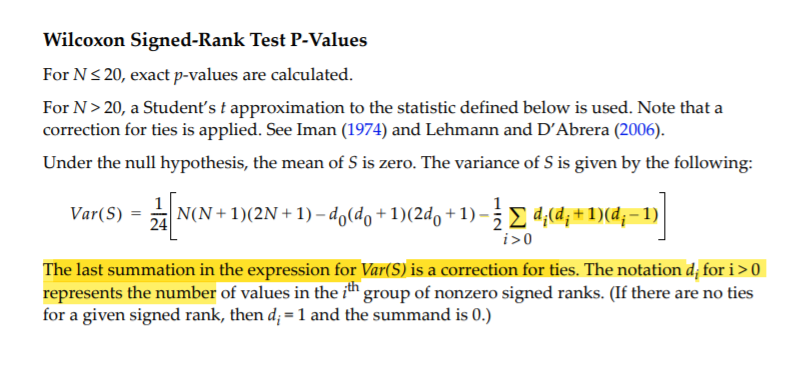
Can you explain to me what the highlighted part of the the variance formula is? I can not wrap my head around the term di.


Thank you,


Rachel
 

David_Burnham
Super User (Alumni)

Re: Wilcoxon Sign Ranked Test - JMP OUT PUT

The principle is that the presence of ties will have the effect of reducing the variance, so an adjustment is required by an amount that is a function of the proportions of the observations that are tied at each tie point. However, I'm not familiar with the details of the calculation or the theoretical basis of it.

-Dave

Recommended Articles