cancel
Showing results for 
Show  only  | Search instead for 
Did you mean: 
  • JMP will suspend normal business operations for our Winter Holiday beginning on Wednesday, Dec. 24, 2025, at 5:00 p.m. ET (2:00 p.m. ET for JMP Accounts Receivable).
    Regular business hours will resume at 9:00 a.m. EST on Friday, Jan. 2, 2026.
  • We’re retiring the File Exchange at the end of this year. The JMP Marketplace is now your destination for add-ins and extensions.

Discussions

Solve problems, and share tips and tricks with other JMP users.
%3CLINGO-SUB%20id%3D%22lingo-sub-431806%22%20slang%3D%22en-US%22%20mode%3D%22UPDATE%22%3EUnderstanding%20the%20meaning%20of%20a%20lift%20curve%3C%2FLINGO-SUB%3E%3CLINGO-BODY%20id%3D%22lingo-body-431806%22%20slang%3D%22en-US%22%20mode%3D%22UPDATE%22%3E%3CP%3EI'm%20trying%20to%20understand%20the%20meaning%20of%20a%20lift%20curve.%20If%20it%20starts%20very%20high%20(%26gt%3B4)%20but%20drops%20to%200%20after%20.1%20does%20that%20mean%20there%20is%20no%20predictive%20power%20for%2090%25%20of%20the%20population%3F%3C%2FP%3E%3C%2FLINGO-BODY%3E%3CLINGO-LABS%20id%3D%22lingo-labs-431806%22%20slang%3D%22en-US%22%20mode%3D%22UPDATE%22%3E%3CLINGO-LABEL%3EAdvanced%20Statistical%20Modeling%3C%2FLINGO-LABEL%3E%3CLINGO-LABEL%3EData%20Exploration%20and%20Visualization%3C%2FLINGO-LABEL%3E%3CLINGO-LABEL%3EDesign%20of%20Experiments%3C%2FLINGO-LABEL%3E%3C%2FLINGO-LABS%3E%3CLINGO-SUB%20id%3D%22lingo-sub-432006%22%20slang%3D%22en-US%22%20mode%3D%22NONE%22%3ERe%3A%20Understanding%20the%20meaning%20of%20a%20lift%20curve%3C%2FLINGO-SUB%3E%3CLINGO-BODY%20id%3D%22lingo-body-432006%22%20slang%3D%22en-US%22%20mode%3D%22NONE%22%3E%3CP%3EThanks%20for%20the%20clarification.%26nbsp%3B%20It%20makes%20me%20wonder%20about%20something%3A%26nbsp%3B%20if%20you%20were%20to%20take%2C%20say%2C%20a%20point%20near%20the%20top%20of%20the%20lift%20curve%2C%20e.g.%2C%20at%20.1%20on%20the%20x%20axis%2C%20then%20the%20y%20axis%20is%20the%20multiplier%20(factor)%20that%20relates%20that%20to%20the%20true%20predictions.%26nbsp%3B%20Let's%20say%20the%20lift%20is%204.0%20at%20an%20x%20value%20of%2010%25.%26nbsp%3B%20Then%2C%20if%20we%20were%20to%20draw%20a%20curve%20xy%3D40%25%20into%20the%20graph%2C%20that%20would%20represent%20no%20additional%20lift%20beyond%20what%20the%20top%2010%25%20of%20the%20probabilities%20predicted.%26nbsp%3B%20For%20example%2C%20when%20x%3D20%25%2C%20the%20xy%3D40%25%20would%20show%20a%20lift%20of%202.0%20at%20x%3D20%25.%26nbsp%3B%20To%20the%20extent%20that%20the%20lift%20curve%20at%20x%3D20%25%20lies%20above%20a%20y%20value%20of%202.0%2C%20then%20the%20model%20is%20adding%20predictive%20value%20beyond%20the%20highest%2010%25%20of%20the%20probabilities.%26nbsp%3B%20It%20seems%20to%20me%20that%20the%20area%20between%20the%20xy%3Dconstant%20curve%20and%20the%20lift%20curve%20provides%20some%20sort%20of%20measure%20of%20the%20lift%20over%20the%20range%20of%20x%20values%20(though%20it%20occurs%20to%20me%20that%20at%20x%3D100%25%2C%20this%20xy%3Dconstant%20curve%20would%20go%20below%201.0%20(0.4%20in%20my%20example).%26nbsp%3B%20I%20would%20think%20there%20is%20some%20way%20to%20manipulate%20these%20areas%20into%20a%20type%20of%20measure%2C%20akin%20to%20the%20AUC.%26nbsp%3B%20Just%20wondering%20-%20do%20you%20know%20of%20anything%20along%20these%20lines%3F%3C%2FP%3E%3C%2FLINGO-BODY%3E%3CLINGO-SUB%20id%3D%22lingo-sub-432000%22%20slang%3D%22en-US%22%20mode%3D%22NONE%22%3ERe%3A%20Understanding%20the%20meaning%20of%20a%20lift%20curve%3C%2FLINGO-SUB%3E%3CLINGO-BODY%20id%3D%22lingo-body-432000%22%20slang%3D%22en-US%22%20mode%3D%22NONE%22%3E%3CP%3ETo%20clarify%26nbsp%3B%3CA%20href%3D%22https%3A%2F%2Fcommunity.jmp.com%2Ft5%2Fuser%2Fviewprofilepage%2Fuser-id%2F1701%22%20target%3D%22_blank%22%3E%40dale_lehman%3C%2FA%3E's%20example%2C%20lift%20is%20a%20factor.%20Lift%20equal%20to%204%20means%20that%204%20times%20as%20many%20targets%20were%20conditionally%20predicted%20by%20the%20model%20than%20would%20be%20predicted%20by%20the%20marginal%20probability.%20See%20this%20slide%20from%20our%20copyrighted%20JMP%20training%20materials%20provides%20an%20example%3A%3C%2FP%3E%0A%3CP%3E%26nbsp%3B%3C%2FP%3E%0A%3CP%3E%3CSPAN%20class%3D%22lia-inline-image-display-wrapper%20lia-image-align-inline%22%20image-alt%3D%22lift.PNG%22%20style%3D%22width%3A%20999px%3B%22%3E%3CSPAN%20class%3D%22lia-inline-image-display-wrapper%22%20image-alt%3D%22lift.PNG%22%20style%3D%22width%3A%20999px%3B%22%3E%3CSPAN%20class%3D%22lia-inline-image-display-wrapper%22%20image-alt%3D%22lift.PNG%22%20style%3D%22width%3A%20999px%3B%22%3E%3Cspan%20class%3D%22lia-inline-image-display-wrapper%22%20image-alt%3D%22lift.PNG%22%20style%3D%22width%3A%20999px%3B%22%3E%3Cimg%20src%3D%22https%3A%2F%2Fcommunity.jmp.com%2Ft5%2Fimage%2Fserverpage%2Fimage-id%2F37184iA701286212661954%2Fimage-size%2Flarge%3Fv%3Dv2%26amp%3Bpx%3D999%22%20role%3D%22button%22%20title%3D%22lift.PNG%22%20alt%3D%22lift.PNG%22%20%2F%3E%3C%2Fspan%3E%3C%2FSPAN%3E%3C%2FSPAN%3E%3C%2FSPAN%3E%3C%2FP%3E%0A%3CP%3EThe%20reduce%20model%20is%20the%20marginal%20probability%2C%200.1%20in%20this%20case.%20The%20full%20model%20is%20conditioned%20on%20the%20predictors%20or%20factors.%3C%2FP%3E%0A%3CP%3EYes%2C%20it%20only%20drops%20to%201%20because%20it%20is%20a%20factor%2C%20comparing%20the%20true%20predicted%20targets%20to%20the%20marginal%20targets.%3C%2FP%3E%0A%3CP%3E%26nbsp%3B%3C%2FP%3E%0A%3CP%3EAlso%2C%20the%20domain%20is%20always%20from%20the%20top%20or%20left%20of%20the%20axis.%20So%20a%20value%20of%200.4%20means%20the%20top%2040%25%20of%20the%20cases%20ranked%20by%20predicted%20probability.%3C%2FP%3E%0A%3CP%3E%26nbsp%3B%3C%2FP%3E%0A%3CP%3ENote%20that%20there%20are%20different%20definitions%20of%20lift%20in%20use.%3C%2FP%3E%3C%2FLINGO-BODY%3E%3CLINGO-SUB%20id%3D%22lingo-sub-431907%22%20slang%3D%22en-US%22%20mode%3D%22NONE%22%3ERe%3A%20Understanding%20the%20meaning%20of%20a%20lift%20curve%3C%2FLINGO-SUB%3E%3CLINGO-BODY%20id%3D%22lingo-body-431907%22%20slang%3D%22en-US%22%20mode%3D%22NONE%22%3E%3CP%3E%26nbsp%3BYou%20should%20provide%20a%20picture%20if%20you%20want%20a%20more%20thorough%20answer%2C%20but%20I%20think%20you%20are%20largely%20correct.%26nbsp%3B%20If%20the%20lift%20curve%20is%204%20at%20a%20value%20of%20.1%2C%20that%20means%20that%20targeting%20the%2010%25%20of%20the%20observations%20with%20the%20highest%20probabilities%20(of%20whatever%20the%20target%20variable%20is)%20will%20pick%20up%2040%25%20of%20the%20actual%20positive%20occurrences.%26nbsp%3B%20If%20it%20drops%20after%20that%2C%20then%20the%20subsequent%20probabilities%20don't%20pick%20up%20many%20more%20occurrences.%26nbsp%3B%20However%2C%20I%20believe%20it%20should%20only%20drop%20towards%201%2C%20not%20zero.%26nbsp%3B%20When%20you%20get%20to%20100%25%20of%20the%20highest%20probabilities%20(i.e.%2C%20all%20of%20the%20observations)%2C%20you%20should%20have%20100%25%20of%20the%20occurrences.%26nbsp%3B%20A%20lift%20curve%20of%200%20doesn't%20make%20any%20sense%20to%20me.%3C%2FP%3E%3C%2FLINGO-BODY%3E
Choose Language Hide Translation Bar

Understanding the meaning of a lift curve

I'm trying to understand the meaning of a lift curve. If it starts very high (>4) but drops to 0 after .1 does that mean there is no predictive power for 90% of the population?

1 ACCEPTED SOLUTION

Accepted Solutions
dale_lehman
Level VII

Re: Understanding the meaning of a lift curve

 You should provide a picture if you want a more thorough answer, but I think you are largely correct.  If the lift curve is 4 at a value of .1, that means that targeting the 10% of the observations with the highest probabilities (of whatever the target variable is) will pick up 40% of the actual positive occurrences.  If it drops after that, then the subsequent probabilities don't pick up many more occurrences.  However, I believe it should only drop towards 1, not zero.  When you get to 100% of the highest probabilities (i.e., all of the observations), you should have 100% of the occurrences.  A lift curve of 0 doesn't make any sense to me.

View solution in original post

3 REPLIES 3
dale_lehman
Level VII

Re: Understanding the meaning of a lift curve

 You should provide a picture if you want a more thorough answer, but I think you are largely correct.  If the lift curve is 4 at a value of .1, that means that targeting the 10% of the observations with the highest probabilities (of whatever the target variable is) will pick up 40% of the actual positive occurrences.  If it drops after that, then the subsequent probabilities don't pick up many more occurrences.  However, I believe it should only drop towards 1, not zero.  When you get to 100% of the highest probabilities (i.e., all of the observations), you should have 100% of the occurrences.  A lift curve of 0 doesn't make any sense to me.

Re: Understanding the meaning of a lift curve

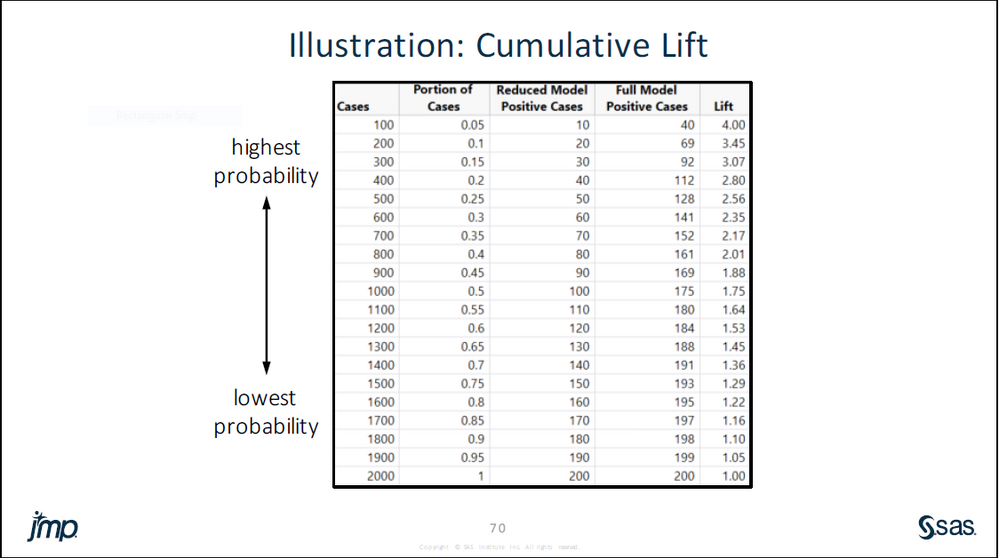
To clarify @dale_lehman's example, lift is a factor. Lift equal to 4 means that 4 times as many targets were conditionally predicted by the model than would be predicted by the marginal probability. See this slide from our copyrighted JMP training materials provides an example:
 

lift.PNG

The reduce model is the marginal probability, 0.1 in this case. The full model is conditioned on the predictors or factors.

Yes, it only drops to 1 because it is a factor, comparing the true predicted targets to the marginal targets.


Also, the domain is always from the top or left of the axis. So a value of 0.4 means the top 40% of the cases ranked by predicted probability.


Note that there are different definitions of lift in use.

dale_lehman
Level VII

Re: Understanding the meaning of a lift curve

Thanks for the clarification.  It makes me wonder about something:  if you were to take, say, a point near the top of the lift curve, e.g., at .1 on the x axis, then the y axis is the multiplier (factor) that relates that to the true predictions.  Let's say the lift is 4.0 at an x value of 10%.  Then, if we were to draw a curve xy=40% into the graph, that would represent no additional lift beyond what the top 10% of the probabilities predicted.  For example, when x=20%, the xy=40% would show a lift of 2.0 at x=20%.  To the extent that the lift curve at x=20% lies above a y value of 2.0, then the model is adding predictive value beyond the highest 10% of the probabilities.  It seems to me that the area between the xy=constant curve and the lift curve provides some sort of measure of the lift over the range of x values (though it occurs to me that at x=100%, this xy=constant curve would go below 1.0 (0.4 in my example).  I would think there is some way to manipulate these areas into a type of measure, akin to the AUC.  Just wondering - do you know of anything along these lines?

Recommended Articles