- Don’t miss your chance to experience Discovery Summit Europe at our best available rate! Early bird registration through 31 Oct.
- Graph Builder Toolbar streamlines interactive graphing. Creates shortcuts on Report and GraphBuilder Helpers toolbars. Download and install the extension.
- JMP will suspend normal business operations for our Rest and Recharge Day on Friday, October 2, 2026.
Regular business hours will resume on Monday, October 5, 2026.
- Subscribe to RSS Feed
- Mark Topic as New
- Mark Topic as Read
- Float this Topic for Current User
- Bookmark
- Subscribe
- Mute
- Printer Friendly Page
Discussions
Solve problems, and share tips and tricks with other JMP users.- User Community
- :
- Discussions
- :
- Re: Restrict combinations in DOE

- Mark as New
- Bookmark
- Subscribe
- Mute
- Subscribe to RSS Feed
- Get Direct Link
- Report Inappropriate Content
Restrict combinations in DOE
Hello all,
I'm sorry if the answer is completely obvious, I just started using JMP. I'm trying to design a DOE containing 1 response and 10 factors, let's call them A-J for now. The factors are either excluded from the run, or present at a certain concentration. In the eventual design certain combinations are restricted, namely A-B, C-D, E-F, G-H and I-J. I tried playing around with the factor constraint option, but I can't figure it out. Can anyone clarify what to do? Thanks in advance!
Accepted Solutions


- Mark as New
- Bookmark
- Subscribe
- Mute
- Subscribe to RSS Feed
- Get Direct Link
- Report Inappropriate Content
Re: Restrict combinations in DOE
I am sorry but I do not understand your confusion. Please explain it so I can clarify my answer for you.
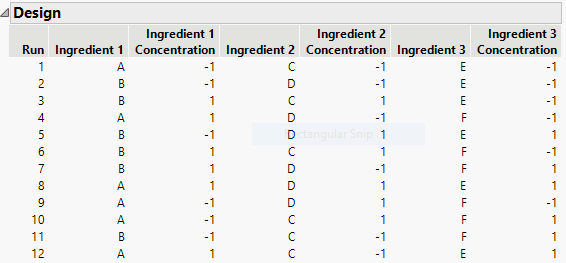
Here is a design based on my approach, so we have something tangible to discuss.
- Mark as New
- Bookmark
- Subscribe
- Mute
- Subscribe to RSS Feed
- Get Direct Link
- Report Inappropriate Content
Re: Restrict combinations in DOE
Are you saying that either A or B is present at some concentration, but not simultaneously? Then you might have one two-level categorical factor to identify the ingredient (e.g., levels A and B) and another factor for the non-zero concentration range.
- Mark as New
- Bookmark
- Subscribe
- Mute
- Subscribe to RSS Feed
- Get Direct Link
- Report Inappropriate Content
Re: Restrict combinations in DOE
Indeed, A and B can not be present simultaneous.
Ah yes that makes sense! But how does the factor for both ingredients being excluded look like? Or can I also make it 3-level categorical?
- Mark as New
- Bookmark
- Subscribe
- Mute
- Subscribe to RSS Feed
- Get Direct Link
- Report Inappropriate Content
Re: Restrict combinations in DOE
I generally recommend against using 0 as a level for a continuous factor. Using 0 turns it into a categorical factor (absent, present). It is better to use two non-zero levels so that you can see the effect of changing the level.
Do you still need to cover the case where both A and B are 0 (absent)?
- Mark as New
- Bookmark
- Subscribe
- Mute
- Subscribe to RSS Feed
- Get Direct Link
- Report Inappropriate Content
Re: Restrict combinations in DOE
I understand the case of making a categorical factor for A or B present, and why it is recommended. But I'm confused on what to do with the "A and B absent" factor.
- Mark as New
- Bookmark
- Subscribe
- Mute
- Subscribe to RSS Feed
- Get Direct Link
- Report Inappropriate Content
Re: Restrict combinations in DOE
I am sorry but I do not understand your confusion. Please explain it so I can clarify my answer for you.
Here is a design based on my approach, so we have something tangible to discuss.
- Mark as New
- Bookmark
- Subscribe
- Mute
- Subscribe to RSS Feed
- Get Direct Link
- Report Inappropriate Content
Re: Restrict combinations in DOE
Ah yes now I understand your approach!
Would it also work to make each ingredient 3-level categorical, including A, B or 0? Or do you foresee problems with such an approach?

- Mark as New
- Bookmark
- Subscribe
- Mute
- Subscribe to RSS Feed
- Get Direct Link
- Report Inappropriate Content
Re: Restrict combinations in DOE
I think your scheme works if you have several pairs of ingredients and some formulations should not include either of the two options for a given pair.
Recommended Articles
- © 2026 JMP Statistical Discovery LLC. All Rights Reserved.
- Terms of Use
- Privacy Statement
- Contact Us