Hi,
I'm working on a dataset where we are testing the effects of 2 treatments and the delay between them, and I'm trying to figure out how to line up my variables so I can do a Dunnett's test against various controls.
We are giving animals a dose of drug A (Variable A), waiting some time (T), and then giving them a dose of drug B . If the animal is NOT given drug A (= 0), then T doesn't have a meaning, so I've been setting it as -1. Similarly, there is no meaning if the animal does not receive drug B, which I've ALSO been setting at T=-1. Therefore all what I'm considering to be the controls (either no A or no B) have a T=-1
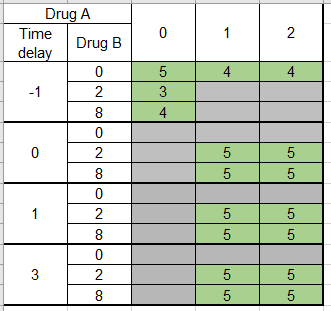
I've been creating my graph using graph builder and then launching a standard least squares analysis. If I use A, B and T to model the effects, I get values, but if I want to look at the interactions, everything falls apart and all my means become NonEstimable.
I understand that this is because there is no overlap between my T=-1 and my other time points, but I don't know how to say that a T=-1 for A=0, B=0 is the same value as a T = 0, 1 or 2. Do I just replicate my data with multiple T's? Do I need to put weighting on that pseudo data to make sure the standard deviations are accurate?