- JMP will suspend normal business operations for our Winter Holiday beginning on Wednesday, Dec. 24, 2025, at 5:00 p.m. ET (2:00 p.m. ET for JMP Accounts Receivable).
Regular business hours will resume at 9:00 a.m. EST on Friday, Jan. 2, 2026. - We’re retiring the File Exchange at the end of this year. The JMP Marketplace is now your destination for add-ins and extensions.
- Subscribe to RSS Feed
- Mark Topic as New
- Mark Topic as Read
- Float this Topic for Current User
- Bookmark
- Subscribe
- Mute
- Printer Friendly Page
Discussions
Solve problems, and share tips and tricks with other JMP users.- JMP User Community
- :
- Discussions
- :
- DOE Analysis

- Mark as New
- Bookmark
- Subscribe
- Mute
- Subscribe to RSS Feed
- Get Direct Link
- Report Inappropriate Content
DOE Analysis
I'd like some help in reading and analysing this response surface graph.

- Mark as New
- Bookmark
- Subscribe
- Mute
- Subscribe to RSS Feed
- Get Direct Link
- Report Inappropriate Content
Re: DOE Analysis
Hi Cedrick,

After I tried per eye to estimate, I used KI to do that for you:
This is a 3D response surface plot showing how two independent variables—essential oil concentration and coconut powder concentration—affect the dependent variable, formulation thickness (mm).
Interpretation:
-
Axes and Variables:
- X-Axis: Essential oil concentration (ranges ~0.7 to 0.8)
- Y-Axis: Coconut powder concentration (ranges ~0 to 6)
- Z-Axis (Response Variable): Formulation thickness in mm (ranges ~0.1 to 0.22)
-
General Trends:
- The surface suggests a nonlinear interaction between the two factors.
- At low coconut powder concentration, increasing essential oil leads to a modest increase in thickness.
- At high coconut powder concentration, thickness is maximized when essential oil is at an intermediate level.
- The response surface has a concave shape, indicating an optimal balance between the two ingredients for maximizing thickness.
-
Optimization Insight:
- There may be a synergistic effect where a moderate combination of both ingredients results in the highest thickness.
- If thickness is a key quality attribute, formulations should be designed near the peak region.
- If excessive thickness is undesirable, reducing either component slightly may be beneficial.
To estimate the factor combination for the highest formulation thickness, let's analyze the response surface visually:
-
Peak Region Identification:
- The highest thickness (~0.22 mm) appears at the upper center of the response surface.
- This corresponds to a moderate-to-high essential oil concentration (~0.74–0.78).
- The coconut powder concentration is moderate (~4–5 g).
-
Approximate Optimal Combination:
- Essential oil concentration: ~0.75–0.78
- Coconut powder concentration: ~4–5 g
- Maximum Thickness: ~0.22 mm
This suggests that an intermediate level of both components maximizes formulation thickness, likely due to a balanced interaction between structuring and binding properties.
-
Conclusion: Estimated Optimal Factor Combination for high thickness
- Essential oil concentration (x1x_1x1): ~0.75–0.78
- Coconut powder concentration (x2x_2x2): ~4–5 g
- Maximum thickness: ~0.22 mm statistical confidence: The curvature suggests a strong quadratic model fit.
Estimated Optimal Combination for Low Thickness- Essential oil concentration (x1x_1x1): ~0.70–0.72 or ~0.78+
- Coconut powder concentration (x2x_2x2): ~0–1 g
- Minimum thickness: ~0.10–0.12 mm
Note from Victor : Use AI tools responsibly and always check, validate, proof-read the responses obtained by these tools before posting ! Incorrect or suspicious conclusions highlighted in red.


- Mark as New
- Bookmark
- Subscribe
- Mute
- Subscribe to RSS Feed
- Get Direct Link
- Report Inappropriate Content
Re: DOE Analysis
Hi @Cedrick1,
I would recommend reading the documentation about Surface Plot (and more particularly The Surface Plot Report) to better understand how it is constructed and how to understand it.
If you have more specific questions about the analysis or else, please specify your question.
Hope this answer will help you,
"It is not unusual for a well-designed experiment to analyze itself" (Box, Hunter and Hunter)
- Mark as New
- Bookmark
- Subscribe
- Mute
- Subscribe to RSS Feed
- Get Direct Link
- Report Inappropriate Content
Re: DOE Analysis
Thank you very much for these explanations. However, can I find out how to use the KI software?
I can't analyse or understand how each variable evolves because the different axes seem confusing.
For the coconut powder, it seemed to me that as this factor increased, so did the thickness.
- Mark as New
- Bookmark
- Subscribe
- Mute
- Subscribe to RSS Feed
- Get Direct Link
- Report Inappropriate Content
Re: DOE Analysis
Hi @Cedrick1,
I think @DualARIMACougar may have used an AI application software able to handle photos, like Claude, Gemini, ChatGPT, or other tools. If you upload an image in these tools and describe your needs in the prompt, you might have interesting explanations and answers. But be careful and always proof-read/validate the output given, as these tools may "hallucinate" (giving inaccurate answers due to their learning mechanisms based on correlations).
Typically in the response from @DualARIMACougar, some infos seem not correct, like the evolution of the reponse depending on "Poudre de noix de coco" (when Coco is increasing, the response decreases, not increases) and the optimal maximum thickness area (middle level of essential oil is correct, but not the amount of coco powder, which seems to be minimized, and not around 4-5).
If I have to explain your response surface plot in a fully "human"-way without AI involved :
- "Form. prév. Epaisseur (mm) 2" is the response of interest and is located on the vertical axis (z-axis).
- Two factors are displayed in the X and Y axis : "Poudre de noix de coco" (Y) and "Huile essentielle" (X). You can check the values on the axis to know what is the impact of increasing/decreasing their amount on the response (Z). X is increased from right to left, whereas Y is increased from left to right :
So when Y increases, the response decreases. For X, the pattern is curvilinear (like "-X²"), so when X increases up to around 0,74 the response increases, after this X middle value the response starts to decrease. - A contour grid is added on the plane delimited by X and Y axis. This contour plot enables to have a 2D representation of the impact of X and Y variables on the response Z. You can more easily identify the area of interest : for example, if your goal is to minimize Z, then you need to be on the lower edges of the plane : Y high and X either high or low.
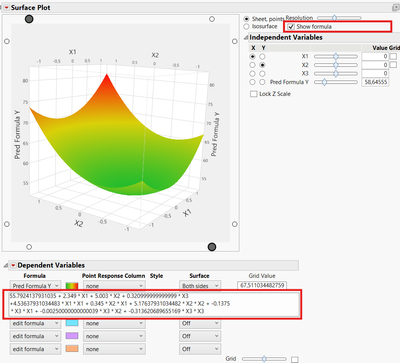
- Your surface plot is curved, showing potential quadratic effects and interaction effect for your factors. It's hard to tell which terms could be present exactly in the Formula and their relative magnitude only with this plot, but there is an option to "Show Formula" in the upper right side of the report (example on another file) :
- On a rough guess and only based on the color gradient chosen (from blue/green to red), it seems the response needs to be either on a middle target value, or minimized (as high values are in red, often a symbol of "bad"/undesirable results). In order to be in the acceptable area (green/blue ?), factor "Poudre de noix de coco" needs to be set at high levels, and "Huile essentielle" at high or low levels (to reach blue area), or middle level (to reach green area).

If you're new or need more explanation about Surface Response methodologies, I would highly recommend to attend/read/watch courses on this topic, like The Open Educator - 1. What is Response Surface Methodology, Lesson 11: Response Surface Methods and Designs | STAT 503, and practice through examples Example of a Response Surface Model.
Hope this explanation makes it clearer. If you still have questions, please share your detailed and specific questions and a dataset, so that we can reproduce the graph with the same data, it's a lot easier to explain on the same use case.
"It is not unusual for a well-designed experiment to analyze itself" (Box, Hunter and Hunter)
Recommended Articles
- © 2026 JMP Statistical Discovery LLC. All Rights Reserved.
- Terms of Use
- Privacy Statement
- Contact Us