- Learn how to build custom Python data connectors and further customize JMP’s Data Connector Framework with the Python Data Connector Demo, available now in the JMP Marketplace!
- See how to move from signal modeling to system modeling at the first JMP Aerospace Analytics webinar. Register. June 18, 1 p.m. US Eastern Time.
- Subscribe to RSS Feed
- Mark as New
- Mark as Read
- Bookmark
- Subscribe
- Printer Friendly Page
- Report Inappropriate Content
Learning Library
- JMP User Community
- :
- Learn JMP
- :
- Learning Library
- :
- Teaching resources for courses in Chemistry and related fields using JMP Student...
Dear instructors,
this page presents a selection of ten teaching resources freely available for higher-ed instructors in Chemistry and related fields like Chemical Engineering, Materials Science, Biotechnology and Pharmacology.
The criteria to be mentioned here are:
- Related to Chemistry: Prove that JMP makes it very unlikely to start on a green field, no matter which course in Chemistry you teach.
- Related to your pedagogy: Show a broad range of resources and where to find them, from simple data sets to tutorials, case studies and e-learning.
- Related to your special needs: Invite you for feedback, either as a request for more resources created by JMP, or by sharing your own teaching material with the JMP community.
Furthermore, this list aims at balancing statistical concepts (like data visualization, modeling, DOE, SQC, multivariate analysis, chemometrics, process optimization) as well as types of resources (like sample data, case studies, how-to guides, webinars, e-courses). Please note that this page should not be considered as a complete inventory, but it wants to represent what is available to support you teaching the relevant skills in your field, and to give you some orientation to find and explore the course material you are looking for.
All teaching examples are ready to run in JMP Student Edition, the no-code & graph-first desktop software for Windows and Mac. Refer to our JMP customer stories to see how these skills matter in the Chemical industry worldwide.
-
Teaching Statistics in Chemistry and Chemical Engineering
Main concepts: Exploratory data analysis, data visualization, statistical analysis, predictive modelling, process optimization, Monte-Carlo simulation
Resource type and source: Academic Webinar “JMP for Teaching Statistics in Chemistry and Chemical Engineering” > see the JMP journal
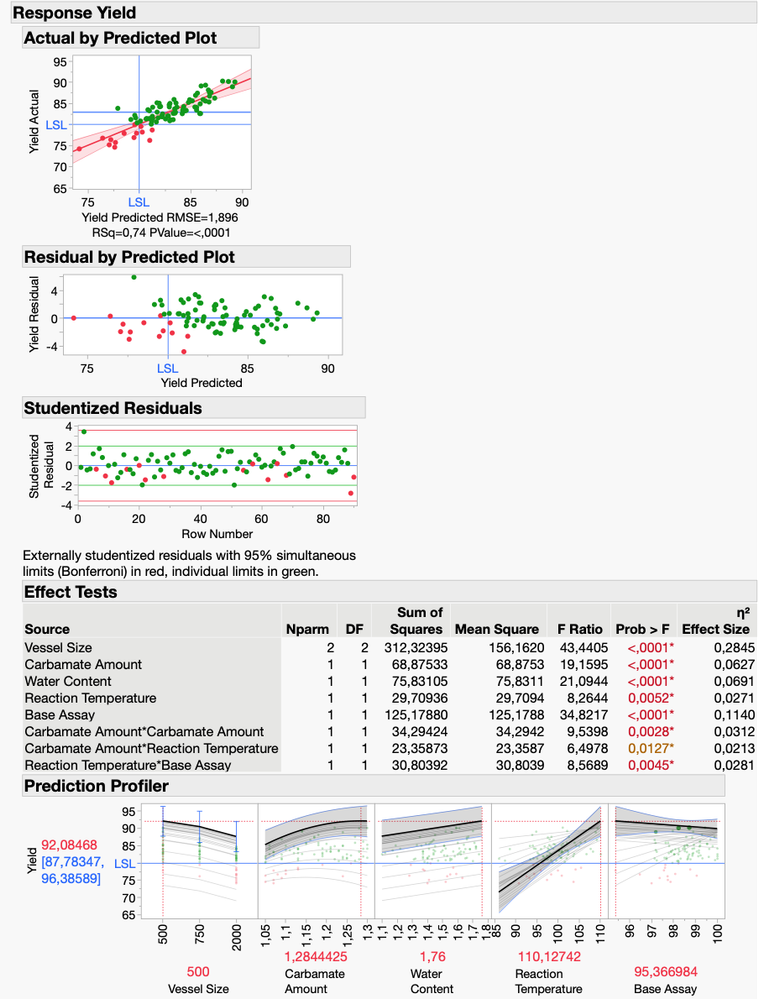
Description: This webinar provides an overview of the utility of the JMP Student Edition for teaching statistical methods in chemistry and chemical engineering. It is intended for instructors who want to learn if and how JMP software meets the needs of their course or curriculum. The webinar journal provides examples about chemical manufacturing exploring and analyzing process data, predictive modelling for high-throughput screening and robust process optimization.
Tips: Other academic webinars to get started are “JMP 101: Intro to JMP for Teachers” and “JMP 101: Intro to for Students”. See also the Student menu in JMP Student Edition to teach basic statistical concepts, and the JMP Learning Library for 100+ quick guides and short video tutorials.
-
Design of Experiments (DOE)
Main concepts: Multifactor experimentation, Screening Experiments, Response Surface Experiments, classical vs. optimal designs
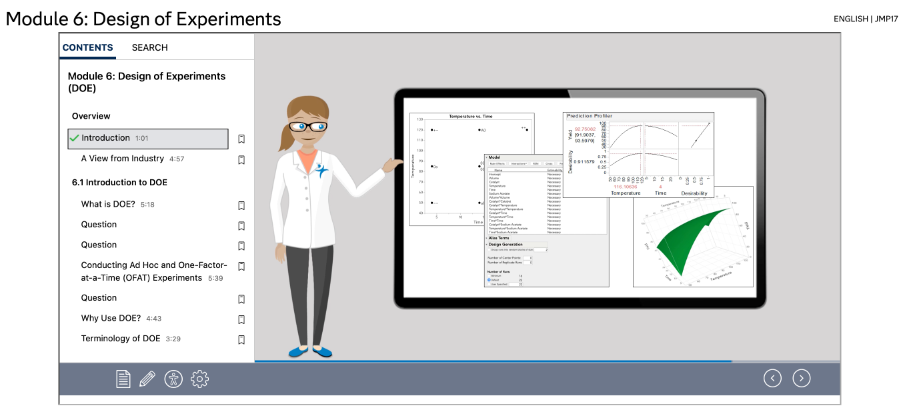
Resource type and source: “Design of Experiments” is one of seven modules of the online statistics course “Statistical Thinking for Industrial Problem Solving” (aka STIPS). While the full course - including all practical exercises using JMP Pro - can be taken in the Virtual Learning Environment, all course content incl. slides can be requested for teaching purposes.
Description: In this introductory module, you will learn why designed experiments are better than trial and error and one-factor-at-a-time approaches to gain an understanding of cause and effect relationships and interactions between factors. You will be introduced to several types of designs such as factorial, response surface and custom designs. Finally, you will learn some DOE guidelines and best practices which will help you succeed with experimentation.
Tips: While working through all parts of this STIPS DOE module takes approx. four hours, for shorter lectures we recommend the Statistics Knowledge Portal (aka SKP, see Design of Experiments) and the ‘Easy DOE’ platform (JMP Help > Design of Experiments Guide > Easy DOE). Other recommended DOE resources are the academic webinars “Designing and Analyzing Experiments, Pt. 1: An Introduction” and “Pt. 2: Advanced Topics”, and two in-depth on-demand courses about “Custom Design of Experiments” and “Classic Design of Experiments”, respectively.
-
Design of Experiments with Mixtures: A Case Study in Plastics Formulations
Main concepts: Design of experiments (DOE), mixture experiment, linear modeling, optimization
Resource type and source: On-demand webinar (registration required) with data set for download
Description: Successful product development often involves optimizing formulations. The goal is to find the right proportions of five ingredients such that the desired product characteristics are achieved while costs are minimized. The demo shows how to design a mixture experiment in JMP’s Custom Design platform, incorporate constraints into your experimental design, assess the impact of variations in process variable settings, and analyze and make decisions from the experimental data in JMP’s Prediction Profiler.

Tips: For convenience designing the experiment, click the top red triangle to save (and reload) the response and factor settings to JMP tables which can then be shared with students.
-
Bayesian Desirability Functions – A Modern Approach to Efficient Product
and Process Design
Main concepts: Bayesian Optimization, Active Learning, Gaussian Process regression
Resource type and source: Online short course “Bayesian Desirability Functions – A Modern Approach to Efficient Product and Process Design” presented by ENBIS and JMP; demo journal with all examples, instructions and slides for download.
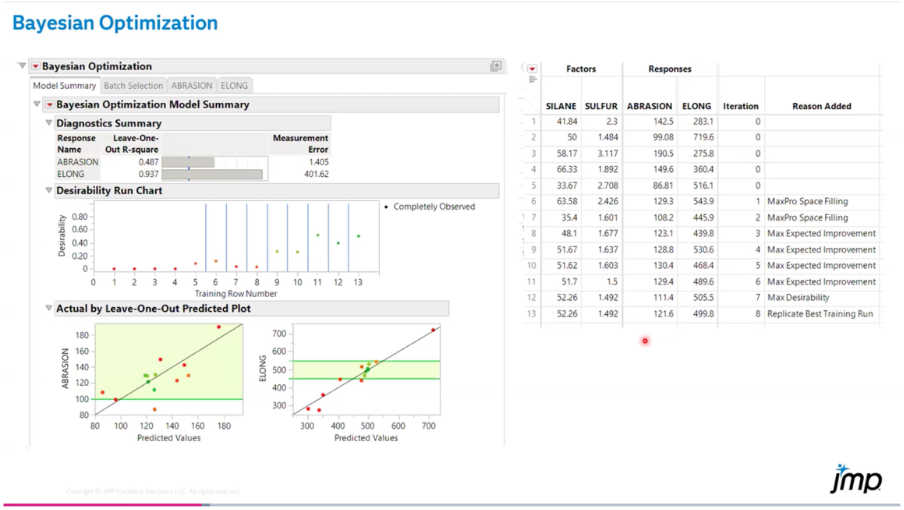
Description: Sequential experimentation using Bayesian optimization promises greater speed and a simpler workflow for non-statisticians by prioritising goal-seeking over model-building. In this webinar we review the basics of Gaussian Process regression modeling and the standard approach to Bayesian optimization. We then introduce the generalization to multiple responses via the Bayesian Desirability framework. Besides an in-depth lecture explaining the technical background, the efficiency and approachability of the techniques using new capabilities in JMP Student Edition 19 are demonstrated by three case studies.
Tips: This earlier course presented some additional concepts, but used a prototype implementation (JMP add-in) for demonstration. Also see JMP Help > Predictive and Specialized Modeling > Bayesian Optimization.
-
Getting Started with Quality and Process Methods
Main concepts: Statistical Process Control (SPC), Control Charts, Process Capability, Measurement Systems Analysis (MSA), repeatability and reproducability, tolerance intervals
Resource type and source: JMP Learning Library > Quality and Process. Quick guides and short videos to get students started with quality methods. Students are referred to the JMP documentation for further reading.
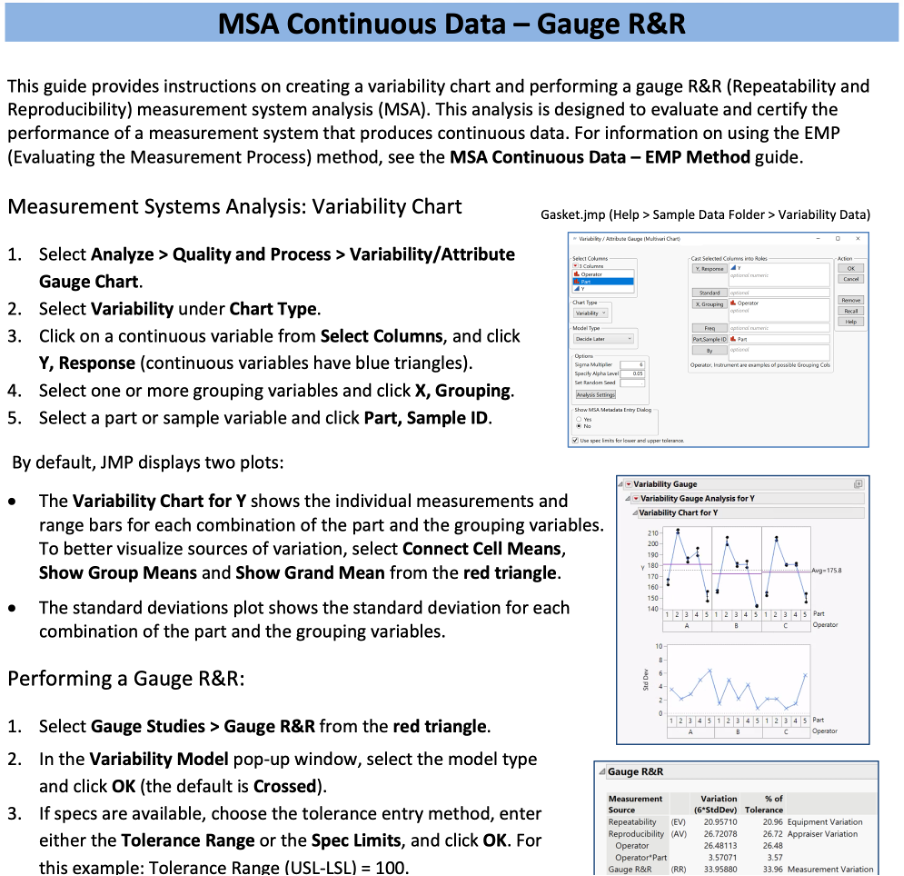
Description: Learn how to use control charts to monitor processes over time to determine if they are in statistical control or if assignable cause variation exits. Use statistical methods to quantify the performance of a process relative to specifications. Learn how to design and analyze experiments on measurement systems to quantify the repeatability and reproducibility sources of measurement variation, and to determine the level of accuracy, precision, and agreement in these systems.
Tips: Students can try the examples themselves since all instructions refer to JMP’s built-in sample data (Help > Sample Index). The STIPS module ‘Quality Methods’ can be visited to learn more about these concepts.
-
Quality: Model Driven Multivariate Control Chart with a PLS Model
Main concepts: Quality and process control, Model Driven Multivariate Control Charts (MDMCC), Partial Least Squares (PLS)
Resource type and source: Sample data with stored analysis scripts (e.g. ‘Fit Partial Least Squares’ and ‘Model Driven Multivariate Control Chart’); see JMP Student Edition > Help menu > Sample Index > Search for ‘Polyethylene’. More info in JMP Help at jmp.com/help > Quality and Process Methods > Model Driven Multivariate Control Charts > Additional Examples of the Model Driven Multivariate Control Chart Platform.
Description: The sample data table ‘Polyethylene Process.jmp’ contains 14 process variables (inputs) and 5 quality or output variables. The first rows contain historical data used to build an initial PLS model. The remaining rows represent new data collected after the model was built, used for ongoing process monitoring.

Tips: In the MDMCC report, hover over data points on the Control Chart to explore graphlets with contributions. Other MDMCC example in sample data table “Chemical Reactor Process.jmp”.
-
Multivariate Analysis: Material Selection using Tabular QSAR
Main concepts: Collinearity, Principal Component Analysis (PCA), Covariate DOE, Partial Least Squares (PLS), Optimization, Model validation, Multidimensional Scaling (MDS)
Resource type and source: Webinar “Advanced Analytics and Deep Learning in Chemistry” from the Academic Webinar Library. Download the JMP journal > case #1.
Description: This case is about selecting the best material, which maximizes a first and minimizes a second response. Starting point are 19 chemical and physical properties from 45 candidate materials. The real-world problem shared by industry discusses how to build a sustainable empirical model in order to understand what makes a good material, predict on new material, know the optimum which may not yet exist and reduce the testing effort. The analytical workflow combines various multivariate analysis methods and is based on the chemometrics application QSAR - Quantitative Structure-Activity Relationship.
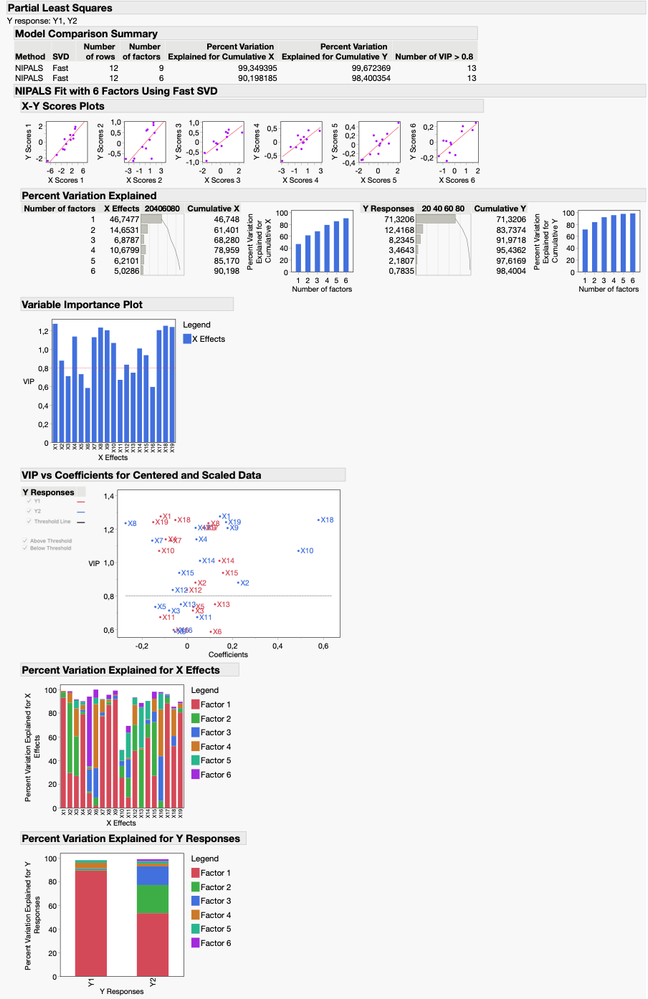
Tips: This case has been shared by a JMP customer. The original customer presentation from a JMP Discovery Summit can be seen here.
-
Process Simulation an Optimization
Main concepts: Model visualization, specification limits, desirability, process optimization, Monte-Carlo simulation
Resource type and source: Learn JMP Event “Simulating and Optimizing Your Process – A Step-by-Step Approach” with downloadable JMP journal and data sets.
Description: The simple 4-factor, 2-response manufacturing example from this webinar shows how to use the JMP Prediction Profiler for model exploration and understanding, and for optimization and simulation purposes. This is the central tool in JMP to support process understanding and process improvement.
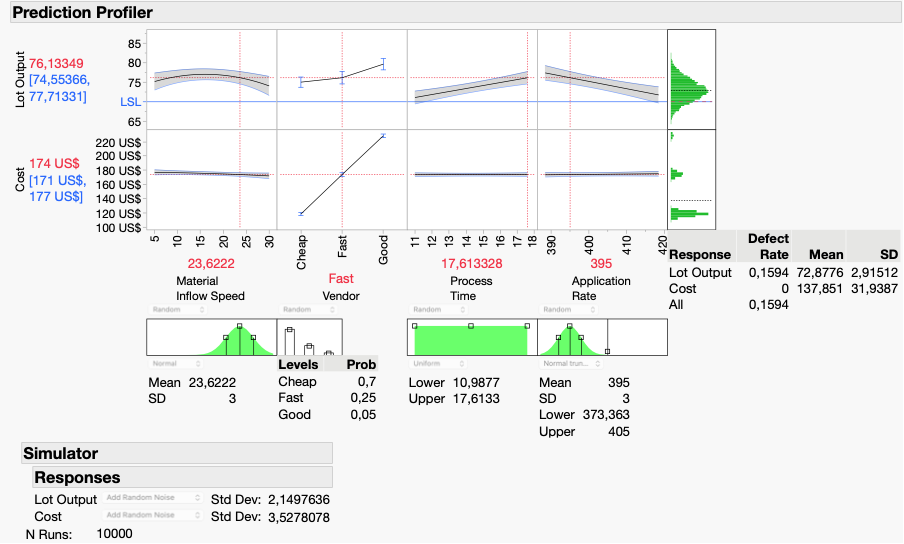
Tips: Recommended next steps may consider Variable Importance (simulated practical importance rather than statistical significance), robustness through Simulation Experiments (finding the flattest part of the curve), and Design Space Profiler (Quality by Design > set specs on Xs).
-
Functional Data Analysis for HPLC Optimization
Main concepts: Functional Data Analysis, Functional PCA, Functional DOE
Resource type and source: Case Study JMP059 from JMP’s Case Study Library.
Description: Uses JMP’s Functional Data Explorer platform Apply functional data analysis and functional design of experiments (FDOE) for the optimization of an analytical method to allow for the accurate quantification of two biological components. Students produce a high-performance liquid chromatography (HPLC) method that can separate two closely related sophorolipid biosurfactants that appear close together on the chromatogram. Tasks include to apply statistical design of experiments (DOE) to find HPLC settings that can improve the method, to use Functional Data Analysis to understand how the curve shape changes as factors change, and to identify optimized conditions for the separation of the two peaks.
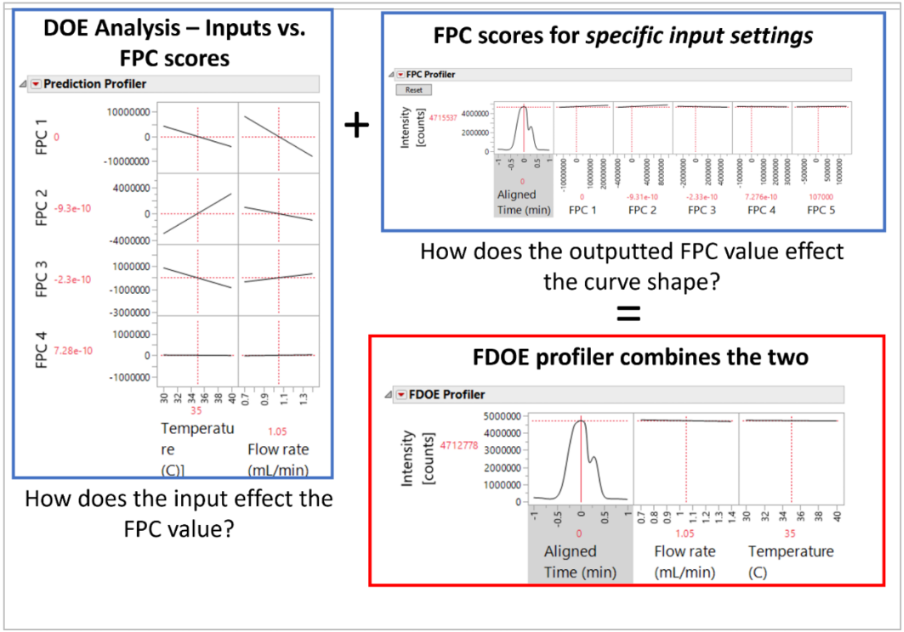
Tips: More information about Functional Data Explorer and other examples using sample data can be found in JMP Help at jmp.com/help > Predictive and Specialized Modeling > Functional Data Explorer.
-
Deep Learning: Solubility Prediction (SMILES QSAR) and Spectrogram Prediction (Image Classification)
Main concepts: XGBoost, Torch Deep Learning
Resource type and source: Webinar “Advanced Analytics and Deep Learning in Chemistry” from Academic Webinar Library. Download the JMP journal > cases #2 and #3. Requires the free ‘Torch Deep Learning’ JMP add-in, which can be downloaded from marketplace.jmp.com. Pre-trained models will be automatically added to the embedded Python installation when needed. XGBoost is also available as an extension from the JMP Marketplace.
Description: Prediction using the Deep Learning functionality and models from pyTorch package in Python, which is as standard installed and configured for JMP Student Edition. No Python coding required, the model launch incl. hyperparameters as well as the model output and diagnostics are available through the JMP user interface. The demonstrated DL models include BertTiny or Chem Prop Message Passing Neural Network to predict solubility based on SMILES strings, and LeNet5 image model to predict a Propanol-Butanol-Pentanol composition based on spectrograms. The DL model performance can be compared with other models, like wavelet parameters from functional data or extreme gradient boosted trees (XGBoost).

Tips: The add-in provides more Deep Learning use cases in Chemistry, see Add-ins > Torch Deep Learning > Example Data > Torch Storybook. A second add-in, ‘Torch Companion’, supports the automatic screening of DL hyperparameters.
Recommended Articles
- © 2026 JMP Statistical Discovery LLC. All Rights Reserved.
- Terms of Use
- Privacy Statement
- Contact Us