cancel
Showing results for 
Show  only  | Search instead for 
Did you mean: 
  • Learn how to build custom Python data connectors and further customize JMP’s Data Connector Framework with the Python Data Connector Demo, available now in the JMP Marketplace!
  • See how to create experiments to support product design and ID useful product features. Register for June 12 webinar, 2pm US Eastern Time.

Learn JMP Events

Events designed to further your knowledge and exploration of JMP.
Choose Language Hide Translation Bar

Developer Tutorial: Designing and Evaluating Measurement Systems Studies Prior to Implementation

Presented in English
Published on ‎11-07-2024 03:31 PM by Staff | Updated on ‎11-07-2024 05:41 PM


Note: All the capabilities shown are in JMP 17, although JMP Pro 17 is used for the demo.  The video includes Q&A and comments from the presenter Caleb King @calking about how MSA works plus plans for possible enhacements. 


See how to:
  • Understand basics of MSA Design
    • MSA primary focus is on decomposing variation in product measurements into distinct sources, with the goal to reduce or elimnate one or more sources

    • The metric of interest is not an effect size (i.e. difference in mean behavior), but rather the variance contribution from a particular source

    • Underlying models are primarily random effects models or even mixed effects models if biasing terms are included

    • Nested factors are also common in MSA, but not exclusively 

  • See improvements made in JMP 17

    • Better diagnostics that more closely align with MSA analytics platforms

    • Greater user interaction that allows exploration of what-if scenarios

    • Fexible Design structure interface so  users can specify nesting/crossing relationships in the design

  • Understand that diagnostics are based on simulation of variance estimates, based on the standard ANOVA approach
    • Example is a 3- factor fully crossed MSA where mean squares have known Chi-square distributions that are easily be simulated and then used to compute confidence intervals, variance proportions, etc.

  • Include nested and crossed structures
  • Make design and evaluate diagnostics for two examples

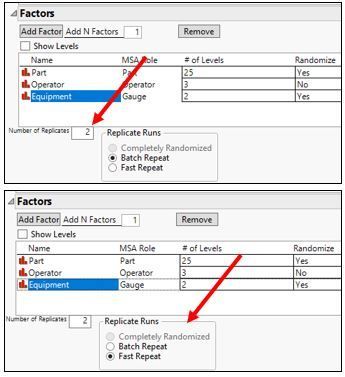
MSA Design Factor ScreenMSA Design Factor ScreenMSA Design Factor Screen


The video includes Questions ansered at the webinar by Caleb @calking, Don McCormack @DonMcCormack and Jerry Fish @JerryFish.


One person asked online if nesting would occur when testing same methods on different equipment.  They responded: Probably not, but it would ultimately depend on how the experiment was run what assumptions were made about the methods and equipment.  If you considered the equipment/method to be a random observation from a much larger population, then they may be considered nested (in some way). If you considered them from a fixed set of values (e.g., types of equipment), then they would more likely be treated as crossed.


Resources


Start:
Fri, Oct 28, 2022 02:00 PM EDT
End:
Fri, Oct 28, 2022 03:00 PM EDT
Attachments
0 Kudos
0 Comments