- Don’t miss your chance to experience Discovery Summit Europe at our best available rate! Early bird registration through 31 Oct.
- Graph Builder Toolbar streamlines interactive graphing. Creates shortcuts on Report and GraphBuilder Helpers toolbars. Download and install the extension.
- JMP will suspend normal business operations for our Rest and Recharge Day on Friday, October 2, 2026.
Regular business hours will resume on Monday, October 5, 2026.
- Subscribe to RSS Feed
- Mark Topic as New
- Mark Topic as Read
- Float this Topic for Current User
- Bookmark
- Subscribe
- Mute
- Printer Friendly Page
Discussions
Solve problems, and share tips and tricks with other JMP users.- User Community
- :
- Discussions
- :
- Re: Using a formula column, how do I find a value in a subset of the data based ...

- Mark as New
- Bookmark
- Subscribe
- Mute
- Subscribe to RSS Feed
- Get Direct Link
- Report Inappropriate Content
Using a formula column, how do I find a value in a subset of the data based on other columns
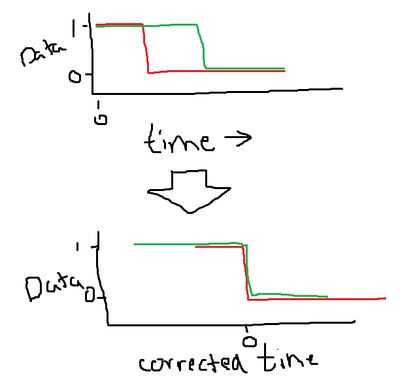
If I have two different time series in a table, and there is a findable event in both series, but they occur at different times. How can I specify a formula column to subtract off the time such that the finable events start at time zero?
Accepted Solutions

- Mark as New
- Bookmark
- Subscribe
- Mute
- Subscribe to RSS Feed
- Get Direct Link
- Report Inappropriate Content
Re: Using a formula column, how do I find a value in a subset of the data based on other columns
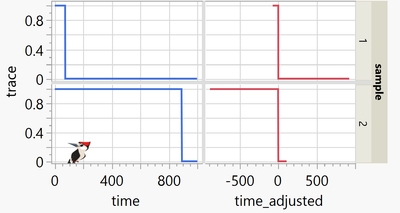
If the signal is very clean, you can just use lag to find the jump - otherwise you have to invest more effort to remove noise etc.
Then you just have to subtract the offset of the jump from your original time.
Col ... aggregations like Col Maximum can be used to spread one value to all rows - which then can be subtracted.
A second argument of the Col ... aggregation can be used as GroupBy argument (1 maximum per group) to subtract individual offsets for the 2 traces.
t1 = random integer(1000);
t2 = random integer(1000);

dt = new table("test",
add rows(2000),
New Column( "time",  Set Each value(Mod(row()-1,1000)) ),
New Column( "sample",  Set Each value(floor((row()-1)/1000)+1) ),

New Column( "trace",  Set Each value(if(:time<match(:sample,1,t1,2,t2),1,0 )))
);

New Column( "marker",  Set Each value(if(lag(trace)==1 & :trace==0,time,.)));

New Column( "time_adjusted",
	set each value( :time - Col Maximum( :marker, :sample ) ),
	Set Selected
);

Graph Builder(
	Variables(
		X( :time ),
		X( :time_adjusted ),
		Y( :trace ),
		Group Y( :sample )
	),
	Elements( Position( 1, 1 ), Line( X, Y, Legend( 14 ) ) ),
	Elements( Position( 2, 1 ), Line( X, Y, Legend( 15 ) ) )
)
- Mark as New
- Bookmark
- Subscribe
- Mute
- Subscribe to RSS Feed
- Get Direct Link
- Report Inappropriate Content
Re: Using a formula column, how do I find a value in a subset of the data based on other columns
If the signal is very clean, you can just use lag to find the jump - otherwise you have to invest more effort to remove noise etc.
Then you just have to subtract the offset of the jump from your original time.
Col ... aggregations like Col Maximum can be used to spread one value to all rows - which then can be subtracted.
A second argument of the Col ... aggregation can be used as GroupBy argument (1 maximum per group) to subtract individual offsets for the 2 traces.
t1 = random integer(1000);
t2 = random integer(1000);

dt = new table("test",
add rows(2000),
New Column( "time",  Set Each value(Mod(row()-1,1000)) ),
New Column( "sample",  Set Each value(floor((row()-1)/1000)+1) ),

New Column( "trace",  Set Each value(if(:time<match(:sample,1,t1,2,t2),1,0 )))
);

New Column( "marker",  Set Each value(if(lag(trace)==1 & :trace==0,time,.)));

New Column( "time_adjusted",
	set each value( :time - Col Maximum( :marker, :sample ) ),
	Set Selected
);

Graph Builder(
	Variables(
		X( :time ),
		X( :time_adjusted ),
		Y( :trace ),
		Group Y( :sample )
	),
	Elements( Position( 1, 1 ), Line( X, Y, Legend( 14 ) ) ),
	Elements( Position( 2, 1 ), Line( X, Y, Legend( 15 ) ) )
)
- Mark as New
- Bookmark
- Subscribe
- Mute
- Subscribe to RSS Feed
- Get Direct Link
- Report Inappropriate Content
Re: Using a formula column, how do I find a value in a subset of the data based on other columns
This solved my problem exactly!
I think col ... aggregations was something I was sorely missing in my mental toolbox.
Thank you!
Recommended Articles
- © 2026 JMP Statistical Discovery LLC. All Rights Reserved.
- Terms of Use
- Privacy Statement
- Contact Us