Turn on suggestions
Auto-suggest helps you quickly narrow down your search results by suggesting possible matches as you type.
- Don’t miss your chance to experience Discovery Summit Europe at our best available rate! Early bird registration through 31 Oct.
- Image to Table JMP extension imports single or batch images as data tables. Useful to extract curves from pictures or convert image data to curve data to use in analyses like Functional Data Explorer. Download and install the extension.
Options
- Subscribe to RSS Feed
- Mark Topic as New
- Mark Topic as Read
- Float this Topic for Current User
- Bookmark
- Subscribe
- Mute
- Printer Friendly Page
Discussions
Solve problems, and share tips and tricks with other JMP users.- User Community
- :
- Discussions
- :
- New Column to show repeated values in for each run/ID across two data types

Level II
- Mark as New
- Bookmark
- Subscribe
- Mute
- Subscribe to RSS Feed
- Get Direct Link
- Report Inappropriate Content
New Column to show repeated values in for each run/ID across two data types
Mar 15, 2024 02:18 PM
(2341 views)
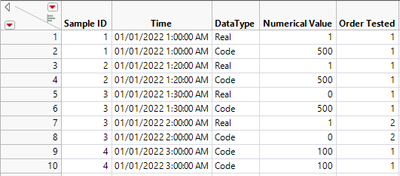
I tried using lag function to indicate when the first test for a sample ID based on time column. Need to the column, Order Tested, to represent first test conducted for a sample ID and second test based on time. Each test will have a real and maybe a code value. See attached file for JMP file. At the end of the day Order Tested column needs to look like image below. This is just a sample, real one has 10,000+ data points.
1 ACCEPTED SOLUTION
Accepted Solutions


Super User
Solution
- Mark as New
- Bookmark
- Subscribe
- Mute
- Subscribe to RSS Feed
- Get Direct Link
- Report Inappropriate Content
Re: New Column to show repeated values in for each run/ID across two data types
You can use Col Cumulative Sum with if statement
Col Cumulative Sum(If(Row() == Col Min(Row(), :Sample ID, :Time, :DataType), 1, .), :Sample ID, :DataType)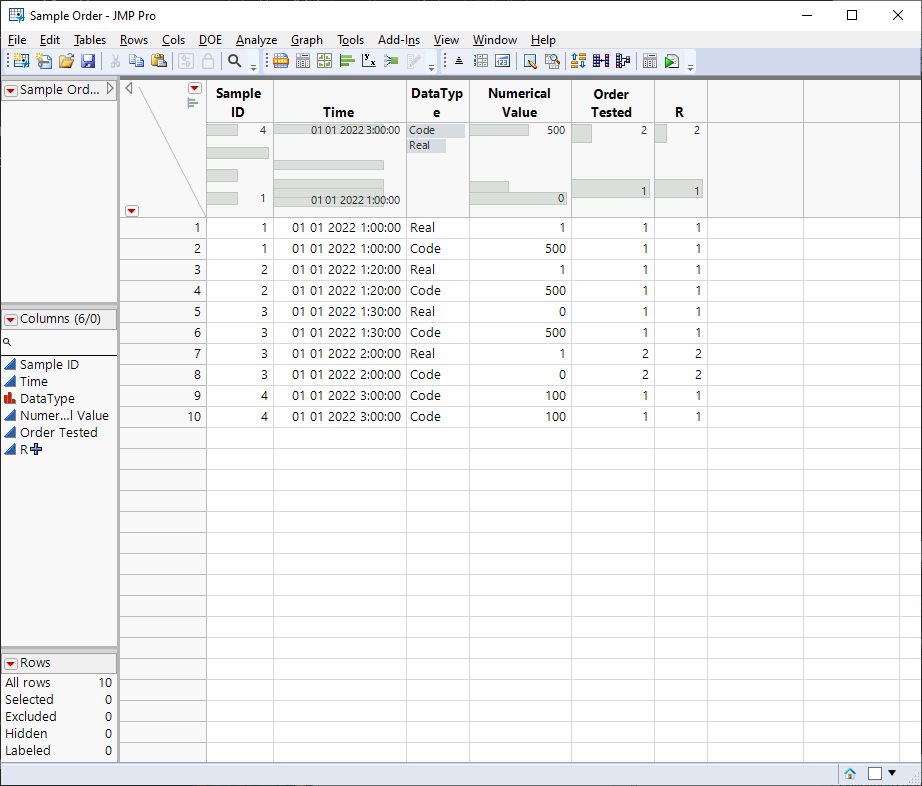
KudosAdd dense ranking to Ranking Tie and Col Rank functions to make this much much easier
-Jarmo
2 REPLIES 2
Super User
Solution
- Mark as New
- Bookmark
- Subscribe
- Mute
- Subscribe to RSS Feed
- Get Direct Link
- Report Inappropriate Content
Re: New Column to show repeated values in for each run/ID across two data types
You can use Col Cumulative Sum with if statement
Col Cumulative Sum(If(Row() == Col Min(Row(), :Sample ID, :Time, :DataType), 1, .), :Sample ID, :DataType)KudosAdd dense ranking to Ranking Tie and Col Rank functions to make this much much easier
-Jarmo
Level II
- Mark as New
- Bookmark
- Subscribe
- Mute
- Subscribe to RSS Feed
- Get Direct Link
- Report Inappropriate Content
Re: New Column to show repeated values in for each run/ID across two data types
Thanks for the solution!
Recommended Articles
- © 2026 JMP Statistical Discovery LLC. All Rights Reserved.
- Terms of Use
- Privacy Statement
- Contact Us