cancel
Showing results for 
Show  only  | Search instead for 
Did you mean: 
  • Sign-in to the JMP Community will be unavailable intermittently Dec. 6-7 due to a system update. Thank you for your understanding!
  • We’re retiring the File Exchange at the end of this year. The JMP Marketplace is now your destination for add-ins and extensions.
  • JMP 19 is here! Learn more about the new features.

Discussions

Solve problems, and share tips and tricks with other JMP users.
Choose Language Hide Translation Bar
Zeban
Level I

How to calculate the one-sided 95% upper confidence bound for the IP of a bioassay (USP <1033> example)

  USP <1033> is a validation guidance to support (cell-based) assay validation. It contains (simulated) validation data and the results of numerical values for different validation parameters. 

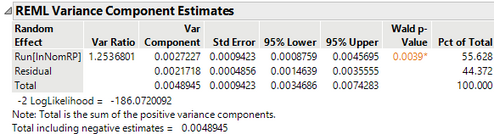
Variant component estimates can be derived by applying a mixed effects model on these data. This is relatively straightforward using JMP. 

However, I struggle with the following: USP <1033> recommends to report validation results with some measure of uncertainty. A one-sided 95% upper confidence bound can be calculated for the IP of the bioassay. An upper bound on IP for the bioassay example is provided (i.e. 11.8% GCV). They give no context other than "The literature contains methods for calculating confidence bounds
for variance components."

Is there someone who can help me with this? Could this value be derived from the confidence bounds generated in the REML Variance Component Estimates window e.g.? 

The anticipated 95% Upper bound should approximate 0.01244.
 

Zeban_1-1638277809680.png


1 REPLY 1
Phil_Kay
Staff

Re: How to calculate the one-sided 95% upper confidence bound for the IP of a bioassay (USP <1033> example)

Hi @Zeban ,

Perhaps you could attach the sample data.

My first thought is that the "95% Upper" column in the variance components estimates should be what you need. It will, of course, require that the model is set up correctly.

Does your variance component estimates for the example agree with those published in the USP guidance?

Phil

Recommended Articles