Hi Everyone,
I would like confirmation on the appropriate analysis to run on a repeated measures design.
Experimental design:
Independent variable: Nutrient treatment (Control, Low, Med, High),
Dependent variable: basal diameter, 5 replicates (plants)
Repeated measurements were taken at Weeks 0, 1, 4, 7, 10, & 12
Split data-> Fit Model-> Y: basal 0, basal 1, 4, 7, 10, 12, Add: Nutrient treatment
Personality: Manova, Choose response: repeated measures
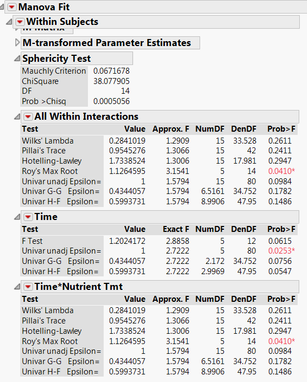
From Mauchly Sphericity Test I see my data is violating the assumption of sphericity making the F tests in the univariate analysis of variance unreliable.
Therefore, I am now attempting to make adjustments to the univariate test statistics by analyzing the data using
Stacked data ->Fit Model-> Y: basal, Add: nutrient treatment, time, Nutrient treatment * Time
Personality: Standard Least Squares, Emphasis: Minimal Report
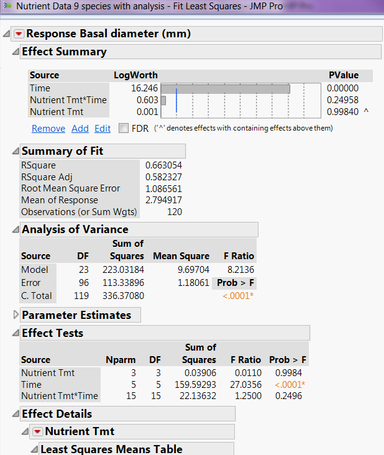
Now I can see there was no significant difference in basal diameter between nutrient treatment, but there was a significant difference in basal diameter between time points. If anyone has any feedback or suggestions please let me know and thank you all for your time.
Sincerely,
Ursula aka Struggling Graduate Student
P.s. I also have measurements of shoot height, and the number of leaves (for 9 different species), but I'm looking at each variable independently and not looking for comparisons between species.