- Don’t miss your chance to experience Discovery Summit Europe at our best available rate! Early bird registration through 31 Oct.
- Graph Builder Toolbar streamlines interactive graphing. Creates shortcuts on Report and GraphBuilder Helpers toolbars. Download and install the extension.
- JMP will suspend normal business operations for our Rest and Recharge Day on Friday, October 2, 2026.
Regular business hours will resume on Monday, October 5, 2026.
- Subscribe to RSS Feed
- Mark Topic as New
- Mark Topic as Read
- Float this Topic for Current User
- Bookmark
- Subscribe
- Mute
- Printer Friendly Page
Discussions
Solve problems, and share tips and tricks with other JMP users.- User Community
- :
- Discussions
- :
- How do I split a big data table into smaller ones? (un-merge or opposite of conc...

- Mark as New
- Bookmark
- Subscribe
- Mute
- Subscribe to RSS Feed
- Get Direct Link
- Report Inappropriate Content
How do I split a big data table into smaller ones? (un-merge or opposite of concatenate)
Hi,
Is there a script or a function which would essentially do the opposite of the "Concatenate" function? I have a massive data file with a source column which is the primary key & other columns associated with each primary key. I am trying to split this massive data table into several smaller tables based on the primary key.
Any suggestions?
Thanks
Accepted Solutions


- Mark as New
- Bookmark
- Subscribe
- Mute
- Subscribe to RSS Feed
- Get Direct Link
- Report Inappropriate Content
Re: How do I split a big data table into smaller ones? (un-merge or opposite of concatenate)
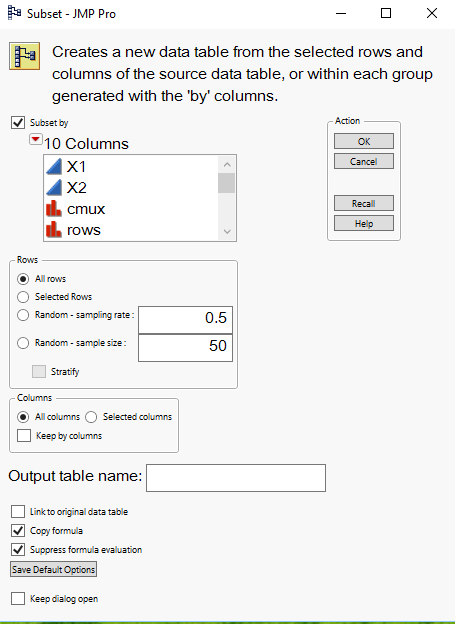
The easiest way to do this is to use the Subset with the "Subset By" selection
Talbles==>Subset
- Mark as New
- Bookmark
- Subscribe
- Mute
- Subscribe to RSS Feed
- Get Direct Link
- Report Inappropriate Content
Re: How do I split a big data table into smaller ones? (un-merge or opposite of concatenate)
The easiest way to do this is to use the Subset with the "Subset By" selection
Talbles==>Subset
- Mark as New
- Bookmark
- Subscribe
- Mute
- Subscribe to RSS Feed
- Get Direct Link
- Report Inappropriate Content
Re: How do I split a big data table into smaller ones? (un-merge or opposite of concatenate)
I tried it and it worked perfectly. Thanks a bunch!
I must confess I am bit embarrassed that for as long as I have been using JMP (especially the "Subset" function) I did not even notice the "By" checkbox.
- Mark as New
- Bookmark
- Subscribe
- Mute
- Subscribe to RSS Feed
- Get Direct Link
- Report Inappropriate Content
Re: How do I split a big data table into smaller ones? (un-merge or opposite of concatenate)
I remember using JMP 3, and with the breadth and depth of JMP, I learn new JMP functionality all the time.
Recommended Articles
- © 2026 JMP Statistical Discovery LLC. All Rights Reserved.
- Terms of Use
- Privacy Statement
- Contact Us